New low-cost "hardware store" racing class; input on proposed rules

Yes a wider beam was discussed some time ago. I wanted it but others rejected the idea

I was sailing my 14ft Zeta trimaran in Port Townsend in September, but no one else came out to race even though a suitable race was organised.

RW
 
Keep in mind that a combined mono/multihull class has been achieved hmmm NEVER! Let alone a development class, and it is inconceivable that doing so would be simple. They share the same wind and water -let's just build on that.

Not true. 10 piedi (10 foot) class in italy. Very comparable class to hw store class
 
Interest is brewing on the east coast, in Oyster Bay NY, in building boats based on the one you're prototyping, Peter. Are the rules posted on page 63 still current? Do they exist online anywhere else, or is page 63 of this thread the official reference?

As I read the length limits, a 2 foot bowsprit would be allowed if and only if the boom does not overhang the transom. An outboard rudder gantry and rudder would be allowed if the total, tip of bowsprit to trailing tip of rudder, does not exceed 18 feet. Is that right? Does the word "length" imply 18 feet is measured parallel to the waterline?

I see a couple boats have been built. Has there been any racing?

yes, the rules on p 63 are the current rules and no other changes have been proposed.

you are correct in interpreting the rules, IRC 14 ft hull, and 16 overall length with all rigging centered. that overall length can be either a bow sprit, or an extend boom, or rudder gantry, or a combination of both as long as over all length not exceed 16 ft.

There has been no official race yet, as far as I know not even any unofficial race either. At some point the local builders will get together and have a fun race.
 
Oh, I must have been half asleep when I read it - the 18 foot number is for multihulls - so 16 feet is the absolute limit for monos. Got it. Wondering if maybe I should think of my design as a budget Merlin Rocket, wih it being up to the individual builder if they want to modify as necessary to comply with the Challege 600 rules. Does that work? Richard, perhaps you're more familiar with Merlin Rockets than we in the U.S. - what do you think?
 
I like the "Challenge 600" name not only because of the $600 limit, but also because I see 600 pounds as roughly the target full load displacement.
 
You should really check out the GP14 which was designed in 1949 as a simple all rounder race/cruise boat able to carry a large load. Designed back in the days of wood spars, galvanised rigging, cotton sails but did use that new invention - plywood. Trouble is that it, like the Enterprise, is too wide for the class! Both have over 20,000 sold. The Merlin is wider still. The 16ft Wayfarer from the mid 1950's is perfect for the class, but also too wide

I have sailed Enterprises and GP's a lot, but not a Merlin. But I have sailed RS400, the modern one design version, many times. BTW my crew on the yellow Strider in my website slide show is Ian Holt, famous Merlin designer

http://www.gp14.org/

http://www.sailenterprise.co.uk/

http://www.merlinrocket.co.uk/

Richard Woods

 
You should really check out the GP14 which was designed in 1949 as a simple all rounder race/cruise boat able to carry a large load. Designed back in the days of wood spars, galvanised rigging, cotton sails but did use that new invention - plywood. Trouble is that it, like the Enterprise, is too wide for the class!

Thats why this is its own class. These other boats maybe, and probably are, magnificent in their own right. But this is not to say this class can't also rise to magnificence. There is no point in repeating what has already been done. Better to risk failure with something different, such as a boat which respects performance, but is more oriented toward utility, such as this one (class).

Both have over 20,000 sold. The Merlin is wider still. The 16ft Wayfarer from the mid 1950's is perfect for the class, but also too wide

It's also too long. Hull Length is 14 ft here. Overall Length here includes Rudders and Spars. If you do the math you will find the Beam/Length proportion of this class is similar to the Wayfarer, close to 0.40 (5/14 = 0.357)

I have sailed Enterprises and GP's a lot, but not a Merlin. But I have sailed RS400, the modern one design version, many times. BTW my crew on the yellow Strider in my website slide show is Ian Holt, famous Merlin designer

http://www.gp14.org/

http://www.sailenterprise.co.uk/

http://www.merlinrocket.co.uk/

Richard Woods

Greater Beam always equals greater sail carrying power. Once enough sail carrying power is at hand, planing becomes more possible. But once you go that route, you end up with something harder to build and more expensive, not to say it's not worth it. But, I for one, am interested in less Beamy boats, which are less performance oriented and more utilitarian. A class I might one day start will have a Beam limit of only 3ft.

I expect the narrower boat will be easier to right after a capsize, require lower rigging loads, and be easier to propel with muscle power alone (there is not much that is more disheartening to me than to see a dinghy with an outboard engine on its transom). Such a boat won't be for everyone, I understand, but it may well be suitable for an under served minority in the sailing community, who want to sail to relax, not to prove their superior stamina.
 
Sorry, a light boat doesn't have to be harder and more expensive to build. A flat panel lightweight hull, like my hard chine Zest dinghy for example, is both cheaper and quicker to build than any lapstrake/clinker dinghy. After all I was sailing mine on a Sunday. It was sheets of ply on the Friday

https://www.youtube.com/watch?v=VnQo_ZuKvag

The intent of this class is to have good load carrying, 600lbs has been mentioned. Not many 3ft wide boats can achieve that

it is also, as the thread title states, a racing class, not a gently pottering, slop along placidly class

RW

No arguments here. Just saying the the HS 600 should be left as it is, not wider, as the classes you mentioned in your previous post, or narrower, like the proposed 3ft Beam one, in mine.

Didn't mean to upset you.
 
Wondering if maybe I should think of my design as a budget Merlin Rocket, wih it being up to the individual builder if they want to modify as necessary to comply with the Challege 600 rules. Does that work? Richard, perhaps you're more familiar with Merlin Rockets than we in the U.S. - what do you think?

I've sailed a load of Merlin Rockets from the pretty old ones through to the modern ones. As Richard says the RS400 is a good example of a Merlin hull, and btw it is a well behaved boat. I'd say it's an NSM4 (Phil Morrison) smoothed out if you want to know. Merlin weight limit is 90Kg and beam max is 7'2" so a lot wider than the Low Cost HW Class. The designs do work well for 14' but you need the righting arm for that size rig. BTW the Merlin rigs are allowed to be a lot taller but most are around the 21'6" - 22' range. Some of the old narrow round deck beasts had 25' masts...

You will find quite a few different designs and each one can have it's own quirks! Current almost one design favourite is the Winder Canterbury Tales Mk 5 a Phil Morrison tweaked Ian Holt shape as far as I am aware. A couple of other designs - Genii (Turner and Morrison) and the Callaghan shape seem to work pretty well too. These boats are definitely racing craft although not(depending on shape) actually all that tippy - but you need to try the design or have a very good 'feel' for real world dynamc stability.
 
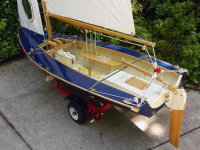
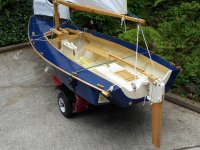
The 2016 BLUE HERON

The Blue Heron was designed and built to HW600 specifications. 5mm “underlayment” plywood, ¾ inch #3 pine, a couple of 2x4s, some ½ inch vinyl tubing and white polytarp for sails.

First launch was in April of this year. Since then, Dunnage finished his Naiad and the two of us have had several outings on Lake Washington. We found a home at the Leschi Marina on one of their floats. Convenient and quite reasonable. Somehow we never got to sailing alongside each other or even race. Probably mostly because I felt compelled after each outing to go back to the shop for some major mods.

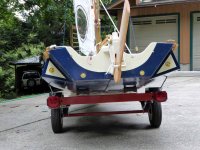
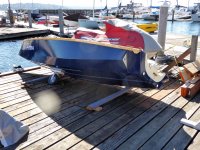
I removed most of my centerline floatation tank to open up the interior for side to side movement. I added external hull extensions, essentially sponsons, to increase lateral stability which was almost non-existent on the Merlin-like hull shape. The pictures below show the evolution.

I am now satisfied that I have a pretty well performing boat and look forward to some competition next spring.There is a good chance that a third boat may be joining us then.

As for the $600 budget, I had no problem meeting it. But I made all my sails, blocks, cleats, fairleads and pad-eyes in my home shop. The only manufactured, non-lumber items are 5/16 hex bolts, nuts and washers, deck screws, cordage and wire.
 

Attachments

  • 1605.019.1.jpg
    1605.019.1.jpg
    1.7 MB · Views: 699
  • 1606.024.jpg
    1606.024.jpg
    259.4 KB · Views: 1,235
  • 1609.002.jpg
    1609.002.jpg
    271.8 KB · Views: 557
  • 1609.007.jpg
    1609.007.jpg
    235.6 KB · Views: 588
  • 1609.013.jpg
    1609.013.jpg
    273.2 KB · Views: 635
The Blue Heron was designed and built to HW600 specifications. 5mm “underlayment” plywood, ¾ inch #3 pine, a couple of 2x4s, some ½ inch vinyl tubing and white polytarp for sails.

First launch was in April of this year. Since then, Dunnage finished his Naiad and the two of us have had several outings on Lake Washington. We found a home at the Leschi Marina on one of their floats. Convenient and quite reasonable. Somehow we never got to sailing alongside each other or even race. Probably mostly because I felt compelled after each outing to go back to the shop for some major mods.

I removed most of my centerline floatation tank to open up the interior for side to side movement. I added external hull extensions, essentially sponsons, to increase lateral stability which was almost non-existent on the Merlin-like hull shape. The pictures below show the evolution.

I am now satisfied that I have a pretty well performing boat and look forward to some competition next spring.There is a good chance that a third boat may be joining us then.

As for the $600 budget, I had no problem meeting it. But I made all my sails, blocks, cleats, fairleads and pad-eyes in my home shop. The only manufactured, non-lumber items are 5/16 hex bolts, nuts and washers, deck screws, cordage and wire.

Why didn't you extend the stability sponsons all the way to the transom?
 
Why didn't you extend the stability sponsons all the way to the transom?

Three reasons:

I limited the "fix" to the available, standard length of 8 feet for a sheet of plywood, trying to place it optimally.

Hull geometry at or near the transom has little effect on buoyancy or lateral stability, because it is at or near the waterline, not below.

I speculated, rightly or wrongly, that a "step" forward of the transom might promote planing. Seaplane floats are built this way.
 
Greater Beam always equals greater sail carrying power. Once enough sail carrying power is at hand, planing becomes more possible. But once you go that route, you end up with something harder to build and more expensive, not to say it's not worth it. But, I for one, am interested in less Beamy boats, which are less performance oriented and more utilitarian. A class I might one day start will have a Beam limit of only 3ft.

I expect the narrower boat will be easier to right after a capsize, require lower rigging loads, and be easier to propel with muscle power alone (there is not much that is more disheartening to me than to see a dinghy with an outboard engine on its transom). Such a boat won't be for everyone, I understand, but it may well be suitable for an under served minority in the sailing community, who want to sail to relax, not to prove their superior stamina.
Beam was discussed at length early on. One reason for restricted beam, discussed earlier, or simply discovered resently, is righting moment. Increasing beam increases the loads imposed on the mast and rigging by two bulky individuals sitting on the gunwale. Increasing the beam much would increase the loads on the mast in particular, complicating a hardware store mast. Simpler is better in this class. Equally, at this beam, the weight of a father and child, or grandfather and grandchild, could be competitive, where wider decks increase this disparity. You are right, rowing this narrower boat is relatively easy, while rowing a Merlin would be near impossible. My boat is very influenced by the Merlin, as was "Blue Heron", so mine might be quite tender when launched, time alone will tell. I see my boat as a teaching grandchildren to sail, and race, exercise, with perhaps some raids included as well. Raids often require manual propulsion as well, at least in the PNW.
 
Forum posts represent the experience, opinion, and view of individual users. Boat Design Net does not necessarily endorse nor share the view of each individual post.
When making any potentially dangerous or financial decision, always employ and consult appropriate professionals. Your circumstances or experience may be different.

  • Back
    Top