
Foiling radio control trimarans

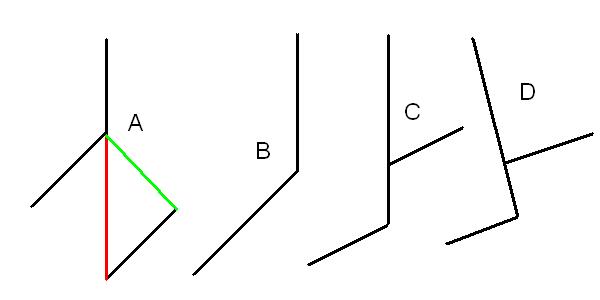
I've drawn a few foil shapes to look at some of the problems and possible improvements:-
4foils.JPG


If you add a downward part to the bottom of foil B you'll have a standard Z foil, but I'm only interested in looking at lift here. As foil B rises, RM is reduced while the need for RM goes up. This is unfortunate, but foil A shows us why we're stuck with it - if the red part is used as a support it's draggy, but even if you use the green part instead, the lower lifting section of the foil reduces the efficiency of the higher lifting section and the higher one reduces the efficiency of the lower one because one is trying to increase the pressure between them while the other is trying to reduce it. Foil C would enable you to reduce the amount of lifting surface by making that lift more upward than sideways leading to less force operating in opposite directions between windward and leeward foils (and it also allows you to generate the same amount of lift to windward as the Moth when sailing upwind with the windward foil raised, although you're probably not going to want to do that on a model). Foil D would be more efficient than C, and it would suffer less from the issue of RM decreasing as the boat rises - there is less horizontal variation of the location where the average acting lift is generated. The stagger enables these designs to provide the same heave stability as Z foils despite sloping the lifting surfaces less. The lower lifting surface would be more efficient when deep and would lose a lot of lift as it approaches the surface, so the aim would be to fly the boat with the lower lifting surface deep and the higher one just clear so that it only adds lift (and drag) when the boat gets too low (or in light winds where it is needed for early flight). I don't know if this kind of foil has ever been tested by anyone, but a model would be the right place to start experimenting. Note that if you measure the horizontal components of the lifting surfaces, foil D has substantially more vertical lifting capability per length of lifting section than Foil B and it also generates substantially less wasted horizontal lift - I suspect this will provide significant performance gains.
 
when sailing upwind with the windward foil raised,

possible to do with those lateral projections?
ADDENDUM Each lifting surface suffers tip losses and intersection losses so with short foils, as you have in D, you may get full lift from only a much smaller length of foil
 
Last edited:
I've drawn a few foil shapes to look at some of the problems and possible improvements:-

View attachment 137166

Hello David
We are always making "stick sketches' like you to see what we can come up with! One issue for the Mini40 class is that it has a maximum beam restriction (for all fittings) of 1.22m. So any part of a foil has to remain inside this limit. Your options C and D therefore require a narrower beam for the hulls so lend themselves to a Cat configuration. I have always kept away from Cats for the following reasons:
Mast requires a strong base.
Jib tack requires strong base
I am a strong believer in only one rudder on an rc multihull so I need a rigid base for the rudder shaft. Cannot see what good the lee rudder on a cat would achieve
Cats are harder to tack

So the result is that - assuming a trimaran of maximum beam - when you superimpose your C and D over the "conventional" kinked foil the benefits do lot look so great. Of course the tri does not have to be maximum beam if you have confidence in your foils! Once you up on the foils the hulls are completely redundant. The issue is always how to survive a gust when you are not foiling, often just after a tack or gybe.

Our little One Metre tri could almost be considered a narrow Mini40. The boat is 100cm x 100cm but the Z foils take it out to 1.2m. Just need an extension for the rudder...!
3 options.JPG
Davids concepts.jpg
CLose-up 2.jpg
THE Z foils.jpg
Z foils head on E.jpg
 
possible to do with those lateral projections?
ADDENDUM Each lifting surface suffers tip losses and intersection losses so with short foils, as you have in D, you may get full lift from only a much smaller length of foil

The lower part of the foil could retract inside the upper part, but I would fit the foil to the side of a hull rather than through it in any case so that it can break free on impacts without damaging the hull. With foil B, you should of course have a vertical section at the bottom of the sloping one, partially to endplate it, but also to stop the boat slipping sideways if the sloping section comes clear of the water - if you have this, you don't lose control every time the boat goes a little higher than the lifting section. The same applies to foil D, and a short endplate at the higher end of the lower section (by extending the "vertical" support by a few inches) might also improve performance.
 
Hello David
We are always making "stick sketches' like you to see what we can come up with! One issue for the Mini40 class is that it has a maximum beam restriction (for all fittings) of 1.22m. So any part of a foil has to remain inside this limit. Your options C and D therefore require a narrower beam for the hulls so lend themselves to a Cat configuration.

That problem can be tackled in various ways, such as having the case on the inboard side of the ama, or by moving the upright part of the foil (and making it vertical if necessary).

1foil.JPG
 
The lower part of the foil could retract inside the upper part, but I would fit the foil to the side of a hull rather than through it in any case so that it can break free on impacts without damaging the hull. With foil B, you should of course have a vertical section at the bottom of the sloping one, partially to endplate it, but also to stop the boat slipping sideways if the sloping section comes clear of the water - if you have this, you don't lose control every time the boat goes a little higher than the lifting section. The same applies to foil D, and a short endplate at the higher end of the lower section (by extending the "vertical" support by a few inches) might also improve performance.

Yes I have tried fitting foils to the outside of the hull and it works quite well, just looks a bit cumbersome. They just slid into tubes on the deck. No
HB 1.JPG
HB 10 F.JPG
need to lock them in as a the water pressure is always trying to push them inboard
 
That problem can be tackled in various ways, such as having the case on the inboard side of the ama, or by moving the upright part of the foil (and making it vertical if necessary).

View attachment 137178

D2 looks like a nightmare to make!!!

I think we'll continue to refine what we have, experimenting with more taper at the tip first. We know our configuration works, and the real beauty of this concept is that it is self-leveling. The faster it goes, the less area is in the water. The Moth-style T foil always has the same area in the water. the only way you reduce lift is with the flap or angle of attack, the T foil frontal area remains constant and I am not convinced that this is a good idea. I have yet to see video of a T foil concept foiling in strong winds. There is always a "sweet spot" for any foil setup, where, with just the right amount of wind, it will foil happily. The issue is, what happens when the wind increases? Can the foil control the extra speed and resultant increase in lift? I have not yet seen this in any video. That said, next year I intend to make a set of T foils with wands and have another go at this. Last time it was most unsatisfactory
IMG_9746.JPG
 
T-foils on a square or oversquare multi(preferably a tri) can be very fast because ,contrary to surface piercing foils, the T-foils use differential lift to provide lots of RM. My F3* did 18mph in a 22mph wind around 2001 with me sailing it. One of our customers claimed 20mph in a 20mph wind-both reefed.
T-foils on a narrow platform don't work so well for speed because they're over-loaded.
*LOA 56", Beam 72", weight 7.5lb.
 
IMG_7328.JPG
Good U.jpg
IMG_7306.JPG
Had a good sail today, trying out a new #2 rig - my first attempt at making a pocket luff mainsail. It was better than I expected, although the wind was a bit light for the #2. Changed up to #1 later on. Used the standard Kinked foils plus had another go with my U foils, which are definitely showing promise. I'll make a slighter deeper set next.

Video is here:

 
Last edited:
D2 looks like a nightmare to make!!!

There are many foils that look a nightmare to make, and D2 isn't the worst in that regard by a long way. I would just go for D though (D1), but the gains from it (if they are real) would apply less to a model if the foils are left down all the time and may well make performance worse. Z foils (on A cats) are probably already close to the best possible shape for a boat where the foils are left down all the time - when going to windward, the lift from the windward foil is automatically reduced by the boat slipping sideways while it's increased on the leeward foil, thereby providing something closer to the right amount of lift to windward (but you need to be able to adjust rake whenever you tack to tune things properly). Staggered foils (D) should outperform them upwind if the windward foil is raised by reducing drag and eliminating the components of lift that work in opposite directions. Staggered foils should also be less draggy downwind (when no foils are raised) because although some lift is then working in opposite directions, Z foils slope more steeply and have more of their lift working in opposite directions. On a model though, if you can't raise the windward foil or change the rake for zero lift, it will generate too much lift on the windward side, which means you're better off following the Z foil path, and the improvement your foils most need is a vertical section running down from the tips so that you don't lose control whenever the lifting section jumps clear of the water.
 
There are many foils that look a nightmare to make, and D2 isn't the worst in that regard by a long way. I would just go for D though (D1), but the gains from it (if they are real) would apply less to a model if the foils are left down all the time and may well make performance worse. Z foils (on A cats) are probably already close to the best possible shape for a boat where the foils are left down all the time - when going to windward, the lift from the windward foil is automatically reduced by the boat slipping sideways while it's increased on the leeward foil, thereby providing something closer to the right amount of lift to windward (but you need to be able to adjust rake whenever you tack to tune things properly). Staggered foils (D) should outperform them upwind if the windward foil is raised by reducing drag and eliminating the components of lift that work in opposite directions. Staggered foils should also be less draggy downwind (when no foils are raised) because although some lift is then working in opposite directions, Z foils slope more steeply and have more of their lift working in opposite directions. On a model though, if you can't raise the windward foil or change the rake for zero lift, it will generate too much lift on the windward side, which means you're better off following the Z foil path, and the improvement your foils most need is a vertical section running down from the tips so that you don't lose control whenever the lifting section jumps clear of the water.

Thanks David
So your conclusion is D2 (=Z) with a tip?
 
Too little tip not useful: too much tip = greater drag = more difficult to foil.
 
Thanks David
So your conclusion is D2 (=Z) with a tip?

No - I think B with a downward tip is best for a model (or full size boat) where you can't raise the windward foil. The shape to copy or use as a starting point is the A-Cat Z foil. When I said that I would go for D1 (a staggered foil) with a downward tip, I was talking about me rather than you, and I would only try using that on a boat where the windward foil can be raised to go upwind, because performance upwind would be really bad with it down.
 
No - I think B with a downward tip is best for a model (or full size boat) where you can't raise the windward foil. The shape to copy or use as a starting point is the A-Cat Z foil. When I said that I would go for D1 (a staggered foil) with a downward tip, I was talking about me rather than you, and I would only try using that on a boat where the windward foil can be raised to go upwind, because performance upwind would be really bad with it down.

Not sure what exactly an A Cat Z foil looks like. Can't find any photos of "Z-looking" foils on one!

Why do you want the tip to go vertically down, not up? All the wing tips on planes go up, helping flow and turbulence on the top side of the foil, not the bottom. You still get directional stability from an upward-tip

When you say "me rather than you", are you sailing an A class? Many moons ago I was general manager for Hobie Cat in the UK, but before the F18 class came into existence .
I designed racing dinghies in England when I was (a lot) younger....
My designs can be found here (look for Ian Holt and "Canterbury Tales"):
Design Guide | About | Merlin Rocket Owners Association http://www.merlinrocket.co.uk/index.asp?selection=Custom&pg=14
 
Forum posts represent the experience, opinion, and view of individual users. Boat Design Net does not necessarily endorse nor share the view of each individual post.
When making any potentially dangerous or financial decision, always employ and consult appropriate professionals. Your circumstances or experience may be different.

  • Back
    Top