
David Cooper
Senior Member
- Joined
- Jan 17, 2015
- Messages
- 184
- Reaction score
- 22
- Location
- Scotland
I've drawn a few foil shapes to look at some of the problems and possible improvements:-
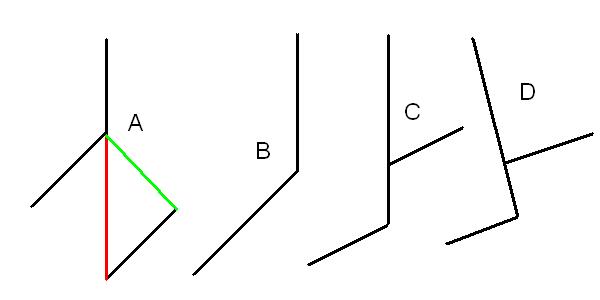
If you add a downward part to the bottom of foil B you'll have a standard Z foil, but I'm only interested in looking at lift here. As foil B rises, RM is reduced while the need for RM goes up. This is unfortunate, but foil A shows us why we're stuck with it - if the red part is used as a support it's draggy, but even if you use the green part instead, the lower lifting section of the foil reduces the efficiency of the higher lifting section and the higher one reduces the efficiency of the lower one because one is trying to increase the pressure between them while the other is trying to reduce it. Foil C would enable you to reduce the amount of lifting surface by making that lift more upward than sideways leading to less force operating in opposite directions between windward and leeward foils (and it also allows you to generate the same amount of lift to windward as the Moth when sailing upwind with the windward foil raised, although you're probably not going to want to do that on a model). Foil D would be more efficient than C, and it would suffer less from the issue of RM decreasing as the boat rises - there is less horizontal variation of the location where the average acting lift is generated. The stagger enables these designs to provide the same heave stability as Z foils despite sloping the lifting surfaces less. The lower lifting surface would be more efficient when deep and would lose a lot of lift as it approaches the surface, so the aim would be to fly the boat with the lower lifting surface deep and the higher one just clear so that it only adds lift (and drag) when the boat gets too low (or in light winds where it is needed for early flight). I don't know if this kind of foil has ever been tested by anyone, but a model would be the right place to start experimenting. Note that if you measure the horizontal components of the lifting surfaces, foil D has substantially more vertical lifting capability per length of lifting section than Foil B and it also generates substantially less wasted horizontal lift - I suspect this will provide significant performance gains.
If you add a downward part to the bottom of foil B you'll have a standard Z foil, but I'm only interested in looking at lift here. As foil B rises, RM is reduced while the need for RM goes up. This is unfortunate, but foil A shows us why we're stuck with it - if the red part is used as a support it's draggy, but even if you use the green part instead, the lower lifting section of the foil reduces the efficiency of the higher lifting section and the higher one reduces the efficiency of the lower one because one is trying to increase the pressure between them while the other is trying to reduce it. Foil C would enable you to reduce the amount of lifting surface by making that lift more upward than sideways leading to less force operating in opposite directions between windward and leeward foils (and it also allows you to generate the same amount of lift to windward as the Moth when sailing upwind with the windward foil raised, although you're probably not going to want to do that on a model). Foil D would be more efficient than C, and it would suffer less from the issue of RM decreasing as the boat rises - there is less horizontal variation of the location where the average acting lift is generated. The stagger enables these designs to provide the same heave stability as Z foils despite sloping the lifting surfaces less. The lower lifting surface would be more efficient when deep and would lose a lot of lift as it approaches the surface, so the aim would be to fly the boat with the lower lifting surface deep and the higher one just clear so that it only adds lift (and drag) when the boat gets too low (or in light winds where it is needed for early flight). I don't know if this kind of foil has ever been tested by anyone, but a model would be the right place to start experimenting. Note that if you measure the horizontal components of the lifting surfaces, foil D has substantially more vertical lifting capability per length of lifting section than Foil B and it also generates substantially less wasted horizontal lift - I suspect this will provide significant performance gains.


