rob denney
Senior Member
- Joined
- Feb 13, 2005
- Posts
- 992
- Reaction score
- 404
- Location
- Australia
Good questions
The inlet holes need to be well above the waterline on the lee side when the boat is flying a hull. The outlet holes can have flaps on them unless the false floor is above the hull flying waterline. The flaps can be gravity, pressure or crew activated.umm, how to ensure lee hull floods only in a capsize?
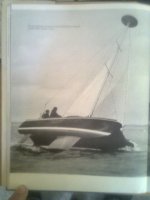
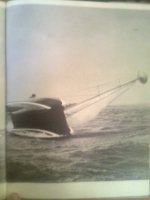
A pitchpole where the boat ended up bows down would be a problem. The self righting would not work. There are a couple of solutions i am playing with, just need time. However, I have pitchpoled my 7.5m test boat ELEMENTARRY – Harryproa http://harryproa.com/?p=1753 a few times. It always ends up on it's side with the mast pointing upwind, even when the true wind is close to dead astern. Consequently, I am pretty confident that a pitchpole resulting in both bows going under would be pretty unusual (the boat would have to be well by the lee) and easily avoided by sailing a little higher.How to ensure that the capsize remains "in plane" and doesn't fall off bow or stern?
That is a function of the roughness of the rig on the model. Apart from foiling Bucket List, which is a test bed for the Volvo Proa , all harrys have unstayed masts. There is more on that boat and it's rig at http://harryproa.com/wp-content/uploads/2017/10/volvoproa.pdfThe mast lee stay seems to have a very acute angle.
Ta.But you are right, if all goes well it is self-righting.

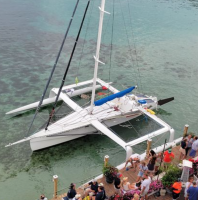
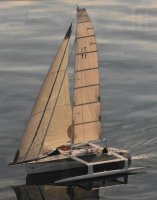


 (But I do see arguments for a tri, for example, that involve the observation that there’s more weight to windward when a tri is up on one hull than a cat ….)