...
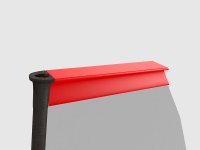
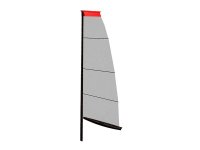
If I get you right, it's about the same effect if you add the area of the winglet perpendicular to a given sail or add it vertical? Very interesting! So the fuss with winglets on planes is all about reducing the length?
And style. Standard Class sailplanes use winglets because their span is limited by the class rules. Airliners are sometimes constrained by the width of the area at terminal gates. But if you look at Boeing's 787, for example, it doesn't have winglets. Winglets do provide the same drag reduction with less bending moment (equivalent to heeling moment), so they can be more attractive as retrofits than simple span extensions.
Here's another way to look at it. The lift is often fixed by the stability of the boat. So there are really only two things the winglet can do. It can provide a reduction in induced drag, which is equivalent to an increase in span, or it can provide the same drag with a reduction in heeling moment. But there are other means to achieve the same end, and it becomes a matter of tradeoffs of other drag sources and practical considerations as to which route to go.
Well, at least on a sail boat this would result in a lower heeling moment from rig weight - center of gravity would be lower.
The effect of the center of effort of the sail remains unclear to me. Stays it on the same height with winglets as with a sail where the area of the winglet is added to the top as an extension?
The winglet would raise the center of effort, if the winglet and sail have the optimum loading. However, it doesn't raise the center of effort as much as a physical increase in span equal to the winglet's equivalent increase in span.
With regard to the center of effort, there are really two centers to consider. The instantaneous center of effort is the heeling moment divided by the lift. Twisting off the head of the sail will lower the instantaneous center of effort.
Then there's the aerodynamic center. This is the location where the change in moment divided by a change in lift is zero. It's where the additional heeling moment from a gust will appear to act if the twist is kept constant.
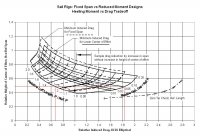
Here's the exact same comparison as before, but this time the vertical axis is the height of the aerodynamic center instead of the instantaneous center of effort:
It's interesting that designing for a different induced velocity distribution, with a corresponding change in both twist and planform shape, doesn't change the tradeoff between the drag and aerodynamic center. The taller rig may have the same center of effort because it's twisted off, but in a gust, it will still feel like a taller rig.
The square-head sails are effective in two ways. They have a planform shape that is closer to the optimal planform for their span, and they twist off to reduce the height of the center of effort when hit by a gust. So the height of the aerodynamic center is effectively reduced by the feedback of the loads on the sail.