Besides the convenience of fitting and filling within the mast and stay(s) without interfering, why are most fore-and-aft sails triangular? Especially when we have square-topped mainsails, why are jibs not also squared off (or really, made elliptical)?

The Boat Design & Boatbuilding Site
Install the app
How to install the app on iOS
To install this app on your iPhone:
- Tap the Share button at the bottom of Safari.
Tap ... if Share is not visible, then Share - Tap Add to Home Screen
Tap View More and scroll down if needed to see Add to Home Screen, then Add to Home Screen. - Tap Add on the top right to confirm.
Note: This feature may not be available in some browsers.
You are using an out of date browser. It may not display this or other websites correctly.
You should upgrade or use an alternative browser.
You should upgrade or use an alternative browser.
Why are fore-and-aft sails triangular?
- Thread starter SPC
- Start date

Thank you hoytedow, however, I am not asking about square rigs, but about the shape of the fore-and-aft sails in a modern sloop.
Also, if you could, I would appreciate more detail than just "not able to sail close hauled as well". Of course we would use a sail if it performed better close to the wind, all other things equal. So that rephrases the question to "why are triangular sails able to go closer to the wind than square rigged sails?" I believe I already know some answers to that, and again I didn't ask about square rigged sails to begin with, so I'm not sure where to go from that.
Also, if you could, I would appreciate more detail than just "not able to sail close hauled as well". Of course we would use a sail if it performed better close to the wind, all other things equal. So that rephrases the question to "why are triangular sails able to go closer to the wind than square rigged sails?" I believe I already know some answers to that, and again I didn't ask about square rigged sails to begin with, so I'm not sure where to go from that.
You kind of answered your own question. Convenience is the short answer. If you are using a fixed backstay the mainsail needs to be triangular to fit under it. Square top mains either have running backstays or swept back spreaders. Jibs are similar, since the forestay is fixed to the mast the jib must fit in the resulting triangle. If you want a squared off jib you must fit it lower. An eliptical jib would need battens to support the leach, exactly like you have with big roach mainsails. You could do it, but it's needless complication.
Why sails became triangular is a little bit more complicated. A complete gaff rig is also triangular since the topsail is part of it (1st reef is topsail down). Then people discovered that high aspect ratio sails are better for going to weather and mainsail booms got shorter while masts got higher. The gaff became redundant and the sails got triangular in one piece instead of two. Then we found out that the pointy end of the sail is not doing much (even harmfull) and it got chopped off, resulting in todays square top mains. All of this goes hand in hand with available technology, since some of todays configurations are dependent on modern material properties.
Why sails became triangular is a little bit more complicated. A complete gaff rig is also triangular since the topsail is part of it (1st reef is topsail down). Then people discovered that high aspect ratio sails are better for going to weather and mainsail booms got shorter while masts got higher. The gaff became redundant and the sails got triangular in one piece instead of two. Then we found out that the pointy end of the sail is not doing much (even harmfull) and it got chopped off, resulting in todays square top mains. All of this goes hand in hand with available technology, since some of todays configurations are dependent on modern material properties.

Will Gilmore
Senior Member
- Joined
- Aug 29, 2017
- Messages
- 1,112
- Reaction score
- 534
- Location
- Littleton, nh
Let me add that gaff, sprit and yard rigged fore and aft sails experience a great deal of twist at the top. When sailing close hauled, if you can't control that twist, your sail luffs at the top or loses attachment (stalls) at the bottom.
Some twist is actually nice to have, since air speeds can vary from bottom of sail to top of sail and that usually means the faster winds aloft and therefore, less apparent wind difference up there than down on deck. There is also the added ability to spill wind up high if weather gets too blustery.
Modern square topped Bermuda rigs are very taught and show minimal twisting, allowing closer sailing to the wind. To do such a thing with a staysail would require enormous tensions on the various parts. Not that it couldn't be done, just that by adding the extra performance requirements might mean spending equally enormous amounts of money in specialized high strength, low weight materials.


Nice question, SPC.
-Will (Dragonfly)
Some twist is actually nice to have, since air speeds can vary from bottom of sail to top of sail and that usually means the faster winds aloft and therefore, less apparent wind difference up there than down on deck. There is also the added ability to spill wind up high if weather gets too blustery.
Modern square topped Bermuda rigs are very taught and show minimal twisting, allowing closer sailing to the wind. To do such a thing with a staysail would require enormous tensions on the various parts. Not that it couldn't be done, just that by adding the extra performance requirements might mean spending equally enormous amounts of money in specialized high strength, low weight materials.
Nice question, SPC.
-Will (Dragonfly)

Yobarnacle
Senior Member holding true course
- Joined
- Nov 10, 2011
- Messages
- 1,749
- Reaction score
- 133
- Location
- Mexico, Florida
The leading edge of the sail is the driving component. that's why you see modern high aspect ratio sails, instead of the old fashioned wind bag sails. More efficient.
CT249
Senior Member
- Joined
- May 2, 2003
- Messages
- 1,640
- Reaction score
- 267
- Location
- Sydney Australia
As others have mentioned, we DO have mains that aren't triangular. Look at J/70s, catamarans, many high performance dinghies and most skiff types, etc.
As has already been pointed out, there are practical issues with squaretops etc. For one, to hold the leach out you need battens, and those are surprisingly heavy (modern high tech windsurfer sails, for example, are often twice as heavy as the low-tech original windsurfer sails because even carbon fibre battens are comparatively heavy), can be expensive, and can be a hassle. For example, many squaretops need you to take out the top batten every time the main is set or dropped. The tension that battens place on the mainsail luff can also mean that the sail is very hard to drop and hoist unless you have expensive (and heavy) battens cars.
The extra weight of battens, like the extra weight of wing masts, means that all else being equal, you have to reduce mast height or suffer more heeling force. However, since tall and skinny rigs often work more efficiently it can often be pretty much as good to put up a simpler, lighter but taller rig of the same heeling moment.
If you try to make a cheaper squaretop sail you run into major problems with cloth stretch, which can mean that the whole head of the sail falls away to leeward. To keep the leach taut with a fat head sail you may need to use very high vang and mainsheet tensions, so you may need to spend a lot more in mainsheet blocks, vang controls, etc. I have some "high tech" windsurfer squaretop sails of about 5m that would probably carry the same sort of downhaul tension as the pinhead dacron mainsail of my 36 footer. That 36 footer uses the old mainsheet system off our 20 foot cat, which had a squaretop.
This is a fascinating area, and here on BDF we have been incredibly lucky in the past to have several regular posters who are top aerodynamics experts. Search
"tspeer" and "mdrela". I won't out them apart from saying that one of them is a professional wing designer with America's Cup expertise while the other is a leading MIT professor of aerodynamics and an America's Cup designer. Also look up SHC, a world champ in development classes and Mikko Brummer, a sailmaker.
The really interesting thing about the people mentioned above is that unlike many "experts", what they say about sails actually fits in with what we actually see happening on the water. For example, Tom points out that we don't need an elliptical sail outline to achieve what we want aerodynamically, which is an elliptical "span loading". The "span loading" is created not just by the sail's shape and area, but also by its twist, the apparent wind, and the depth. We can therefore get many of the aerodynamic advantages of a non-triangular sail by merely setting the correct leach twist and depth in a triangular sail.
Another relevant point that Mdrela has neatly pointed out is that for many boats, reducing aero drag is not a major speed factor. What matters, he notes, is not the lift/drag factor of the rig, but the lift/drag factor of the whole boat. If you have a boat with high hull drag then the aero drag can be of little importance, and it's worthwhile creating a rig that has higher drag but more power. Perhaps the analogy can be between a truck and a bicycle - one needs lots of power and aero drag is largely irrelevant, while the other has very little power so reducing aero drag can be critical. You can really see this in windsurfers. This means that the fact that a certain type of sail works on really high performance craft does NOT mean that the same type will work on "normal" boats which have different characteristics.
As has already been pointed out, there are practical issues with squaretops etc. For one, to hold the leach out you need battens, and those are surprisingly heavy (modern high tech windsurfer sails, for example, are often twice as heavy as the low-tech original windsurfer sails because even carbon fibre battens are comparatively heavy), can be expensive, and can be a hassle. For example, many squaretops need you to take out the top batten every time the main is set or dropped. The tension that battens place on the mainsail luff can also mean that the sail is very hard to drop and hoist unless you have expensive (and heavy) battens cars.
The extra weight of battens, like the extra weight of wing masts, means that all else being equal, you have to reduce mast height or suffer more heeling force. However, since tall and skinny rigs often work more efficiently it can often be pretty much as good to put up a simpler, lighter but taller rig of the same heeling moment.
If you try to make a cheaper squaretop sail you run into major problems with cloth stretch, which can mean that the whole head of the sail falls away to leeward. To keep the leach taut with a fat head sail you may need to use very high vang and mainsheet tensions, so you may need to spend a lot more in mainsheet blocks, vang controls, etc. I have some "high tech" windsurfer squaretop sails of about 5m that would probably carry the same sort of downhaul tension as the pinhead dacron mainsail of my 36 footer. That 36 footer uses the old mainsheet system off our 20 foot cat, which had a squaretop.
This is a fascinating area, and here on BDF we have been incredibly lucky in the past to have several regular posters who are top aerodynamics experts. Search
"tspeer" and "mdrela". I won't out them apart from saying that one of them is a professional wing designer with America's Cup expertise while the other is a leading MIT professor of aerodynamics and an America's Cup designer. Also look up SHC, a world champ in development classes and Mikko Brummer, a sailmaker.
The really interesting thing about the people mentioned above is that unlike many "experts", what they say about sails actually fits in with what we actually see happening on the water. For example, Tom points out that we don't need an elliptical sail outline to achieve what we want aerodynamically, which is an elliptical "span loading". The "span loading" is created not just by the sail's shape and area, but also by its twist, the apparent wind, and the depth. We can therefore get many of the aerodynamic advantages of a non-triangular sail by merely setting the correct leach twist and depth in a triangular sail.
Another relevant point that Mdrela has neatly pointed out is that for many boats, reducing aero drag is not a major speed factor. What matters, he notes, is not the lift/drag factor of the rig, but the lift/drag factor of the whole boat. If you have a boat with high hull drag then the aero drag can be of little importance, and it's worthwhile creating a rig that has higher drag but more power. Perhaps the analogy can be between a truck and a bicycle - one needs lots of power and aero drag is largely irrelevant, while the other has very little power so reducing aero drag can be critical. You can really see this in windsurfers. This means that the fact that a certain type of sail works on really high performance craft does NOT mean that the same type will work on "normal" boats which have different characteristics.

Doug Lord
Flight Ready
- Joined
- May 26, 2009
- Messages
- 16,679
- Reaction score
- 353
- Location
- Cocoa, Florida
A number of boats use a square top jib including at least one Aussie 18. I have a number of pictures other than the Fire Arrow below, but for some reason I can't find
them.
PS-the Aussie 18 pix I have somewhere also shows that they use an upper endplate with the square top jib.......
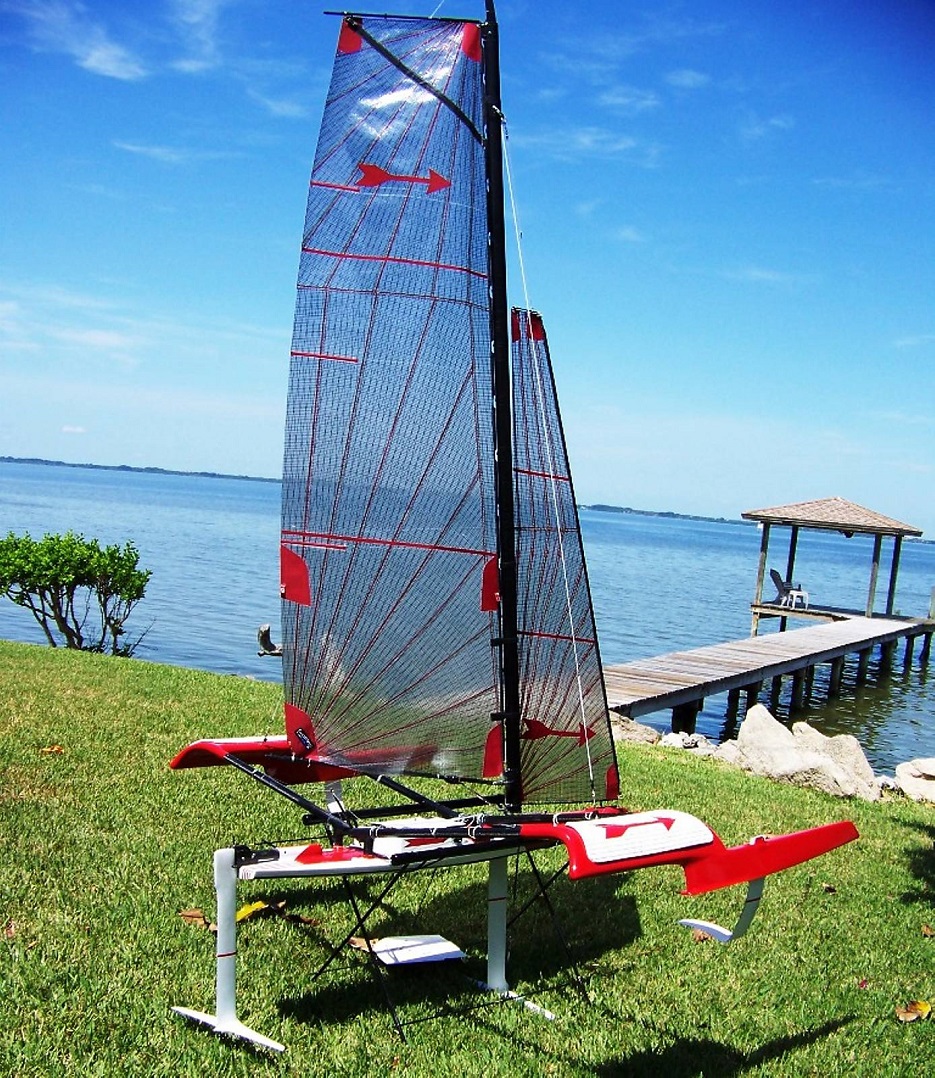
them.
PS-the Aussie 18 pix I have somewhere also shows that they use an upper endplate with the square top jib.......
Thank you for the excellent responses!
I just saw the Te Aihe with a square-topped jib, which seems to be used when they need less sail area.

I guess triangular sails can have the same aspect ratio as a narrower rectangular sail of the same area, with the center of effort lowered. With some of the other affects accounted for (either by slightly modifying the shape or with careful trimming/twisting), a triangular sail is pretty great for boats that need to reduce heeling moment.
I'm am wondering, though, does anyone place a spreader facing forward to pull the forestay away from the mast?

I just saw the Te Aihe with a square-topped jib, which seems to be used when they need less sail area.
I guess triangular sails can have the same aspect ratio as a narrower rectangular sail of the same area, with the center of effort lowered. With some of the other affects accounted for (either by slightly modifying the shape or with careful trimming/twisting), a triangular sail is pretty great for boats that need to reduce heeling moment.
I'm am wondering, though, does anyone place a spreader facing forward to pull the forestay away from the mast?
Last edited:
You would need side stays to the front of the forward projection up top, or as soon as you put the pressure to the top would twist off. But of course those side stays would then interfere with the sail..Thank you for the excellent responses!
I just saw the Te Aihe with a square-topped jib, which seems to be used when they need less sail area.
View attachment 158790
I guess triangular sails can have the same aspect ratio as a narrower rectangular sail of the same area, with the center of effort lowered. With some of the other affects accounted for (either by slightly modifying the shape or with careful trimming/twisting), a triangular sail is pretty great for boats that need to reduce heeling moment.
I'm am wondering, though, does anyone place a spreader facing forward to pull the forestay away from the mast?
View attachment 158791
Last edited:
Its been done, but the downside is that it tends to bend the mast the wrong way when a gust hits.I'm am wondering, though, does anyone place a spreader facing forward to pull the forestay away from the mast?
You should look at the sail designs used by the Dashews before they got into their mini battleships. Picture of Beowulf below with twin roached mainsails. Apparently the roached mainsail ketch configuration was a big part of allowing a couple to operate this huge boat without the need for crew.

sharpii2
Senior Member
- Joined
- May 31, 2004
- Messages
- 2,282
- Reaction score
- 348
- Location
- Michigan, USA
Cost vs. performance may be the main reason. The earliest fore-and-aft rigs had first spritz then yards.
The earliest ones to have yards were likely to be lateens and modified Square-rigs. Both sailed to windward better than the square rig.
The modified square-rig probably became the dipping-lug, with greater and greater pitch to the yard.
The long yard of the lateen rig was difficult to handle for its sail area. So someone, presumably in Bermuda, in the mid 1600's, made the yard stiffer and stepped it like a mast. Now, only the clew moved. Sprit booms were later added.
Only after the advent of more dimensionally stable sail cloths became available, was the gaff rig replaced with the Bermuda one, with the boom moved down to the foot of the sail.
Doing this removed a lot of moving parts. Gone was the peak halyard with its seemingly miles of cordage, not to mention one or more pulleys.
The mast had to get taller to get the same area, but it only needed a light pulley at the top.
Stick a small jib in front, along with stays which don't go all the way to the top, and you have one of the most weatherly rigs ever invented.
Adding battens may improve its performance, but probably not in proportion to the added costs--and furling hassles.
Racers don't care about these things; cruisers do.
Moving the stays to the top of the mast, then adding a pair of spreaders and a back-stay, allowed a bigger jib and a smaller mainsail. Such also allowed a shorter mast which had much better support. Such could be engineered to be strong enough to withstand a complete roll over. Many have.
But this meant the boom had to be shorter, so it wouldn't hit the back-stay, if it clocked up and happened to swing at that time.
Short battens were added to get some of the lost sail area back by adding a roach.
So, I hope you can see that the main virtue of the Bermuda sail is its simplicity. This is why it is just about the only sail type you see, and why it is almost always pointed at the top.
The earliest ones to have yards were likely to be lateens and modified Square-rigs. Both sailed to windward better than the square rig.
The modified square-rig probably became the dipping-lug, with greater and greater pitch to the yard.
The long yard of the lateen rig was difficult to handle for its sail area. So someone, presumably in Bermuda, in the mid 1600's, made the yard stiffer and stepped it like a mast. Now, only the clew moved. Sprit booms were later added.
Only after the advent of more dimensionally stable sail cloths became available, was the gaff rig replaced with the Bermuda one, with the boom moved down to the foot of the sail.
Doing this removed a lot of moving parts. Gone was the peak halyard with its seemingly miles of cordage, not to mention one or more pulleys.
The mast had to get taller to get the same area, but it only needed a light pulley at the top.
Stick a small jib in front, along with stays which don't go all the way to the top, and you have one of the most weatherly rigs ever invented.
Adding battens may improve its performance, but probably not in proportion to the added costs--and furling hassles.
Racers don't care about these things; cruisers do.
Moving the stays to the top of the mast, then adding a pair of spreaders and a back-stay, allowed a bigger jib and a smaller mainsail. Such also allowed a shorter mast which had much better support. Such could be engineered to be strong enough to withstand a complete roll over. Many have.
But this meant the boom had to be shorter, so it wouldn't hit the back-stay, if it clocked up and happened to swing at that time.
Short battens were added to get some of the lost sail area back by adding a roach.
So, I hope you can see that the main virtue of the Bermuda sail is its simplicity. This is why it is just about the only sail type you see, and why it is almost always pointed at the top.
Forum posts represent the experience, opinion, and view of individual users. Boat Design Net does not necessarily endorse nor share the view of each individual post.
When making any potentially dangerous or financial decision, always employ and consult appropriate professionals. Your circumstances or experience may be different.
When making any potentially dangerous or financial decision, always employ and consult appropriate professionals. Your circumstances or experience may be different.
Advertisement:


