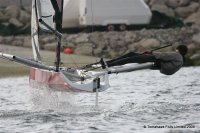
Tomahawk Foils
Excellent post by Jon Howes from Yachts and Yachting's Tomahawk thread (
http://www.yachtsandyachting.com/forum/forum_posts.asp?TID=5271&PN=2 )
"As the foil was my concept I may be able to lay to rest some of the speculation regarding how it works.
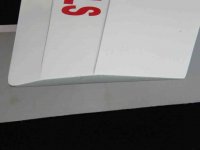
The facets towards the aft side of the upper surface are designed to ventilate progessively from rear to front as speed builds. When fully non-ventilated the section is highly cambered and generates a lift coefficient of around 0.77 and this gives a very low lift off speed.
When fully ventilated (from the mid-chord aft facing step on the upper surface) the lift coefficient is 0.2. Between these two extremes there is a need for an intermediate condition so that, as the foil approaches the surface, sufficient speed has already been achieved to fully ventilate and no loss of lift occurs as the foil surfaces.
I have missed out a lot of developmental steps here, but briefly, the pressure coefficient at the leading edge of the last facet is the lowest on the upper surface when completely unventilated and so giving an air path to this location (by an aft facing step or channel on the vertical strut) leads to early ventilation. The aft facing step on the facet tapers from root to tip and the step is swept (as is the foil). In combination these two features lead to a progressive ventilation growth across the span. By the time the ventilation is approaching the tip the next facet forwards is generating a healthy low pressure coefficient and the ventilation can either jump forwards from the aft facet or be fed to the step at the leading edge of the forward facet and a similar ventilation growth, and steady reduction in lift coefficient then occurs as speed continues to increase. By now the foil is approaching the surface and when it finally breaks out into surface running no sudden lift change occurs. The ventilation cavity follows the foil when submerged and, in design, is treated as an integral part of the foil section.
As for drag, just like an aircraft, this is in two parts, lift induced drag and skin/profile drag. The profile drag of this family of sections is always higher than that of a conventional section if below cavitation speed, however the lift induced drag follows the same rules as any other lifting surface, ie, three things matter: wingspan, wingspan and wingspan. A comparison would be a lift to drag ratio (L/D) for a conventional section of around 100, for this section it is 22. When used on a 3D foil, the lift induced part becomes important and a conventional foil may then give around 12 to 15 whereas the ventilated section as we use it here gives about 10.
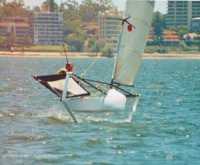
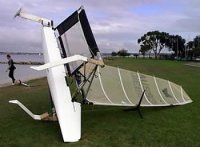
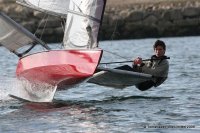
In conclusion, upwind we will not beat a moth in moth conditions. With the wind free, after all the conventional foils have cavitated this thing will keep going and speed will be limited by nerve and structural failure. Note that this section was originally developed for my Monofoil project and is designed to behave beyond 100kts (getting there is another problem but if you don't design for it......). The foil on the dinghy will give simple sailing, low lift out speed, relatively shallow draft and, if the conditions and nerves allow, high speeds on the freer points of sailing.
I notice the comments on combiantions of surface running foils with submerged foils below. We are experimenting with this on the dinghy rudder to give some tactile feed back to allow the correct incidence to be maintained. It could also be used to give crude ride height control to a submerged lifting foil but will obviously have problems if the speed increases sufficently for the submerged foil to lift the SR foil away from the surface. We put this in the patent application because you need to (?) but I do not have much faith in it as a design approach.
On a sailboard it gets very interesting since cavitation will not occur, the board is kept away from wave impacts (and hence much of the source of drag on a planing board) and the span loading is reduced by at least a factor of two giving a much lower lift induced drag. If you want easy foiling go for the dinghy, if you want to scare yourself go for the board.
Jon."