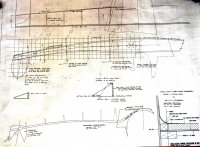
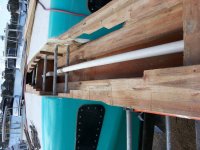
Steel is not a material that you build multihulls from BUT there are exceptions. A school teacher in rural victoria Australia built in his spare time a 100 foot long full bridgedeck cruising catamaran which was used for charter work for about 30 years. Last seen in Queensland. 6 mm steel in hulls 4 mm steel superstructure. He did the job in about 8 years. Amazing.
Smaller steel cats have been built. A 36 footer full bridgedeck that crossed the Atlantic. This boat was so overweight it had less than 1 foot underwing clearance and could sail but was slow!
Another was a Boden designed catamaran Catrina which was 36 x 18 foot full bridgedeck displacing 25000 lbs and weighing 17000 lbs built. At least one was built and floated to lines. The multi chine hull was 3 mm plate with a 4 mm keel plate. Frames were 44 x 44 x 5 mm angle sections or 63 x 51 x 5 mm angle sections at 500 mm center lines. Decks and cabin structures were 3 mm steel with a lot of light framing (the design is no longer on the Boden site). Steels basic problem is it needs about 3 mm minimum thickness to weld smoothly unless you are a really skilled boiler maker. 3 mm steel weighs 5 lbs per square foot versus 9 mm ply at 1.25 lbs per square foot or foam glass at under a 1 lb per square foot. Also steel requires a lot of framing to support flat panels. Steel main virtue is it bends but doesn't break in most hits that would hole a plywood cat.
But maybe we can learn something from monohull boats. Brent Swain builds what he calls origami boats. Basically a tortured steel monohull. Get a large plate of 3 mm steel cut darts in it at appropriate points, add three 25 x 25 mm square stringer for 70% of the hull length, add a gunnel tube then pull the half hull into shape and weld up the dart seams. Get the 2 hull halves and weld them together. A 36 foot monohull with minimal framing is ready for internal fitout and decks. Monohull boats from 27 to 65 feet have been built this way. Home https://www.freewebs.com/origamiboats/ During the war 2 a British firm built a series of stress skin aluminum patrol boats from flat sheets of aluminium again pulled into shape and then "glued" and riveted together.
Another really interesting steel monohull was a 3 masted schooner Sundancer built by a British farmer in his 105 x 20 ft shed with a 12 foot wide door. How big was the boat? 104 x 12 foot. It displaced 78000 lbs and carried 2000 square foot of sail. It had a retractable keel. Why is interesting? It circumnavigated 3 time and could hit 17 plus knots, it averaged 11 plus knots. It was built from 6 mm steel pipes 12 foot in diameter. The ends were pulled in to form a monohull shape with a 8 to 1 length to beam ratio. Deck webs were added to the tube to provide a 12 foot wide flat deck and flat topsides for additional stability. The boat heeled a lot but was fast. It was in Australia at Ballina for a few years.
Finally a classic wharram cat of 40 foot plus had its hulls built in 3 mm steel but the rest of the boat decks etc was in plywood. A reasonable compromise if you like sailing around reefs. Steel if properly designed can form the basis of a multihull but it will not be fast unless it is large. Finally I do know of a 48 foot trimaran with a ferro cement main hull that sailed up the Australian east coast. It had steel crossarms and plywood floats. The main hull was 6 foot wide with no overhangs. Again it sailed but was slow. Len Hedges also designed a 42 foot ferro cement wide hulled tube catamaran that was partially built until the builder realized he could not sell the finished boat for anything like to money it was costing him.