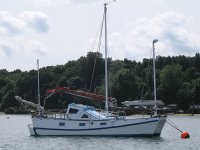
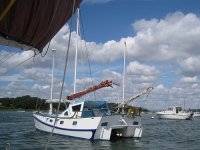
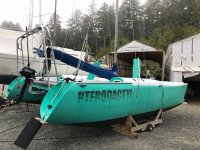
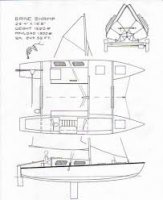
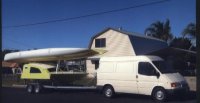
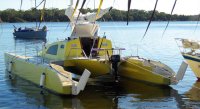
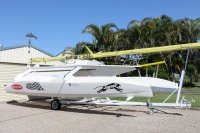
Bluebell. I have not seen a floating Streaker 23, I have only read about them (Xeno in Holland and Pterodactyl in Canada). The owners appear to be happy with them. Streakers were designed at a stage where Tennant was using light cross beams and hull build techniques which indicates they should be fast for there size. The boats were built in the early 90's and still looked in good condition. Xeno was built as a folding version (as the original design) which can be 8.2 foot wide for trailing and 13.1 foot wide for sailing. The hull shape looks similar to the 28 foot GBE which was a very good design.

The Boat Design & Boatbuilding Site
Install the app
How to install the app on iOS
To install this app on your iPhone:
- Tap the Share button at the bottom of Safari.
Tap ... if Share is not visible, then Share - Tap Add to Home Screen
Tap View More and scroll down if needed to see Add to Home Screen, then Add to Home Screen. - Tap Add on the top right to confirm.
Note: This feature may not be available in some browsers.
You are using an out of date browser. It may not display this or other websites correctly.
You should upgrade or use an alternative browser.
You should upgrade or use an alternative browser.
Multihull Structure Thoughts
- Thread starter oldmulti
- Start date
- Featured
After showing many catamaran crossbeam options I will finish this part of the thread with the relatively simple approach to bridgedeck catamaran crossbeams. The foam glass beam. Cat foam glass beams are still a lot of work but are easier and a lot more integrated (if well designed) than building a timber crossbeam structure. The 1984 design PDF gives you the idea. Materials and design has moved on but this will give a good idea of how its done. Again I reintegrate that the top and bottom unidirectional glass flanges should be done in epoxy over about 24 hours to prevent excessive heat as build up as layers cure. Also pretension the unidirectional glass in the flange slots prior to glassing. Do not under build foam glass beams, follow the designers specifications, as they depend apon an integrated structure to distribute the loads over the beams and hulls. Also use good quality foam like divinycell, airex etc. The latest foam glass beams are likely to use uni directional carbon fibre in the flanges and on the foam glass faces. Do not under any situation mix carbon fibre and unidirectional glass in a beam flange. Use either one or the other material. Carbon fibre and uni directional glass have different elongation characteristics (stretch) which means in a flange all the loads would go onto the carbon fibre first before the glass would be loaded.
Attachments
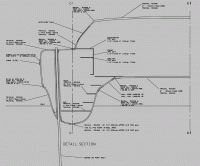
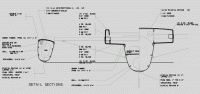
When you build a multihull it is generally a series of parts which are then assembled into a boat. Each part is designed to meet its given function with materials that suit that function so we end up with a variety of materials of varying weights and thicknesses to put strength were it is needed. In the attached document is a sample of a Kurt Hughes 55 foot bridgedeck cat that highlights the differences. The cabin roof and under wing have 50 mm airex (or equivalent) core with Triaxal glass rovings either side. The hull has 25 mm airex (or equivalent) core with Triaxal glass rovings either side. The furniture can be as light as 12 mm foam and 350 gsm glass either side. The foam weights in furniture can be 60 kg/cubic meter to 100 kg/cubic meter in heavily loaded structural areas such as keels. The joining tape weights also vary according to structural requirements. I suspect the tapes indicated on the plan show the material used but not the detail of the number of layers used etc. Again the taping matches the structural requirements to pass the the loads from one part to another. Joining tapes can be made strong but have one problem they are difficult to fair into the surrounding surfaces to be smooth and visually look good. This is part of the reason production boats use molds as big as possible to minimize the number of joins in a boat which increases strength and reduces weight. Please do not underestimate the amount of joints and taping required in a boat. It literally can add 5% extra weight and time to build the boat.
Attachments
Last edited:
trip the light fandango
Senior Member
- Joined
- Apr 2, 2018
- Posts
- 525
- Reaction score
- 114
- Location
- Rhyll Phillip Island Victoria Australia
Another really good post , thanks Oldmulti.
The Kurt Hughes 23 daysailer trimaran is an example of a modern use of a combination of materials to suit a purpose. This boat is mainly timber and ply hull structures, but it uses glass and balsa and some flat decks with ply, balsa and glass. It will be a long lasting boat if built to plan. BUT it is a complex boat to build requiring many skills to finish the boat. It would be an excellent training build if you were planning a larger build later. As an example the float deck is combination of several layers of unidirectional glass, balsa core and 3 mm ply. Balsa needs to be effectively sealed to prevent any rot, multiple layers of unidirectional glass needs to be laid smoothly to prevent ripples and get a uniform strength over a surface. All this could be simplified to a single 6 mm ply deck covered with 200 gsm glass. The weight would be similar but the work to build it would be reduced. Don't get me wrong Hughes has designed an excellent boat that reportedly sails very well as designed. All I am trying to say sometimes simplification can achieve a very similar outcome with less work. There was a guy who built a full carbon fibre 16 foot long tri for fun. The boat took a long time to build and cost more than a new Hobie 21 that used to be able to sail past it. Keep it simple in boat building has its virtue.
Attachments
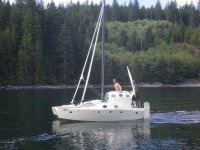
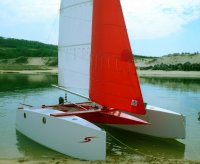
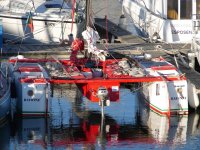
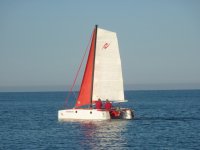
A variation. Small cruising catamarans are interesting and vary enormously from the "what is that" to Atlantic crossing boats. In the "what is that" category is a 3 masted junk rig 24 foot cat to the 18 foot wisecrack cat from Canada. But the most interesting is Micromegas 5. A 16.3 x 12.8 foot tube cruising cat of 2240 lbs displacement with 200 sq foot of sail that crossed the Atlantic. The hulls have a length to beam of 7:1 are flat bottomed and basically a box shape. 1.2 meter high and 710 mm wide. The hulls are 9 mm ply with just gunnels and chines no stringers and minimal BH's. The cross beams are 50 x 250 mm timber with 6 layers of 300 gsm unidirectional glass top and bottom of the mid and aft beams. The mid and aft beams have dolphin strikers of 4 ropes of deema 6 mm (very low stretch) to help support the fore and aft cockpit which also supports the rig. The brothers who sailed the boat are EXCELLENT seamen and can build a good boat. The cat, when loaded, is heavy due to need for stores, gear etc. It may not be fast but it can cross oceans if you have the skill.
Attachments
-
 cat rig junk b.jpg108.4 KB · Views: 1,072
-
 cat junk rig a.jpg126.2 KB · Views: 1,026
-
 wildflower wisecrack 18 ft cat.jpg94.8 KB · Views: 1,089
-
 micromegas 5 r.jpg32.5 KB · Views: 1,060
-
 micromegas 5 c.JPG73.6 KB · Views: 1,067
-
 micromegas 5 l.JPG382.9 KB · Views: 1,157
-
 micromegas 5 t.jpg6.8 KB · Views: 1,070
-
 5 mtr berques cat.jpeg168.7 KB · Views: 1,280
Last edited:
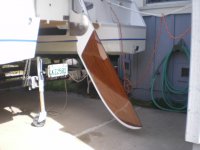
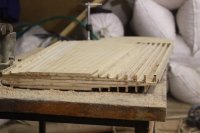
Rudders come in many formats from transom hung to full under the hull spade of hung off a skeg. But all rudders are vital to the control of a boat. Rudders have to be built just strong enough to handle the loads without being barn doors that are heavy and inefficient. In smaller boats transom hung rudders that kick up work well but when boats get above 30 feet and sail offshore transom hung rudders have an annoying characteristic. They get hit with wave action on reaches and downwind. Unless the steering mechanism dampens the shock load there is continuous vibrations through the EG tiller as you sail. OK for few hours, bad for a day. So lets look initially at ways you can attach a rudder to a boat and still have it kick up if it hits something underwater. The Reynolds has the classic kickup rudder system, good for a small boat. Wildflower is a trailable cat that cruises Canada's west coast and has a central rudder on its wingdeck that kicks up. This is a good solution IF the rudder foil section is well designed and the blade is strong. If the rudder foil is badly designed the rudder ventilates and you lose control. Another option is to have a semi under slung rudder that kicks up as in the Streaker 23. This option is light, simple gives the advantages of spade rudder hung partially under the hull. Spade rudders are the most "efficient" type of rudders for steering but they are not bullet proof. I know one designer who designed his under hull spade rudders to break off if the rudders are turned hard over at 25 plus knots of boat speed. Why? Because if the rudders hit ground at lower speed he wanted them to bend or break away in preference to splitting the hull apart potentially sinking the boat. Rudders like everything else are a compromise. Also there is a shot of how one person "shapes" his rudder blade during construction. PS please minimize the use of plywood in rudder blades as 50% of the wood is not working in the right direction for you. Find some western red cedar, shape the blade and cover it with several layers of glass cloth and epoxy and you will get a relatively light and effective rudder.
Attachments

The structure of rudders and associated steering equipment is a problem. Spade rudders are often built with a stainless steel or aluminum tube with the blade at one end and a steering head attached at the other. The tube should be reasonably light and small in dimension to fit a slim blade of between 10 and 15% thickness compared to its width. But a larger diameter thinner wall tube is best for stiffness, strength versus weight. Next the rudder blade has to be attached to the tube. The tube either has to be flattened or have small square plates welded to the tube to prevent the blade rotating on the tube. Glueing a blade to a tube only works in light airs. The rudder blade can be built of many materials from WRC glass covered to high strength foams fiberglassed over with strengthening spars etc in them. Whatever the rudder blades are built from make sure you can repair or replace them easily as I can assure you, you will break a rudder or 2 in your sailing life (personal score 7). Also if you can have a sacrificial foam glass tip on the bottom 25% of your rudder it may save a bigger repair job if you hit bottom. Modern design says you can build an integrated carbon fibre rudder and shaft for lightness and strength. I agree but I don't drive a Ferrari. Carbon fibre shatters, it does not bend, resulting in any knocks can break the entire structure needing a full replacement. Attaching a steering system to the head of the rudder shaft ranges from metal clamps to bolts through the rudder shaft to the tiller catchment. Monohulls often use solid shafts with keyways or machined square tops to attach tillers to. It costs money, is harder to repair and a solid shaft is a heavy item, a tube is lot lighter. The easiest way for me is a tube with a welded plate covered with WRC and glass at one end and a tiller attached by bolts through the rudder tube at the other end. Transom hung rudders is another topic but make sure the rudder box is strong with the hold down mechanism that really works and is able to be used, repaired or replaced whilst at sea. I have seen a big cat that required someone to go for a swim or sit in a dingy each time its rudder kicked up. Not viable in big waves.
One of the simplest plywood build methods I know of was invented and patented in 1970 (the patent has run out). It was initially used to build high speed round bilge power boats but could be adapted to any hull shape. The method is basically 24 inch (600 mm) wide plywood strips glued together to form a clinker hull. Now the best part get your 24 inch strips and scarf them together lengthwise to the length of hull. Use eg 3 mm ply for say a 23 foot boat. Put a series of round bilge hull shaped former's on a strongback about 18 inches apart. Place the first 24 inch strip from the keel line outward. Lay the next 24 inch strip about 10 inch from the keel outward covering just over half the first 24 inch strip. Lay the next 24 inch strip 22 inches from the keel line over lapping the 2nd strip and 2 inches of the first strip. Repeat until you get to the gunnel line. Result you have a 6 mm thick hull with an 9 mm thick hull every for 2 inches every 10 inches. The 9 mm thick part act as a default stringer every 10 inches. This techniques build a monocoque hull structure that only requires BH's to support the hull shape. A stem, keel and gunnels still needs to be inserted. Also at the keel and gunnel you will have double any 3 mm ply to form a 6 mm ply hull. This technique can be used for 4 mm and 6 mm ply which means it will work on hulls up to 50 feet. Yes it looks like a clinker ply boat (as Peter Spronk cats were) but it is very fast and easy to do with a minimal need for timber stringers etc. If this needs further explanation I will find the original article which had pictures and diagrams.
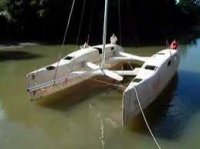
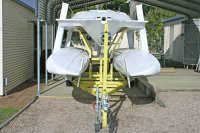
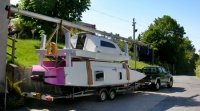
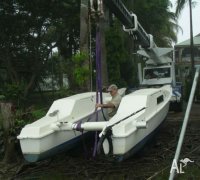
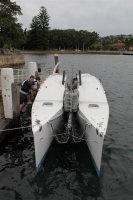
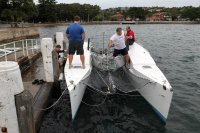
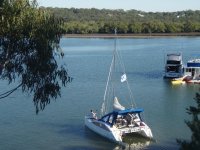
Trailable catamarans come in many styles from Jarcats which are 8 foot (2.5 meter) wide bay sailors to 36 foot cats (2 fold cat) that can expand from 8 foot to over 20 foot wide. Each has its advantages and disadvantages. Brine shrimp 23 foot cat is a home built design that would be harder to put on a trailer as it would have to be folded in the water then landed on a trailer. The Surtees 29 needs to be landed on a trailer then the hulls need to be pulled up for trailing. When hulls get this big you need mechanical help to winch them up. Surtees ran lines to his trailer winch. Surtees also copied woods approach to a folding catamaran in his 22 footer. Richard Woods (sango) developed the hull fold under trailable technique and is the most advanced in its ability to float a full width boat on a trailer then as the boat leaves the water it automatically folds its hulls under the central unit. A good solution. Catamarans that slide together on aluminum beams is a troubling solution (International 23). As you pull apart the hulls they tend to bind unless equal pressure is applied to both ends of the boat at the same time. This is hard in water and requires a special trailer if you expand or contract it on land. Another solution has been tried many times but has only succeeded in very few designs. It is the fold and unfold on water with folding cross beams (Takeaway). The method requires really good design of the folding crossbeams as the hinges are taking very large loads especially on the mast beam. Takeaway works well. Of all the concepts I would prefer a narrower solid build (in Australia with special permits you can trail up to 11.5 foot 3.5 meters wide cat) next would be Woods Sango and finally the Takeaway design. Alternatively just buy a Farrier tri.
Attachments
-
 2fold cat.jpg6.2 KB · Views: 970
-
 brine shrimp 23.jpg7 KB · Views: 878
-
 9m-folding-cat-ready-to-go1.jpg46.3 KB · Views: 875
-
 surtees 29 cat Cruising.jpg114.2 KB · Views: 1,015
-
 s-22_folding_catamaran.jpg546.7 KB · Views: 880
-
 s22_ontrailer.jpg331.7 KB · Views: 875
-
 sango pink trail1.jpg103.1 KB · Views: 870
-
 crowther_international_catamaran.jpg192.4 KB · Views: 924
-
 IMG_1749 (Large) takeaway 25 mm ss pins.JPG52.2 KB · Views: 846
-
 IMG_1754 takeaway 25 mm ss pins.JPG126.9 KB · Views: 908
-
 P5120078 (2) takeaway tube.JPG247.4 KB · Views: 803
Terrific thread old multi - thanks!
Another folding catamaran I have seen was called Project 8 and won a 'Silk Cut Nautical Award' for design innovation in 1992. Designed by David Alan-Williams
in the UK the aluminium beams were hinged in the centre so that the 8 metre cat could be expanded in the water from trailerable 2.3m to sailing 5.6m beam
whilst simultaneously tensioning the trampolines and raising the mast! When I saw the boat it was at Lymington (UK) and I was only able to stand on the boat,
not sail it at the time. It did seem 'rigid' enough to me but my background then was from another 'tube' cat called a 'Spyder' design from the Tennant design house.
I built a slightly lengthened Spyder in the late 80's - very fast but a bit 'floppy' unless one used stays from each bow.
I was offered the manufacturing rights to the extrusions, hinges etc. for the design but afaik the only one that was made was the prototype I stood on.
Phlames. Spyder looked a nice design, a few questions. You said it was floppy, did anything break or crack in your ownership? Is it still sailing? Can you remember much about the structure. The information helps us all understand the strength and weaknesses of light boats.
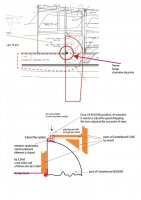
Centreboards or dagger boards or low aspect ratio keels is a choice we all have to make. Low aspect keels are easier to make and attach to a hull but are only about half as efficient as a dagger board for a given surface area. The problem of low aspect keels is "tip" losses. Near the tip of any board, there is a flow of water from the high pressure side to the low pressure side under the tip. A high aspect ratio board (long vertically thin fore and aft) has relatively smaller tip losses. All foils need to be aerofoil in shape to get the best performance. Next comes the choice of a dagger board or a kickup centreboard. A kickup centreboard can be as effective as a dagger board but has one big downfall. The centreboard slot in the hull creates a lot of turbulence under the hull which slows the boat. On a couple of tris the turbulence was so strong it blew the top of the case out allowing water into the hull. Centre board cases need to be strong. Dagger board are the most efficient overall but have one big drawback they break if you hit anything at speed (yes I have destroyed at least 5). Newick, shuttleworth have crash boxes at the bottom of their dagger board cases which help minimize board damage but they do stop all breakages. Dagger board cases need to be shaped like the board itself to minimize the amount of water that is "carried around" by the boat. Also it minimizes the fire hose effect where water spurts out the top of the dagger board case at speed. Any type of board needs to be strong enough to handle sailing loads but capable of breaking if the boat grounds at high speed. It better to replace a dagger board than replace a split hull. Some smaller cats and Kelsall larger cats have a daggerboard on the centre of the wing deck. The foil pierces the water with no effective end plate above it. The foil shape has to be good or the foil ventilates reducing its effectiveness. Foils have been built of many materials from foam glass to aluminum but my preferred is Western Red Cedar wrapped in fiberglass and epoxy. They can be repaired and they are heavy enough to sink. Please make sure your up haul and down hauls attached to the board work easily and are strong. I know of a couple of guys who have lost their dagger boards as it dropped out of its case when the up haul and down hauls broke. Attached is a diagram of a 6.7 meter catamaran which has a wing deck dagger board case that the builder was converting to a centreboard model. It does not have the slot dragging under water but it depends on the board fitting well in the case for strength etc.
Attachments
To tie rudders and centre boards together the attached plan will give you an idea of the shape, construction and detail of skegs and cases required for a 40 foot tri. Several of these boats have sailed trouble free for years. Study the detail in this plan as each part has a function and is strong enough to do the job but will break if its hits something at real speed. One BIG warning when sailing. If you think you can get over a 4 foot deep bar with a draft of a 3 foot deep rudder think again. If there is any wave action your rudder draft may be 2 feet on a crest and 5 feet deep in a trough as the boat pitches through the waves. Often a partially deployed dagger board is not the deepest part of a boat pitching through waves.
Attachments
Sailing rigs are always interesting. A fully efficient racing rig often is not a suitable rig for cruising. The rig has to suit the need. In smaller boats 25 foot or less the forces are not to large so you can do a good fractional rig with overlapping head sails and wing masts without to much trouble. But once you move to larger sizes large forces start to build which need increasing amounts of deck gear to control it. So I will break this conversation into several parts, and start a talk about boats under 25 foot. A lot of smaller boats can be driven by EG Hobie cat rigs that can be gotten second hand. These rigs are efficient, fairly easy to handle even with rotating wing masts and the sails can be modified to include some reefing points. To get the right size of rig for your boat work out your boats righting moment (multiply half the width of the hull centrelines by the boats displacement) then match it against against the righting moment of EG a hobie 21 ( again multiply half the width of the hull centrelines by the boats weight then add the weight of the people on trapezes multiplied by the distance they are from the hull that is in the water). A hobie rig can have a light wind genoa added to it to improve its performance but you cannot add more sail area in heavy airs. Roller furling gear is easy to add to jibs if you are a cruiser. And finally add a small jib or small substitute mainsail for really heavy airs if you go sailing in strong winds. ( I live in a place you can leave in 10 knot winds in the morning and have a 40 knot change when you are going home). If you do buy a second hand rig really inspect the rigging wire and replace any suspect wires. Rigs often fall down due to a lack of maintenance not abuse.
Forum posts represent the experience, opinion, and view of individual users. Boat Design Net does not necessarily endorse nor share the view of each individual post.
When making any potentially dangerous or financial decision, always employ and consult appropriate professionals. Your circumstances or experience may be different.
When making any potentially dangerous or financial decision, always employ and consult appropriate professionals. Your circumstances or experience may be different.
Advertisement:
Similar threads

- Replies
- 36
- Views
- 8,691

- Replies
- 33
- Views
- 9,124
- Replies
- 22
- Views
- 9,031