Multihull Structure Thoughts

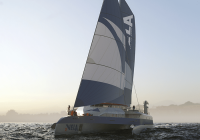
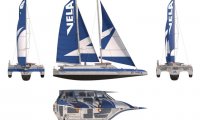
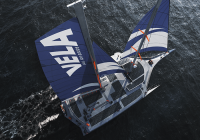
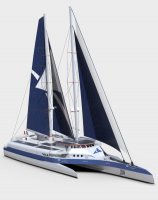
This is an update on a fast sailing ship to provide a shipping service between Europe and the USA, French start-up VELA asked VPLP Design to explore the range of possibilities of a zero-carbon transport vessel of goods by sea. This led to the design of a 65 metre (now 66.7 metre) schooner-rigged trimaran which can carry 350 tonnes of cargo between Nouvelle-Aquitaine (France) and New York in under two weeks, including loading and unloading.

Vela is 218 x 82 foot sailing cargo trimaran with a displacement of about a 1000 tons (2,240,000 lbs). The 155 foot carbon masts in the schooner rig carry 14,000 square foot of sail. The length to beam on the main hull is 10.7 to 1 and on the floats is 18 to 1. The draft of the tri is 11 foot over the main hull. The is limited mechanical power as the intention is to sail the tri 99% of the time.

The proposed sailing btime between France and New York is between 10 and15 days including loading and unloading. This implies a 250 to 350 miles/day sailing capability with peaks of over 400 miles per day. This is 10 to 17 knots of average speed under sail with peaks probably close to 25 knots. To achieve this the VELA is fully computerised is sail control and weather routing to optimise the sailing speed potential.

Now we get to the construction. The shell is basically all aluminium with a few items like the onboard crane etc in steel, but the really interesting part is the rig. The masts, sails and rigging would need to be really strong as this tri’s righting moment is very high and the VELA would think 50 knot wind speed and 25 foot waves “good sailing weather”. The loads on things like sheet winches, sheet cables etc will require electric or hydraulic components that will be computer controlled. The VELA will only have 8 crew.

VELA will transport approximately 560 EU pallets or 450 US pallets (about 50 containers worth) on each run. There are many French companies especially in the fashion industry that want a near100% environmental transport medium.

Now the update. Vela Transport of Bayonne, France has raised about 40 million Euro and signed a contract with Austral Australia to build the first VELA. The exact purchase price for the vessel cannot be disclosed for commercial reasons, however, is in the range of A$40–$45 million. The first-of-class, 66.8 metre high-value cargo vessel, based on a concept by VPLP of Paris and featuring a sailing system by MerConcept, will be constructed by Austal Philippines, in Balamban, Cebu, and is scheduled for delivery in mid CY2026. By 2027/28 there is a further 4 vessels planned to be built and sailing.

This is a bold venture and if it works the world could be a better place. The jpegs give the idea.
 

Attachments

  • vela a.jpg
    vela a.jpg
    40.4 KB · Views: 258
  • VELA-IM-2.png
    VELA-IM-2.png
    124.4 KB · Views: 225
  • VELA-study plan.jpg
    VELA-study plan.jpg
    48.4 KB · Views: 238
  • vela i.jpg
    vela i.jpg
    43.8 KB · Views: 226
  • vela e.jpg
    vela e.jpg
    48.1 KB · Views: 202
  • VELA-1.png
    VELA-1.png
    2.2 MB · Views: 224
  • VELA-IM.png
    VELA-IM.png
    218.3 KB · Views: 215
DK12-Legs_of_Mann_4.jpg
20241024_103459.jpg
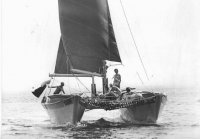
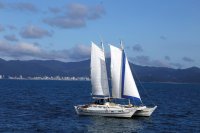
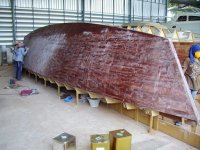
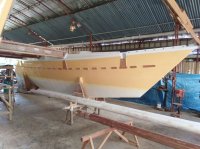
Derek Kelsall and Nick Keig did many design/build together. Derek had a creative design mind and Nick had a very practical approach to building, as his 35 x 15 foot shed provided the space to build many simple components for assembly in outside “greenhouse shelter”. Nick’s trimarans were well built and successful on the race circuit. Nick then produced a 63 foot racing cat that had a short fast life under the VSD sponsorship. Finally Nick decided fast cruising would be good and asked for a 52 foot fast cat from Derek. The result was Legs of Man V.

Legs of Mann V is 52 x 24.5 foot with a weight of 9,000 lbs and a displacement of 15,700 lbs. The 60 foot long, 97 square foot, rotating Gougeon wooden wing mast carries a 682 square foot mainsail and a 420 square foot genoa. The length to beam on the hulls is 10.5 to 1. The minimum draft is 1.5 foot to over 5 foot (if it has fixed keels, more if it had daggerboards). The power is a 9.9 HP outboard (yes 9.9 HP, Nick is a sailor). The underwing clearance is 2.4 foot.

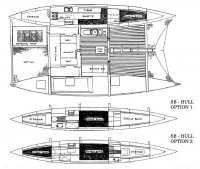
The accommodation has a double berth cabin aft and a double berth cabin forward with a toilet in each hull. There is a galley in the port hull and a formal toilet shower bathroom in the central part of the starboard hull. The main saloon has seating and a navigation station, but what the main saloon lacks is headroom with only 5.3 foot available over the majority of the floor area except a small central fore aft slot.

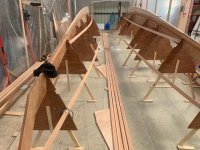
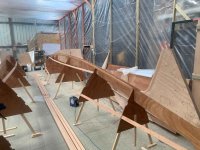
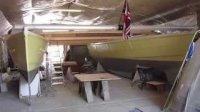
The construction is mainly flat panel foam e-glass polyester resin. The hull bilges are rounded segments integrated into the build. Nick built half length hull panels inside his shed then assembled the cat outside.

Performance was very good. Nick describes Legs of Mann V capable of 13 to 15 knot speed range whenever the wind cooperates. Nick Keig built a very fast cruiser capable of going far. But Nick was a sailor first and a cruiser second. A simple light engine and a low windage bridge deck was more important than a big engine and 6 foot headroom.

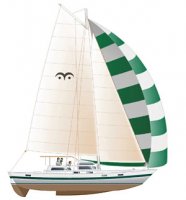
The first be 2 pages of jpegs give the story. The other cat jpegs featured is what a “cruising” version of the 52 could turned into and is available for sale on EVACOM. The Caitanya 52 foot cat is 2 foot wider, 4,400 lbs heavier, carries about 100 more square foot of sail and has a full headroom main cabin.
This is Legs of Man V on Kelsall's design catalog 1990's -great looking boat.
View attachment 198840 View attachment 198840
 
Last edited:
Some times I am surprised how effective a good story and marketing overrides logic. Classic Wharram designs have been surpassed by the latest TIKI and Phai designs which are often a little easier to build, sail a bit better and have better rigs. Angie, Remy, children ryder and hunter with dog Sage plan to build and sail a Narai Mk 4 around the world.

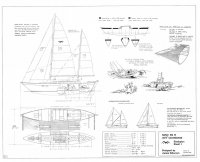
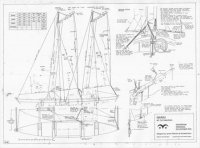
The Narai Mk 4 is 41 x 19.5 foot with a weight of 7,840 lbs and a displacement of 14,800 lbs. The working sail area is 529 square foot and 840 square foot depending if it is a Ketch or a Sloop rig with options. The ketch main mast is 35 foot high. The sloop main mast is 40.5 foot high. The length to beam is about 11.5 to 1. The draft without any lateral resistance is 2.4 foot. The engine options range from outboards to wing deck inboards with tilting shaft drives.

Now the fun begins, the construction. Remy is considering his options. The standard construction is 9 mm ply with timber frames backed by plywood bulkheads. The hull has stringers and the keel line is a very solid laminated timber. Remy is also considering solid glass hull (one was built with 5 mm thick glass). Remy is reluctant to use fossil based fuels as he is into sustainability. The cross beams were originally solid laminated timber cross beams but Remy in one jpeg is holding a sample of the latter style ply and timber cross beams. The rig is some debate as Wharram and co have designed 3 different rigs for this cat, including a wingsail ketch option.

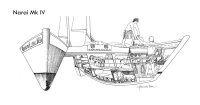
The accommodation on a Wharram is emphasised as the hulls are 6.5 foot wide at shoulder height. At waterline width the beam is less than 3 foot. Life become uncomfortable when you have to push past people in rough conditions. Yes, there is great deck space, but sorry to say getting repeatably wet in ocean sailing is not great even in warm areas. You can sleep 6 people possibly but you are likely to live 3 or 4 people while seriously cruising.

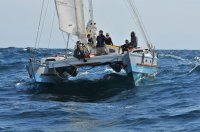
The sailing performance of a Wharram 40 is very average unless the wind is aft or beam reaching. Yes it can go upwind but the lack of foils limits its pointing and VMG.

The Jpegs give some ideas.
 

Attachments

  • narai a.jpg
    narai a.jpg
    38.4 KB · Views: 252
  • narai fwd.jpg
    narai fwd.jpg
    41.6 KB · Views: 244
  • Narai+MkIV+Study Plan.jpg
    Narai+MkIV+Study Plan.jpg
    196.7 KB · Views: 273
  • Narai-Mk-Iv-Sail-Data_2.jpg
    Narai-Mk-Iv-Sail-Data_2.jpg
    100.2 KB · Views: 251
  • wharram_narai interior.jpg
    wharram_narai interior.jpg
    71.6 KB · Views: 252
  • narai remy and crossbeam section.jpeg
    narai remy and crossbeam section.jpeg
    186.5 KB · Views: 240
The traditional Wharram cats really had their heyday in the 70's and 80's - I was quite enamoured with them in the early 80's, and I bought a copy of their catalogue then. Fortunately I didn't go any further, such as buying a study plan, or (worse) a full size set of plans.

I did take that extra step (re study plans), when I bought a set for Richard Woods Gypsy 20 years later - I still have them, and I still think she is a brilliant wee boat, but it would make a lot more sense now to look for a secondhand cat that is ready to go now, rather than build something new.

I am baffled as to why the family in OldMulti's post above want to build a new Narai from scratch now - time has moved on, and there are much better (in every sense, from sailing ability to accommodation to looks) designs available now.

I just googled 'Wharram catamarans' to see what comes up, and amongst the links was this thread on the YBW Forum from 12 years ago.
Wharram's catamarans: tropical dream, nightmare at 50ºN, 2ºW? https://forums.ybw.com/threads/wharrams-catamarans-tropical-dream-nightmare-at-50%C2%BAn-2%C2%BAw.308317/

I am bajansailor on there as well, and I chipped in my 2 cents worth then with post #14.
In this post I mentioned a Bajan family who had built a Narai in their back yard when they were living in Vancouver in the 70's - they then sailed her westabouts back to Barbados (almost a circumnavigation). They finally sold Kiskadee about 15 years ago, and I last saw her living on a mooring in Chaguaramas, Trinidad - but this was some years now. I don't know if she still lives in Trinidad.
I will attach a few photos of Kiskadee - they do epitomise the ideal dreams of a family sailing around the world.
The first photo was taken when they were leaving Prickly Bay in Grenada.

Kiskadee leaving Prickly Bay.jpg


Kiskadee sailing.jpg


Kiskadee.jpg
 
having built my 34' Tangaroa MkI (in landlocked Austria, never having sailed on saltwater before) from 77 to 81 & rtw-ed her in 7 years together with my-then-girlfriend (wife since 88) "straightaway" after launching I feel I have to comment too:
1. it was a great adventure for us youngsters (25 & 23 when we set out), that was not to be topped by 2 & 1/3rd further rtws (in monohulls). Zero, absolutely zero regrets.
2. in retrospect (always 20/20, no?) I could have built - with the same effort in time & money - a much (much!) more suitable (& comfortable!!!) boat (among the cruisers we met, our boat must have been the benchmark in discomfort...)
3. THE key to our success lay in the "marketing" of James Wharram (& for this I am grateful to him for the rest of my life): he gave a youngster (a teacher, of all things!) of 21, that had never sailed a meter on saltwater & who's greatest "construction project" had been taking the engine of his 50cc motorcycle apart & (successfully!) putting it together again, the confidence, that with excessive care, caution & diligence (& maybe a bit of luck?) - that he could build a boat with his limited funds & sail her to the dream islands of the "South Seas".

Time has moved on- while I had to have books & "Multihulls" magazine shipped from the US (& "Multihull international" from the UK) the information available today is a zillion times greater than in 77 - & insisting on building a Wharram cat is a bit quixotic... just my 2 cents
 
The other thing about Wharrams that no other designer has is you get to join a tribe. A tribe that is a lot more out there adventurous and fun than being a vegan or joining a religion.
 
Looks fun to me! For less experienced builders they are easy to understand and will get them there and back. Maybe the next gen wants to continue the marketing.
 
After some good words in support of Wharram cats yesterday, I will try and show why I questioned the choice of the classic Narai 40. We will compare it to the Tiki 38, a design done by Wharram and co 30 plus years later. The Tiki 38 waterline length is only 150 mm shorter (0.5 foot) so the comparison is fairly valid.

The Tiki 38 is 38 x 22.4 foot with a weight of 6,600 lbs and a displacement of 11,000 lbs. Depending on the rig the mast options are 150 x 3.5 mm aluminum tubes, a 140 x 4 mm aluminum tubes or in timber 150 mm diameter with 25 mm walls. The mainsail is 225 square foot, the fore sail is 222 square foot and the jib is 140 square foot. The spinnaker is 536 square foot and if a staysail is carried 140 square foot. The hulls at light displacement have 12 to1 length to beam. The draft is 2.5 foot including small low aspect ratio keels.

The Tiki 38 is 25% lighter than the Narai 40, carries similar sail area but with the wing sail rig a more efficient sail area than the Narai 40. The length to beam on both boats are about the same but the Tiki 38 has a lower wetted surface and more rounded hull shape with small keels. Summary. From comments and user experience the Tiki 38 is a better sailing cat than a Narai 40. EG Pilgrim, a Tiki 38, crossed the Atlantic from New York to the South of France in 2011 in 31 days for the 4500 nautical miles at an average speed of 6 knots. They frequently sailed at 14 knots and their top speed was 16.6 knots.

The structure of Tiki 38 is plywood with timber framing and supports etc. A lot of epoxy and filleting material is used with glass epoxy used to tape parts together. The lower and upper hull skin is 9 mm plywood. Bulkheads in the lower hull are 9 mm ply and the keel is 18 mm plywood. The lower hulls/keel are bogged together with glass biax tapes inside and out. The upper hull has 12 mm plywood bulkheads. Stringers are 45 x 19 mm on the flat against the hull sides. The decks are 9 mm with under deck stringers notched on the bulkheads. The 3 main cross beams have a centre I beam plywood web of 2 layers of 18 mm ply with a top and bottom flange of 140 x 70 mm timber. In each corner of the web flange interface is a 56 x 85 mm triangular support timber. There are many support “bulkhead” timbers between the top and bottom flanges. The Tiki 38 three I-shaped beams are lashed to the hulls in twelve places. Four lashings per beam, one inside and outside each hull. These lashings have to be stretched tight, really tight. Wharram recommends 6 wraps of 8mm polyester (Dacron) braid. It takes a lot of effort to get the last bit of stretch out of 8mm Dacron braid. The aft beam is a 140 x 4 mm aluminum tube.

The accommodation and layout of the Tiki 38 is better than the Narai 40 and could sail with a similar number of crew. It is interesting that Wharram's later designs, in the smaller cats, have introduced chine hull shapes to get more internal space, a slightly easier shape for building and hopefully a better sailing hull shape.

The jpegs give the idea.

 

Attachments

  • Tiki 38 sailing c.jpg
    Tiki 38 sailing c.jpg
    144.4 KB · Views: 252
  • tiki 38 ikst built.jpg
    tiki 38 ikst built.jpg
    278.8 KB · Views: 231
  • tiki 387 study plan.jpeg
    tiki 387 study plan.jpeg
    69.4 KB · Views: 232
  • tikio 38 framing structure.jpg
    tikio 38 framing structure.jpg
    70 KB · Views: 244
  • tiki 38 frame aft.jpg
    tiki 38 frame aft.jpg
    69.7 KB · Views: 215
  • tiki 38 fairing semi curved hu;;.jpg
    tiki 38 fairing semi curved hu;;.jpg
    80.1 KB · Views: 223
  • tiki38 build a.jpg
    tiki38 build a.jpg
    137.1 KB · Views: 218
  • tiki 38 cross arm install.jpg
    tiki 38 cross arm install.jpg
    9.4 KB · Views: 233
  • tiki 38 deck relaxing.jpg
    tiki 38 deck relaxing.jpg
    90.6 KB · Views: 225
  • Tiki38-wharram-rig.jpeg
    Tiki38-wharram-rig.jpeg
    20 KB · Views: 236
Last edited:
Yep, a nice more modern boat,,,
But!
The classic designs can be built with far less ( or no) epoxy. Plus that timber keel is reassuring to run aground on making them a good choice for hippies on a budget.
 
I should also add for a public service announcement that Wharram's offer the Tiki style lashing beam designs for the classics as well as the aero wing sail schooner rig and deck pod updates.
And for the kids.... Epoxy glass on the outside and inside epoxy coating is a good thing...
For leeway the best Classic upgrade I've seen is putting a dagger board in one hull.
 
Too bad there aren't as many similar open deck catamaran designs with more performance oriented hull shape available as there are Wharrams. It is not much more time and effort to build round bilge approximation shape from same plywood sheets than Wharram deep V hull resulting in better sailing performance and more roomy interior. I like the general idea behind Wharrams, but there seems to be a lot of improvements possible like better hull shape, less overhangs resulting in more waterline for same LOA, simpler crossbeam construction, better interior layout while keeping simple to build anywhere hulls, assemble at water side, no complicated bridgedeck structure general idea.
 
THE main & very first improvement would be: aft-facing companionways! Those facing the center were exactly in the place where the heaviest spray from the opposite hull landed...
(wouldn't have cost an extra penny, but I didn't know better when I built her...)
 
Yep, a nice more modern boat,,,
But!
timber keel is reassuring to run aground on making them a good choice for hippies on a budget.
would still be VERY bad to grind through the sheathing to the wood...teredo & all
 
The other thing about Wharrams that no other designer has is you get to join a tribe. A tribe that is a lot more out there adventurous and fun than being a vegan or joining a religion.

Speaking about religion, you have very nearly nailed it ....
Wharram's are a cult.
 
Forum posts represent the experience, opinion, and view of individual users. Boat Design Net does not necessarily endorse nor share the view of each individual post.
When making any potentially dangerous or financial decision, always employ and consult appropriate professionals. Your circumstances or experience may be different.

  • Back
    Top