It is an old thread, but a few notes anyway:
When it comes to all this liability and engineering, which I am sure are correctly summarized, it does depend on the aspect ratio of the spar. The gougeons were long proponents of efficient rigs and hulls. But on most high performance boats it seems as though they get more extreme all the time. Are you looking to set the world on fire, or make a practical rig for a simple boat, preferably a multihull with a wide staying base.
So to throw out more leads:
Article on the famous Gougeon/Watson built ply and core mast for Atom (not the commercial design):
...
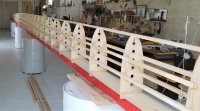
"This boat sports an experimental wing mast constructed of 1/16″ thick aircraft birch plywood outer skin, 1/64″ thick plywood inner skin separated with 1/2″ Tricell H™ (resin impregnated paper) honeycomb. It was fitted to the boat five years after initial launching. With some reinforcing stringers, this laminate stack was lightly vacuumed while flat, then folded and placed into a form to establish an airfoil until all cured. An aluminum bolt rope was simply bonded into the back end slit from which the vacuum bag was removed. Mast hound was a stainless steel plate with threaded rod passing through it into localized wood and unidirectional carbon fiber buildup. The result was a very light section that has proven very efficient. Despite several stepping accidents, the structure stands to this day."
Gold coast yachts:
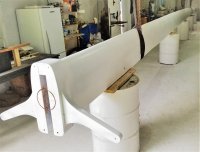
Not really any specifics but they were proponents of a 2-1 spar section (probably also the Atom mast is fat, you can't get a 3-1 section in a single fold without s leading edge seam). They used 1/2" wood strip, and 10 oz glass, from what I have heard of one set of scantlings. Localized re-enforcements of carbon would probably be necessary. The 2-1 section seems to be more sensible when it comes to cruising, or handicap racing. The 3-1 gougeon section is famous for basically being a small sail at all times. In area like a storm sail, if you are lucky.
Meade on revisions to Adagio (quoted from Epoxyworks as also above):
Building a new wingmast
"The original wing mast had always seemed marginal when pressed hard in heavy air. We’d built it light (120 pounds for a 39-foot mast without hardware) and it had never failed. It may have lasted many more years, but with modern sail technology imposing more loads on a rig, we decided to build a new wing mast.
We built the original mast using a fold-up plywood construction technique, which became the basis for many more built since. It is a simple and quick procedure that results in a good product for the time and money involved. However, this time around I wanted to build a state-of-the-art wing mast that would be stronger, stiffer and smaller in section than the original, and weigh less. The original section was 17 inches in chord length with pointy leading and trailing edges, which are inherent in “fold-up” construction. My primary goal was to reduce the chord length to just 12 inches but not give up any precious edgewise stiffness; one of the advantages of the rotating wing mast concept. My other goal was to adapt a larger leading and trailing edge radius. The resulting smaller section would be less adversely affected by wind when moored, or at the dock.
A new building method allowed us to accomplish both goals. It was relatively easy and did not require a lot of man hours. Our strategy was to separate the mast building effort into four separate parts; two molded side panels and two more molded sections, one for the nose and one for the tail. We made all four of these parts on two simple, easily fabricated molds. For the nose and tail parts, we used 3-inch diameter PVC pipe. We used a simple, curved plywood mold to make the side panels.
To build the nose and tail sections, we used Unidirectional Carbon Tape sandwiched between a 4-inch wide woven 9-ounce glass tape. This allowed us to achieve 60 percent fiber weight in a wet lay-up, without any vacuum pressure. The total weight was 14 pounds for each 40-foot long section.
We laid up the side panels with 0.1-inch Douglas Fir veneer sandwiched between layers of 5-ounce woven carbon cloth. In the center area of the 10-inch wide panel, we concentrated further layers of Unidirectional Carbon Tape for an all-up weight of 28 pounds per panel. To consolidate this more complex laminate and achieve a light weight, we used vacuum pressure on the side panels.
For temporary clamping pressure, we set up one of the side panels in a simple fixture and held the leading and trailing edges in place with sheet metal screws. Then we installed the sheer web (see photos) and the other internal pieces and parts that support the tangs, hounds, halyards and the other complexities of a modern mast system.
The benefit of this new construction approach over the older fold-up method is that you can deal with the interior complexity at your leisure, then complete the mast by bonding the opposing side panel in place.
With the mast structurally complete, we needed only to fair in the bonded joints and add some strength on the exterior of each joint with 2-inch glass tape. After final fairing and finishing, our mast weighed 105 pounds. With all the hardware, rigging and halyards in place, the new mast weighs 132 pounds."
Of course they don't say exactly what the schedule is, but if I was building a smaller less stressed boat, and I could probably reverse engineer it from those numbers. There are also some standard haircuts when you move from cedar to Al, and Al, to carbon. I forget what they are for stiffness, but it probably run from something like 1/16 for carbon (or whatever you have to do to make the structure tough enough), to 1/4 for al, and 1" for wood. Just stuff you pick up when designers provide alternatives for materials.
Keep in mind that the Gougeons have an engineering department...