fishing sailboat

My father ran head boats out of Clearwater, FL. for many years. They went about 80 miles off shore, three to four hours out, three to four hours back, 6am to 5pm. Back in the day, they caught maybe an average of 2, 15 pounds fish per passenger x 50 passengers (a conservative guess from the 1960s). That's approximately 2 x 15 x 50 = 15 x 100, or fifteen hundred pounds of fish. The boats refueled every other day. I think I remember about 1000 gal. That's a large chunk of change to get out and back from the Middle Grounds for 3000 pounds of fish. I don't know if those numbers would hold today, but you could buy a new sail for you boat every week for less than that.

The fishbox was 8'x8'x4' and filled with chip ice. If you could fish commercially, you could conceivably fish at night and beat the power boats back in the morning the next day.


Maybe something with a center cockpit that can be converted.


I ran across a center cockpit yesterday. That crossed my mind
 
Have you studied the weather patterns in your locality?If the wind isn't consistent,you will be using the auxiliary quite often.
 
Trolling, rod and reel is the plan. 1 ton is roughly 1 cubic yard?, trying to picture that in the boat. Gulf coast, Texas, Forida, mackerel. The carib small boat has my interest

Not sure on mackerel, even salmon species pack in to a fish hold different. I can get 53lbs a cubic foot of pink salmon but 50 per cubic foot in an rsw hold. Cod packs into several different media's for chilling but in the mid 40s. Our rockfish aren't very dense and I kinda knock a third off my sockeye and am not usually disappointed. Guessing the mackerel are nearer rockfish and cod.

Keep in mind sail is likely only going to be useful in transit to and from the grounds. The modern engine is probably the single biggest development in all fisheries.
 
Maybe I should be a little more explicit, a thirty foot boat carrying any quantity of fish will be a displacement boat if it travels under sail.It might see six knots on a very good day.Which would make those fishing grounds eighty miles out a long,long trip.How much of the catch would be in prime condition on returning?Different story if the fish are ten miles or so away,but lots more people are likely to have tried their luck there.
 
I can't think of any fishery where sail would be advantages. Even centuries ago before steam or IC, large sailing vessels would transport small rowboats to do the actual fishing from.
 
80 miles at 6 knots is probably par for the course on a lot of boats. Truthfully we all drive slow and live and die with our autopilot. Couple inches extra spray foam in the hold can go a long way.

One thing to note, very few fisheries in the developed world are viable a ton at a time. The ones that are almost certainly have a corresponding permit that's usually very very expensive.

Fleet consolidation and increased efficiency is how we survive. One of my main species is within pennies of what my grandfather fished for before I was born, not adjusted for inflation... the same actual price. This is true across a large swath of fisheries in north America. It's been good for middle men and processors and to some extent consumers to have a steady almost constant fish price, but it's come at the cost of fisherman. Case in point. The amount of permits in my home district was set at 100 in the late 60s and finalized in the early 70s. 86 were transferable and 14 were interim and went away after the original dies or retires. Last year 26 permits fished, the 5 year average is probably in the upper 30s. As a kid there were still 100 active registered permits (I'm a millennial so not that long ago) now were looking at 30 some odd permits. While our dock price has not meaningfully increased, certain portions of boats catch way more fish. Last year 10 of the 26 boats caught 55% of the fish. I was 7 or 8 in that lineup and the top boats doubled me... it's a dog eat dog world that's very competitive. Fisheries that aren't, usually aren't profitable enough for anyone but bored retires.... not knocking it but it's just the reality. Insurance, food, fuel, regulatory compliance.... it's not cheap. My break even harvest numbers are around my grandfather's "really good year". On the flip side, the year he gave his operation to my uncle the insurance bill for the boats and crew for the year was less than my insurance bill for one crewman on one boat for 3 months.... so the world just changed.

All that to say, hook and line fishing can be done on just about anything. Keeping a few thousand pounds of fish cool for a couple days isn't all that taxing. Making a living on 2k pounds of fish is the hard part.
 
As a kid, I use to dream of just that type of commercial fishing life. 50' sailboat, out for a few days, living aboard. I even designed a fishing vessel for it as my senior project in high school drafting class.

Maybe with flash freezing, longer outings could be handled.

Keep overhead low by living on the boat full time.
 
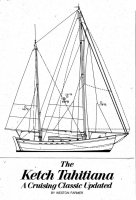
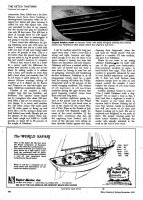
My dad built a steel Tahiti Ketch, design by John Hanna and published in Mechanics Illustrated in 1935.
Apparently this was a very popular design as there are a number of boats on the used market at very reasonable prices. You can check it out be searching on Tahiti ketch. I do not see why a cooler couldn't be added to the constructed vessel.
Unfortunately my dad was unable to complete his dream. He lofted the plans in the winter of '70 I believe, had a heart attack that summer and began work on the boat while in the back yard he was recuperating. Was able to weld the whole hull, install the desil engine, sand blast and paint the whole hull and then.... He sold the house, lifted the boat over the roof, on to a trailer and trucked it to a new owner. Oh well, it would of been nice..
 
As a kid, I use to dream of just that type of commercial fishing life. 50' sailboat, out for a few days, living aboard. I even designed a fishing vessel for it as my senior project in high school drafting class.

Maybe with flash freezing, longer outings could be handled.

Keep overhead low by living on the boat full time.


It's a good life but not a great living.

Since my last post many fisheries have taken a dump price wise. Pretty solid numbers posted across the board, salmon, cod, crab except the bering as well as some of the smaller volume species have taken a 60 to 75% haircut on price. Posted some good numbers and total harvest was good, ocean looks really healthy. It's actually fun to see the ocean continue to team with life after the scary years between 14 and 17'. Wife hasn't totaled the tally but tanners went from 8.75 to 3.35, sockeye from 1.55 to .60, pinks .37 to 18, and then .15 when the volume hit and 10 when the fishing got good. Heard dungies are down from mid 4s to 1.10... halibut is down 2$ but I'd say it's the only one holding, it's domestic compared to the others being predominat export. Wish we had more quota for that.

Even with fuel being 5$ instead of 6.37 like last year the weather was cold and windy, my expenses still went up but only minimally (slightly more fuel burn and insurance goes up like the US debt.).

Suffice to say we did books last week and for the effort put forth, second collapse of price near this level in a decade. Wife knows it's a way of life, but it's wearing. Can see the results all around town. Not many industries can have collapses like this in markets and survive, but we'll weather this one just like We did in 92, 97, 02, 16 and now this year.

It's become a lifestyle choice more than a living, but circumnavigation YouTube bloggers get better weather and locals... might be the better lifestyle on the water.
 
My dad built a steel Tahiti Ketch, design by John Hanna and published in Mechanics Illustrated in 1935.
Apparently this was a very popular design as there are a number of boats on the used market at very reasonable prices. You can check it out be searching on Tahiti ketch. I do not see why a cooler couldn't be added to the constructed vessel.

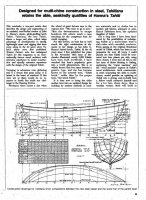
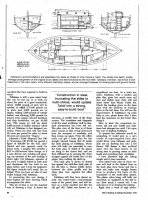
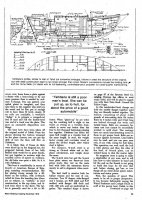
Here is a copy of an article from Motor Boating & Sailing in November 1976 about the steel version Tahitiana -

Tahitiana P 1.jpg Tahitiana P 2.jpg Tahitiana P 3.jpg Tahitiana P 4.jpg Tahitiana P 5.jpg
 
You need to first define what your target species is and the area of operation. Based on that, regulations will largely dictate the design of the boat.
 
Based on that, regulations will largely dictate the design of the boat.
You think so? What regulations for small scale commercial hook and line fishing care about boat design? Not that my finger is on it. Not at all. I just can't see what they would regulate. Maybe box size.

ince my last post many fisheries have taken a dump price wise. Pretty solid numbers posted across the board, salmon, cod, crab except the bering as well as some of the smaller volume species have taken a 60 to 75% haircut on price.
I sell jellies and jams, elderberry syrup, honey and a few other items that my wife and I grow, raise, or forage for. We sell at farmer's markets, craft fairs and county and state fairs. At one farmer's market, my booth was right next to a commercial fishing boat's booth. He'd bring three large coolers of fish and sell directly to the consumer; no middleman. He had regulars who came just to find him. He sold at a premium, above grocery store prices, and always sold out.

I don't know how many pounds of fish that was (an estimate of 75 lbs per box, maybe a total of 225 lbs of fish), but it wasn't the only market they sold at.

We also sell above supermarket prices (maybe x2). Many consumers don't mind paying for the knowledge that industrial processing hasn't touched their food.
 
Last edited:
You need to define the fishing area, season of operation, species, etc. and then look at the regulations.
 
Absolutely. Post magnusen Stevenson act there are very few hook and line fisheries not controlled by limited entry or ifq fisheries. Even the open access will likely have gear and boat length restrictions. Most fisheries, or in North America at least almost every single fishery will have a boat length restriction, likely a gear restriction, and sometimes a catch limit as well as tonnage restrictions.
 
Length restrictions have led to very beamy tall hulls with terrible sea handling.
 
Forum posts represent the experience, opinion, and view of individual users. Boat Design Net does not necessarily endorse nor share the view of each individual post.
When making any potentially dangerous or financial decision, always employ and consult appropriate professionals. Your circumstances or experience may be different.

  • Back
    Top