34th America's Cup: multihulls!

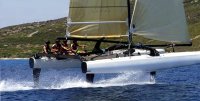
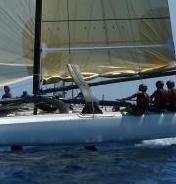
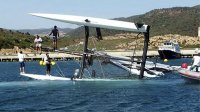
For Doug's (and other crazies') eyes; Luna Rosa's 33 foot cat testing in Sardinia. They have a wing also - which broke during a capsize. T rudder and C main foils. These shots from our friends at SA.

=================
Thanks old man! What is so very interesting is that here we have another cat flying on four(see following post-just three foils) foils when every cat in history that has flown on 3-4 foils has been slower than it was w/o foils. What are they doing different than Rocker that makes them think they will see an improvement?
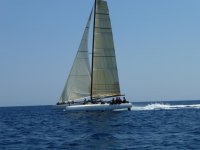
 
34th AC

Just found the thread and a link to an Italian site: they said the boat did 20-25 knots in a 10 knot wind-not too shabby-in fact excellent!
And I found a picture that shows they were sailing on three foils not, four-they had the windward(wierd-looking) foil retracted. You can see a sort of "S" shape to the windward foil in the picture:
click-
 

Attachments

  • AC 34 Luna Rossa foils.jpg
    AC 34 Luna Rossa foils.jpg
    51.9 KB · Views: 771
Here's an enlargement.
The difference is that Luna Rosa have curved main foils, not draggy inverted T's. Also their windward main is lifted. Also the windward T rudder is almost clear of the water, so you're only talking two and a half/quarter foils in water, big difference to four immersed T's.
 

Attachments

  • lunarosateat3.jpg
    lunarosateat3.jpg
    179.3 KB · Views: 591
Here's an enlargement.
The difference is that Luna Rosa have curved main foils, not draggy inverted T's. Also their windward main is lifted. Also the windward T rudder is almost clear of the water, so you're only talking two and a half/quarter foils in water, big difference to four immersed T's.

====================
Appears to me to be an "L" foil pointed inboard. And Greg Ketterman(designer of the Hobie Trifoiler and the record holding "Long Shot") says an "l" foil has less drag than a "t" foil. They all must be talking because this mayb be very close to Oracle's configuration except for the wierd curve of the foil-similar but not exact....Very cool stuff!
Heres another view of the windward foil:

click-
 

Attachments

  • AC 34 Luna Rossa foils - Copy.jpg
    AC 34 Luna Rossa foils - Copy.jpg
    7.4 KB · Views: 680
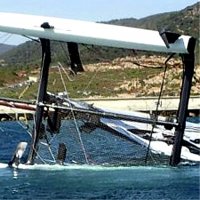
Foils. And broken wing. The starboard main foil lower area also appears secondhand. Was that the reason for the tip over?
 

Attachments

  • lunarosa5.jpg
    lunarosa5.jpg
    171.2 KB · Views: 645
34th AC

Foils. And broken wing. The starboard main foil lower area also appears secondhand. Was that the reason for the tip over?
------------------
Good one. Thats a hell of a lot of curve on those main foils. And you can see the planform of the rudder foil as well. This is history being made-it's like a race to see who can fly most reliably-very interesting. And they're changing what has been "known" about foils up until now!
And people bemoan that I don't like one design racing in 70' tri's and 65' monos. Think of all the development we may lose out on.......
This is history in fast forward-so cool!
 
Actually I don't think the cat is 33 feet long, maybe 28? And the main foils are lazy S, not C?

Gooday 'baggi' - Let's start - - QUIDS - for one of those in 'your' bay (of puss like people) or - that should be - AND - I'll have one over here as well.

You'd sure 'burn-up' Hamo & Airley regattas - this month - with one of them.

Nice hull shape - bow-flare - is what the 'A' class cats need (very soon - to stop nose diving) - - Nice (well aft) rocker & then run to transom - - 'main-beam' is well positioned aft & strong point-area pick-up for the c/b's - - - now the contradiction is; well-up on foils (10) - - good fore & aft balance (10) - - great boat speed (10) - - all that with the jib leech - curled back by at least 80mm for over 1/2 the length (minus 20).

Gary - Doug - Corley - Steve - Blunt'd - - how difficult is it - in total honesty - to design/build a set of 'S' foils - - I understand it's not like making a 'regular' set of c/b's BUT surely it's not 'aero-space stuff - is it really ???

There just - - MUST-BE some simple calculations - that one can use to come up with something - that works to at least 80% efficiency - Yes/No ???

Thanks guys, james
 
Is that starboard foil broken or not, maybe not. But check out the T rudder; doesn't seem to be the full T (if I'm seeing this correctly), like half a T on the outer side - to not impinge on overall beam restrictions?
Silver Raven, have only built curved L foils, have no experience with S.
 

Attachments

  • lunarosa6.jpg
    lunarosa6.jpg
    230.2 KB · Views: 470
...James-I'm not sure I fully understand "S" foils and the weird trunks they require.

You'd like to be able to change your foil configuration according to the wind conditions and whether you are sailing upwind or downwind. Induced drag is inversely proportional to the square of the span, and also inversely proportional to speed squared. So when you are going fast, the induced drag is lower and you can stand to have less span. When you are going upwind, you need more span in the vertical direction because of the higher side loads, and less span in the horizontal direction because more vertical lift isn't necessarily faster then.

The problem with a C foil is when you retract the foil to reduce the horizontal area, you lose vertical span. The S foil is basically a C foil with an added bit at the top so that when you push the board deeper, the recurve in the trunk makes it angle to a more vertical position so it acts more like a straight foil. That way you get a deeper, more vertical foil for upwind and a shorter, more horizontal foil for off the wind.

The trunks aren't that weird. You need a rotating bearing at the bottom, which typically means a torpedo-like fairing, and a bearing at the top. In between, the case needs to be wide enough to accommodate the curvature of the board between the two bearings.
 
34th AC

From Scuttlebutt last night:

HOW BEST TO WIN THE AMERICA'S CUP Emirates Team New Zealand Coach Rod Davis muses on the big debate as the
America's Cup action warms up with the appearance of the AC72...
----------------------------------------------------------------------
There is always a difference of opinion amongst challengers, defenders and
the sailing community in general on how best to win the America's Cup. In
fact I suspect the debate goes on within each team.

In the Blue corner are those who see an America's Cup campaign as an
academic challenge... almost like a science project.

Blue corner residents are very clinical in their approach. Do this and
that's the result. How do they know? Because the best science, in our case
the best software tools available, tells them so.

In the Red corner are the guys who think nothing is as straight forward as
that. They believe sailing/racing skill is the key to winning the Cup.

The Blue corner insists the fastest boat will win the America's Cup. While
history does not back up that statement completely, a fast boat is
essential.

The Blue corner believes the switch to catamarans for 2013 strengthens
their position. The pendulum swings away from the sailing side to the
design side every time the America's Cup changes the type of boat.

It's not one group versus the other as designers and engineers can be in
Red corner and a lot of sailors can be in the Blue camp. It is more of an
outlook in how best to win the Cup.

The Red corner's world is far from clinical. There are few tools that
anyone would trust. Trial and error are still the way to learn. Hours on
the water, practicing starts and tactical situations - and racing. Anything
and everything to make a team match fit.

Write a play book: when your competition does this, your defence is this.
Moves and counter moves. The problem is real life almost never mirrors the
playbook.
-- Read on:
http://etnzblog.com/#!2012/08/red-and-blue-different-ways-to-skin-a-cat
 
Forum posts represent the experience, opinion, and view of individual users. Boat Design Net does not necessarily endorse nor share the view of each individual post.
When making any potentially dangerous or financial decision, always employ and consult appropriate professionals. Your circumstances or experience may be different.

  • Back
    Top