High Tacker www.damsl.com
Re: masthead detail photos below
Hello Brian,
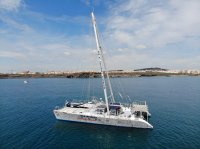
Not very much ever escaped ol' Malcolm Tennant's attention. See pics below for his solution to stresses at the masthead. Each leg of the A has a sizable plate welded to it at the top, and these two plates are then bolted together. Note that the bolts have advantage of being scattered over some considerable area. I forget exactly how long the plates are, something like 1.5 m. Note that they are quite long relative to mast fore and aft section length. Note also the outline of black, which is the edge of a thick rubber gasket between the two plates to allow flexibility for some motion. Also, the boltholes are slightly bigger than the bolts. Malcolm said that if there was no such allowance for motion, then there would be a problem, stress cracks developing and so on. I think Procyon's problem was that there was a rigid connection at the top.
Also, for flexibility at the other two corners of the triangle formed by A-frame and boat, the two legs of mast are stepped on pedestals, each pedestal on the corner of two very strong interior bulkheads (one fore and aft, one across). The masts actually are sitting in collars on stainless steel plates that are sitting on the pedestals with thick rubber gaskets providing flex between the plates and the pedestals, and the plates are through-bolted to chainplates on the interior bulkheads (that spreads the compression load, and can also take tension because theoretically one mast or the other could at times be in tension).
Another allowance for movement is that the bases of the masts have rocker, in other words, the base of each mast tube is cut in a slight curve, so that the masts can actually rock, tilting fore and aft within stainless collars welded onto the base plates and through which collars the masts are pinned athwart ship. Sorry I don't have photos of the mast bases handy, am still traveling. To sum up, there is flexibility at the top and at the bottom(s) of the A-frame.
To shape the plates at the masthead in the form of a bird, a profile of a catbird, was my idea. The catbird builds its nest in the highest tree around, is a predator who then swoops down on its prey. Hence the expression, to be "in the catbird seat" is to have a very big advantage, like, on top of the world. It is an American bird, and there is a famous James Thurber short story, "In the Catbird Seat". I took some liberties with its profile, gave it more of a hawk's curved beak, whereas a catbird actually has a straight beak. The boat herself has a suite of cabins and a suite of sails (all with pics of Catbirds on them), and she is my symphony, hence the name "Catbird Suite".