WishBone Sailing Rig

Hi Brian
I am looking into the feasibility of an "A" Frame mast on a 54' Trimaran. On entry #170 in WishBone Sailing Rig | Boat Design Net you have Photo and a short description, are they the same photo's at the end of the post? If not do you still have them?

Not sure you have the correct posting number there? I don't see the vessel you are asking about?

At one time I was very interested in this A-frame/wishbone concept, but in my talks with Randy West who skippered Procyon, I became aware the much attention needs to be paid to the masthead connection, PARTICULARLY if the base of these masts are rigidly connected to 2 different movable entities.

Randy,..
(oops I lost my place where I had his thoughts)

Have you looked thru this?
PROCYON project........a Bold experiment https://www.boatdesign.net/threads/procyon-project-a-bold-experiment.10771/


2) to make note that Procyon did experience some small problems with keeping the tips of those mast legs together (and that was on a monohull base structure compared to a multihull 'spread')

Alternatively have a look at these mast bases,..
High Tacker www.damsl.com

Re: masthead detail photos below

Hello Brian,

Not very much ever escaped ol' Malcolm Tennant's attention. See pics below for his solution to stresses at the masthead. Each leg of the A has a sizable plate welded to it at the top, and these two plates are then bolted together. Note that the bolts have advantage of being scattered over some considerable area. I forget exactly how long the plates are, something like 1.5 m. Note that they are quite long relative to mast fore and aft section length. Note also the outline of black, which is the edge of a thick rubber gasket between the two plates to allow flexibility for some motion. Also, the boltholes are slightly bigger than the bolts. Malcolm said that if there was no such allowance for motion, then there would be a problem, stress cracks developing and so on. I think Procyon's problem was that there was a rigid connection at the top.

Also, for flexibility at the other two corners of the triangle formed by A-frame and boat, the two legs of mast are stepped on pedestals, each pedestal on the corner of two very strong interior bulkheads (one fore and aft, one across). The masts actually are sitting in collars on stainless steel plates that are sitting on the pedestals with thick rubber gaskets providing flex between the plates and the pedestals, and the plates are through-bolted to chainplates on the interior bulkheads (that spreads the compression load, and can also take tension because theoretically one mast or the other could at times be in tension).

Another allowance for movement is that the bases of the masts have rocker, in other words, the base of each mast tube is cut in a slight curve, so that the masts can actually rock, tilting fore and aft within stainless collars welded onto the base plates and through which collars the masts are pinned athwart ship. Sorry I don't have photos of the mast bases handy, am still traveling. To sum up, there is flexibility at the top and at the bottom(s) of the A-frame.

To shape the plates at the masthead in the form of a bird, a profile of a catbird, was my idea. The catbird builds its nest in the highest tree around, is a predator who then swoops down on its prey. Hence the expression, to be "in the catbird seat" is to have a very big advantage, like, on top of the world. It is an American bird, and there is a famous James Thurber short story, "In the Catbird Seat". I took some liberties with its profile, gave it more of a hawk's curved beak, whereas a catbird actually has a straight beak. The boat herself has a suite of cabins and a suite of sails (all with pics of Catbirds on them), and she is my symphony, hence the name "Catbird Suite".

 
Last edited:
...posted over here,.. Multihull Structure Thoughts https://www.boatdesign.net/threads/multihull-structure-thoughts.62361/page-242#post-953100

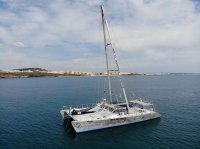
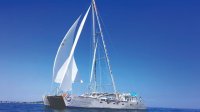
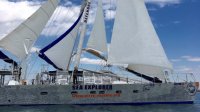
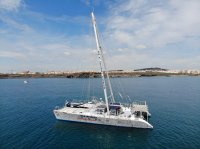
The following catamaran is used as a floating school, education tool about the marine environment. Sea Explorer plays a fundamental role in the Association Terre Marine Ecole de la Mer, which Franck and Bourguignon set up in 2014 to contribute to sustainability in the Mediterranean. They aim to engage the public toward greater understanding and enthusiasm for marine life and more responsible behaviour. In winter, the yacht is used for scientific research and educational film projects; in summer, it welcomes the public.

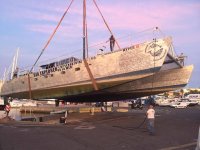
Michel Frank conceived this design with naval architect Nicolas Fauroux and structural designer Rivoyre Ingénierie. Micheal had the cat shell built by professionals in France in the Lerin Islands and then he and volunteers put in 38,000 hours to complete the cat from as many second hand and or recycled items that he could find. Many companies donated previous model equipment and left over building materials to help the build be completed. The cat was completed in 2017.

The cat is 79 x 37 foot with a “displacement” of 60,500 lbs. The 90 foot A frame aluminum masts carry up to 5 genoa’s of an unknow sail area. Michel has vast sailing experience and wanted an A Frame mast so that the mast connected directly to the crucial strong points of the boat, the hulls. This would allow the boat to remain light and strong. It also allowed a proper ladder and crows nest lookout points for spotting dolphins and whales.

The draft is 4.3 foot over the hull rudder and propellers. The hulls have a flat bottom for beaching and have no keels or boards for lateral resistance. The hulls were designed to be long and thin to provide the “lateral resistance’ like a Hobie 14/16. The engine power has 2 John Deere PowerTech™ 4045TFM85 engines with direct drives for port maneuvering and emergencies. For additional motoring the cat carries lithium batteries (54 kWh used EV car battery), battery management systems, 4 x 10kW electric motors and solar charge controllers with 25kW of solar panels. The intention is to power the cat by wind and solar with minimal fossil fuels.

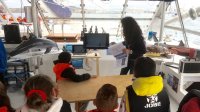
The accommodation is vast but the main cabin is used for education and a “lecture” hall. The catamaran is equipped with microscopes, underwater camera and aquariums covering 250 square meters (2700 square foot) spread over three decks. The hulls have the sleeping spaces, toilets and galley equipment.

The structure is basically aluminum. The multichine hull has a flat bottom and is a simple shape to build. The remaining wing deck and cabin structure is flat panels so its basically cut and weld. Simple fast shape. BUT like all big boats addition things like engines, winches, deck gear, plumbing, electrical lines etc take the same amount of time as any 79 foot cat. The reason the cat took 38,000 hours (18 years of 40 hour weeks) to build this cat. Also the comment about the A Frame mast reducing the loads and weight of the cat is only partial valid. At this size of cat to add some additional weight to strengthen the main mast carrying for a single mast is a minor addition.

The performance of the cat is moderate for 2 reasons. The owners have no reason to push the cat as it is an education tool and why sail hard with children on board who may get scared or seasick. Result the statement “typical sailing speeds of 5-7 knots”.

An interesting total concept and catamaran. The jpegs give the idea.

Attached Files:

Any updates on this vessel with its aft mast, AND its A-frame rig configuration??
 
Found myself reading back thru some of my old website, and this particular section here,..
Alternative Race Boat Design ,.... Alternative Race Boat Design https://www.runningtideyachts.com/race/

excerpt...
Could we adapt this rig to a downwind racing catamaran?? I would propose the following. There is now no need to rest the base of the mast (aft rig) on the front crossbeam, so lets look at alternative crossbeam arrangements. Wouldn't this very beamy cat be much stronger and more rigid if the crossbeams were configured in a "X" arrangement? Their angled attachment at the hull ends would likely prove superior in strength to the 90 degree arrangement, and most importantly, the cantilevered length of these highly stressed beams would be half that of a conventional arrangement. Very often one forgets the huge downward compression loads exerted on the front crossbeam by the towering wingmast and its rigging pulling at the mast like an arrow in a cocked bow; and this is intensified hugely as the boats pounds thru a sea; and all the while this beam must hold the boat together. It should prove interesting to closely inspect Club Med and Innovation Explorer in light of the front beam problems of Team Adventure.(* see note)

My forward raked mast exerts quite a bit of compression to its own aft bulkhead, so lets modify things a bit for the racing version....split the mast into an "A" arrangement and mount the two bases into each hull at the point of attachment of the rear "X" crossbeam(s). We've triangulated everything...much stronger for its weight. And we may have even simplified the spreader/rigging arrangements.
 
As I mentioned many times before , mast is only our attachment to tradition. Kites. What's is the reason use of surfing kites on heavy boats ? There's no other solutions? I like this wishbone mast .
 
I have reviewed a lot of the observations and precepts/opinions and most everyone is "correct". Paradoxically, the boat sails well mainly because the hull is a racing hull. So this will never be a popular boat. Slack bilges, close quarters below, and tight deck space - but what a beauty in the slings....
The wishbone legs are bowed (cleverly), and require pre-loading, if you will, by the shrouds at the mid-arc to keep them from springing (they are afterall bows of carbon/kevlar/plastic). The wires do the trick as designed. As such the bowlegs of this mast act as shroudmasts with the wires performing the role of the string on a bow, only this string is attached in the mid-arc.
Shortening sail does result in lee helm but not a lot. I have not yet been able to get it to heave to. Still working on it. Fore reaches fine.
Tension loading is "extreme" I suppose. I have bent the upper mast back a few inches to get high tension of the forestay. Replaced some turnbuckles on aft stays but they were not badly worn. Rig is heavier than I would have liked, but necessarily so for strength. Still not much different from standard Marconi with same sail area and probably a little less weight depending or reefing of the Marconi reefing system. This is all anecdotal from my yard experiments, mainly involving my back, which has been a reliable tool thus far.
Aero-hydrodynamically speaking, the thing works well. I did hang it in the yard but the scale was broken...
Very comfortable ride to wind and on a reach she goes. Ran into the harbor last week with 20 knots of wind doing 8 knots without much fuss. Keeping the staysail boom down is a problem. I like sharpieII's ideas and observations.
Many of the observations of the individuals are right on and I appreciate the spirit of the discussion, unlike so many forums on the web, this one seems to keep it neat and respectful. I appreciate that more the older I get.
This will not likely ever be a "popular" rig for many reasons but primarily because it requires a very lean hull to take advantage. Most people just want real estate below and on deck. I do feel safer on it than on the vintage open 60 however. I know this one will come back up...


I've gotten re-interested in this wishbone mast subject, and thought the owners observations needed hi-lighting again,....particularly his observations about the mid-arc attachments of the shrouds. I believe i have some older illustrations i made with this same arrangement.
 
Last edited:
I've gotten re-interested in this wishbone mast subject, and thought the owners observations needed hi-lighting again,....particularly his observations about the mid-arc attachments of the shrouds. I believe i have some older illustrations i made with this same arrangement.
Here are those images of my Wishbone Rig Alternatives

Variations on the Mast Aft Rig Concept

By now many of you readers are aware of my affinity for the mast aft or aft mast sailing rig concept. For the most part I am content with this being a singular mast column, stepped a little further aft on the vessel, and canted forward approx 10 degrees.

However, I’ve had more than a few people interested in alternative rigs ask about my rig and bi-podded rigs in the same questioning. Now, I was always enamored with bi-pod mast rig aboard Olaf Harken’s ‘Procyon’ vessel. And this wishbone shaped mast rig in my photo gallery also intrigued me.

So here I present some variations of the mast-aft rig configured with a wishbone/bipod mast column. There is a wide based version, and a narrow based one. And with each of these there are two different spreader arrangements that affect the very important cap shroud angle. Modern mast and rigging materials could very well make these unusual rigs a viable entity

Attached Files:

PS: Say we forget the canted forward version, and just think about a straight standing rig that has it feet stepped wee bit more forward, but still carries a roller furling mizzen sail rather than a big main like Procyon did.

Might make a very easy handled rig for cruising, and perhaps a very good one for my gamefishing design.
 
Last edited:
Forum posts represent the experience, opinion, and view of individual users. Boat Design Net does not necessarily endorse nor share the view of each individual post.
When making any potentially dangerous or financial decision, always employ and consult appropriate professionals. Your circumstances or experience may be different.

  • Back
    Top