What is wrong with a Junk rig

Sharpi,

I would quibble with your definition of a boomlet, but it isn't germain so let's just go with it.

One of the issues I see is that stiffness increases much faster than thickness of the span of a spar. So your boomlets at 1/8 the thckness of the boom don't have 1/8 the stiffness, but something on the order of 1/74 the stiffness. At best each boomlet needs to be about 1/2 the thickness of the original boom to retain 1/8 stiffness, and since stiffness not strength is what's important here that's our constraining factor.

I did mention that in my post. If I simply stopped there, the eight Boomlets would indeed weigh four times as much as the Boom they replaced. But this seems to be the part you don't get. Even if this were the case, the 1.20 lb Boom would be replaced with 4.8 lbs of Boomlets. So, subtracting the 1.2 lb Boom(which has been replaced) from the 4.8 lbs of Boomlets leads to a net 3.6 lbs of added weight. So now this new rig weighs 22.8 lbs instead of the original 19.2 lbs.

But I didn't stop there. Instead of planing one dimention down to 0.5 inch, I planed both dimensions down to 0.595 inches. Doing this gave me the same moment of inertia, but with a smaller sectional area, meaning a lighter Boomlet. So instead of weighing o.6 lbs each, they ended up weighing only 0.425 lbs each. 8 x 0.425 lbs = 3.4 lbs total. 3.4 lbs - 1.2 lbs = 2.2lbs. 19.2 lbs + 2.2 lbs = 21.4 lbs. And this is before I shortened the mast.


If we have 8 boomlets at 1/2 the thickness then in total we have used four times the amount of material. Worse much of that weight is high up the rig, subtracting from RM, and adding substantial loads to the mast. The extra compression loads from them need to be taken into account, requiring a heavier mast section to be use further reducing RM, and the mast weight itself adds to compression loads.[/QUOTE]

The additional load on the mast is significant but not all that substantial. Merely shortening the mast may more than make up for that.

The added weight aloft is certainly a real issue, which shouldn't be taken too lightly. Pun. But, as I have said in many posts, good cruising boats are considerably different than good racing ones. Weigh aloft robs performance long before it steals safety. It also adds rolling inertia, which lengthens the roll period, but also makes for a far more gentle roll.

Racing sailors are like athletes. Some actually are athletes. Discomfort, for the sake of potentially race winning performance, is a sacrifice they must learn to live with. Not at all true with cruising sailors. In fact, a more comfortable boat often ends up being a safer one, as the crew ends up less exhausted. I've even heard of slower boats reaching their destination sooner than faster ones, due to this factor.
 
Chinese Lug Weight.

Hi Skyak.

Before I get into my relatively lengthy investigation, I’d like to nail down some nomenclature, as to what is the difference between a “Batten” and a “Boomlet”.

Both Battens and Boomlets stiffen a sail, so that definition is out.

Battens and Boomlets both can be used to increase the Sail Area (SA) set within Mast and Boom, or within Mast, Boom and Yard (or Gaff), so that definition is out.

So this is what I came up with:

A Boomlet, which is long enough to span the greatest width of a sail (from Luff to Leech), must be stiff enough to be set on two saw horses, which are at least 90% of that Boomlet’s length apart, without bending enough to fall through.

This test might be too easy, but I believe it creates a sharp distinction.

Now on to my investigation..

It is based on simple Beam theory.

To explain it in simple enough terms, I’ll create hypothetical sail, with two versions.
The first will be a Balanced Lug (BL). The second will be A Chinese Lug (CL).

Since this hypothetical sail is to determine the relative weight difference between the two, I will follow the same material and section shape rules for both versions. Here are the rules:

1.) Spars are to be made of Douglas Fir,
2.) Spars are to be solid,
3.) Spars are not to be tapered at the ends, and
4.) Spars are top be square in section.

Both sails will be rather crude in construction to keep the construction labor to a minimum.

Now for the dimensions:

1.) Yard, Boom and Boomlets will be 5.0 ft long.
2.) Yard will be at a 1:1 pitch.
3.) The distance between the Boom and the front end of the yard (the Hoist) will be 10 ft.

The BL version of this sail will be approximately 51.5 sf. The CL will be the same. It’s hoist will be adjusted to produce the same Sail Area, so its mast will be a bit shorter, because the equal length Boomlets will create a slight roach.

The needed stiffness of the spars is based on the maximum righting moment of the boat.

Since we have no boat here, let’s assume that it was discovered that 1.0 inch square was sufficient section for both the Boom and the yard, for the BL version. These 5 ft spars would weigh approximately 1.20 lbs each.

The mast section will likely be 2.0 inches square or more, due to its great length (approximately 15 ft). For the sake of this argument, we will put it at 2.0 inches square, so it will weigh about 15 lbs.

So the total weight of all three spars will be about 17.4 lbs. The sail cloth will weigh about 0.75 lbs, including re-enforcement patches. Add another lb for the halyard, down haul, and a sheet line, and the all up weight comes to a little over 19 lbs. No one would ever accuse this rig of being weight efficient. With tapering (not allowed in this case) the rig might weigh a little under 16 lbs, still no feather weight.

Now let’s convert this to a CL.

To do this, lets divide the sail into eight panels, which will require one Yard and Eight Boomlets, for a total of ten spars, including the mast.

These Boomlets will be splayed, so that the 45 deg. angle, between the lowest Boomlet and the Yard, will be divided by eight, giving 5 to 6 degrees for each of the seven middle Boomlets. Fortunately, this is a whole lot easier to do than it sounds.

Now, we will assume that each Boomlet will have its own Sheetlet.

This is where the math comes in.

Since each Boomlet effectively has its own sheet, the bending load on each can be divided by eight, so it would seem that each Boomlet can have one eighth the sectional area as the old Boom, on the BL sail.

But this is clearly not the case. This because the stiffness of a beam is governed by its elasticity multiplied by its inertia, and limited by its material breaking strength.

The formula for inertia, for a rectangular section is:

I = w(d^3)/12

“w” = width and “d” = depth, and “d” always faces the load.
What this boils down to is that, with one eight the distributed load, we need to find the cube root to 0.125, or one eighth.

This works out to be 0.50, so our Boomlets will be 0.50 inch x 1.0 inch and will therefore weigh in at about 0.60 lbs each. But we can do better by complying with my rules and insisting on a square section. Doing this, I come up with a Boomlet which is 0.595 inch square. This now comes to 0.425 lbs per Boomlet, which is far better than 0.60 lbs, with the rectangular section.

So, with eight of them we will end up with 3.4 lbs - 1.2 lbs (for the old Boom), or 2.0 lbs more weight for the Boomlets.

The Yard will have the same duties it had before, so will probably remain unchanged.

But now, because the roach created from the Boomlets adds some SA, we can shorten the hoist of the mast to make up for this. The roach will add about 13% more SA, so the 10 ft Hoist can be shortened to about 8.8 ft.

Hmm. At about 1.0 lb a foot, this subtracts 1.2 lbs from the rig, which leaves only 0.80 lbs of additional weight. So this turns a 19 lb rig into an 19.8 lb one, an increase of less than 5%.

This kind of makes me wonder what Tom Colvin was talking about when he said a CL rig weighed four times as much as a Gaff one.

Now that I look at this, I see most of the weight coming from the mast. With a Gaff rig, you can have a system of stays and shrouds to help support the mast, so maybe the mast could be lighter. But there is no reason you couldn’t do that with this rig.

Another error I may have made here is that this rig is quite tall, with a 15 ft mast only netting 51.5 sf of SA. With a shorter Mast, the Yard and Boomlets would have to be longer, to get the same SA, so would have to be bigger in section. Still, it doesn’t seem to add up to four times the weight. I wish I still had the book I read this from.

I do remember him saying that the Yard on a CL had to be relatively massive, in order to carry the weight of the Boomlets without drooping. Perhaps he was just talking about the weight of the sail itself and counting the Boomlets as part of it.

The reasons your exercise does not conform to my 'proof'
-assuming solid constant section mast -just wrong, tapered at least, prefer hollow. The lug mast will have to be thicker to support the higher compression of the lug with the sail downwind of the mast.
-assuming a classic chinese junk with a yard equal to your lug (well then yes it will be hard to make up the weight elsewhere) -I specified an elliptical planform that can use thin battens of declining length all the way up. The reason they can be so thin is that they are supported at the mast and the sheetlet. By comparison the lug yard must be thick because it is a beam in bending from the hoist to the leach which takes a huge force to hold flat.
-the last point is I specified an equal safety factor to size components vs your guestimate. If you put the stress of an elliptical load distribution (proper trim) at design load of about 1psf you find that the lug you specified deflects too much to hold shape.

I will do a sketch if I get the chance.
 
The reasons your exercise does not conform to my 'proof'
-assuming solid constant section mast -just wrong, tapered at least, prefer hollow. The lug mast will have to be thicker to support the higher compression of the lug with the sail downwind of the mast.

I only specified such to make the math simpler. Off course, with a real rig, the spars would be tapered. But I think the tapering, or even hollowing out, would confer an advantage to neither rig, so I chose to ignore it. You may be correct on your second point, as the Yard and single Boom, on the Balanced Lug (BL) give the Mast just two point loads, where the multiple Boomlets add several, distributed along the length of the Mast. Weight wise, the results of this experiment were a complete surprise to me. I expected the Chinese Lug (CL) to end up considerably heavier. It didn't. From my own data, as well as the excellent point you made here, the weight advantage could end up with either rig. And if it does it should be relatively modest.

-assuming a classic chinese junk with a yard equal to your lug (well then yes it will be hard to make up the weight elsewhere) -I specified an elliptical planform that can use thin battens of declining length all the way up.

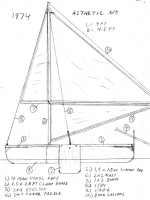
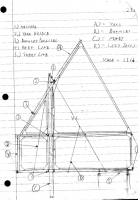
But is such really a CL? I think not. Instead, I would call it a Chinese Lug-oid, in that it has some of the properties of a CL, but makes a major design departure. To be fair, I'd have to be allowed to do the same with a BL, creating what I will call a Balanced Lug-oid. Like your proposed sail, it would not have a yard. In fact, I once made a sail like that (see attachment) to power an inflatable raft. The sail worked splendidly. It outsailed a boat with a Bermuda Rig, with both boats being about the same size, and bothe rigs having roughly the same SA. This was despite the fact that the other boat had dacron sails, and mine were made out polyethylene.

The reason they can be so thin is that they are supported at the mast and the sheetlet. By comparison the lug yard must be thick because it is a beam in bending from the hoist to the leach which takes a huge force to hold flat.

Gerally, BL luffs are not held straight. There is a considerable catanary in them to leeward. But due to the longer Leech, there is more in the Leech.

-the last point is I specified an equal safety factor to size components vs your guestimate. If you put the stress of an elliptical load distribution (proper trim) at design load of about 1psf you find that the lug you specified deflects too much to hold shape.

I will do a sketch if I get the chance.

This has been an interesting discussion.
 

Attachments

  • AsthNo2.png
    AsthNo2.png
    86.8 KB · Views: 695
This has been an interesting discussion.

For the record, I never said 'Chinese' junk. I don't have the time or inclination to argue history. Of course you must have the opportunity to modify and optimise the lug. My motivation is to teach and learn not 'win'. The interesting point will be -does your modified lug have to become the modified junk? or take most if not all it's attributes? If you think about some dramatic picture of a lug sailboat in a blow -is the boom bending like crazy? Is the yard bent and straining despite the sail being obviously over twisted? You can 'see' the flaws just thinking about it.

I can't say I thought of the elliptical junk before I saw Petro do it on a boat he built in two days.

I am not sure what to make of your sketch. Sort of a balanced leg-o-mutin? Or an aero rig with an undermain? Or a poor mans windsurf rig. It gets me thinking about wanting to do a sail rig that can fold quickly to just a stick.
 
The interesting point will be -does your modified lug have to become the modified junk? or take most if not all it's attributes?

I can't say I understand your question. But I think I get the drift. Even full length Battens do a great deal to stabilize a sail an keep it from Flogging. I only made the point I made to show there is always a weight penalty for adding things like this to a sail. The weight penalty may not be over all weight, as I once though, but top hamper. But the benefits may be worth it. Boomlets hold the sail cloth straight, and because of the Boomlets above and below, can not be bent up or down. With a "Single Membrane Sail" such as Balanced Lug, there is only one Boom, along with the yard. These are free to bend toward each other, so the sail-maker can cut a curved edge in the sail for each. The advantage here is this allows some control of the camber of the sail. If the wind increases, the down haul on the Boom can be tightened. This would cause the Yard and the Boom to bend towards each other in such a way as to take the camber out of the sail, making it much flatter. Even the catenary loads on the Luff and Leach can have this affect. With a CL or any other multiple membrane sail, what ever camber is built into the membrane panels is the camber you get. It does not change, unless the membrane stretches. I don't see this a necessarily a bad thing. I've designed multi-membrane sails of my own (see attachment)

If you think about some dramatic picture of a lug sailboat in a blow -is the boom bending like crazy? Is the yard bent and straining despite the sail being obviously over twisted? You can 'see' the flaws just thinking about it.

No. Not really. The Boom and Yard are engineered to the max righting moment of the boat. So, before the sail bends out of controlability, the boat is heeled onto its Beam ends.

I can't say I thought of the elliptical junk before I saw Petro do it on a boat he built in two days.

I am not sure what to make of your sketch. Sort of a balanced leg-o-mutin?

I never even heard of an aero rig, when I designed and built this sail. So you could call it a Balanced Bermuda rig, with an under-sail. The "undersail" proved to be a bit of a joke, so was omitted in later designs.

Or an aero rig with an undermain? Or a poor mans windsurf rig. It gets me thinking about wanting to do a sail rig that can fold quickly to just a stick.

You could consider a Boomless Bermuda, flat cut. It would handily wrap around the mast, and could even be reefed this way. Probably the best fold up sail would be the sprit sail, as you get a lot more sail per given length of mast. Very popular for 19th century work boats for this reason.
 

Attachments

  • Rig.png
    Rig.png
    93.8 KB · Views: 646
Who knows the ratio formula for size of junk sail to hull. If i have a 48’ steel roberts, with a bilge keel, what sail power will i need?
 
Hi, Andrewski. Welcome to the forum.

A simple if not over simplified answer to your question is the formula:

((vol.) ^O. 667)*12 to 18

"vol." is the total weight of the boat divided by the weight of a cubic unit of sea water.

Since you described the boat in feet, you will use cubic feet. Sea water weighs 64 lbs per cubic foot. So you devide the weight of your boat in pounds by 64 to get the vol.

You then raise this number to the O. 667 power. After this, you multiply it by 12 to 18.

This will give you an approximation. The actual number will be influenced greatly by the hull type, the rig choice, and the number of and skill of the crew.

Wide hulls with hard bilges, for example, can carry more sail than narrow deep ones with soft bilges, if they have the same amount of ballast.

Tall rigs are more efficient. Shorter ones are safer in knock-down situations, such as sudden shifting gusts.

But if you stay within the 12 to 18 range, you probably won't be far from the truth.

More sail can be easily handled on a rig with three or more sails than one with just one or two, with the same level of sail handling equipment, such as winches an roller-furling gear.
 
I sailed a 18' Prindle for years. It had an fractional sloop rigging w/ a full battened sail, one could adjust the tension on each batten giving the sail the desired shape. Tacking in a lightest of breazze I could give the boom a quick tug to move the foil to the windward side, it would make a kind of low tone snap as all the battens moved to the opposite side.
A junk rigging could have the same unfortunate turn of events as a gaff rig and end up with the top and bottom of the sail in opposite sides of the mast in heavy unstable air.
 
Forum posts represent the experience, opinion, and view of individual users. Boat Design Net does not necessarily endorse nor share the view of each individual post.
When making any potentially dangerous or financial decision, always employ and consult appropriate professionals. Your circumstances or experience may be different.

  • Back
    Top