Chinese Lug Weight.
Hi Skyak.
Before I get into my relatively lengthy investigation, I’d like to nail down some nomenclature, as to what is the difference between a “Batten” and a “Boomlet”.
Both Battens and Boomlets stiffen a sail, so that definition is out.
Battens and Boomlets both can be used to increase the Sail Area (SA) set within Mast and Boom, or within Mast, Boom and Yard (or Gaff), so that definition is out.
So this is what I came up with:
A Boomlet, which is long enough to span the greatest width of a sail (from Luff to Leech), must be stiff enough to be set on two saw horses, which are at least 90% of that Boomlet’s length apart, without bending enough to fall through.
This test might be too easy, but I believe it creates a sharp distinction.
Now on to my investigation..
It is based on simple Beam theory.
To explain it in simple enough terms, I’ll create hypothetical sail, with two versions.
The first will be a Balanced Lug (BL). The second will be A Chinese Lug (CL).
Since this hypothetical sail is to determine the relative weight difference between the two, I will follow the same material and section shape rules for both versions. Here are the rules:
1.) Spars are to be made of Douglas Fir,
2.) Spars are to be solid,
3.) Spars are not to be tapered at the ends, and
4.) Spars are top be square in section.
Both sails will be rather crude in construction to keep the construction labor to a minimum.
Now for the dimensions:
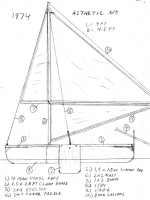
1.) Yard, Boom and Boomlets will be 5.0 ft long.
2.) Yard will be at a 1:1 pitch.
3.) The distance between the Boom and the front end of the yard (the Hoist) will be 10 ft.
The BL version of this sail will be approximately 51.5 sf. The CL will be the same. It’s hoist will be adjusted to produce the same Sail Area, so its mast will be a bit shorter, because the equal length Boomlets will create a slight roach.
The needed stiffness of the spars is based on the maximum righting moment of the boat.
Since we have no boat here, let’s assume that it was discovered that 1.0 inch square was sufficient section for both the Boom and the yard, for the BL version. These 5 ft spars would weigh approximately 1.20 lbs each.
The mast section will likely be 2.0 inches square or more, due to its great length (approximately 15 ft). For the sake of this argument, we will put it at 2.0 inches square, so it will weigh about 15 lbs.
So the total weight of all three spars will be about 17.4 lbs. The sail cloth will weigh about 0.75 lbs, including re-enforcement patches. Add another lb for the halyard, down haul, and a sheet line, and the all up weight comes to a little over 19 lbs. No one would ever accuse this rig of being weight efficient. With tapering (not allowed in this case) the rig might weigh a little under 16 lbs, still no feather weight.
Now let’s convert this to a CL.
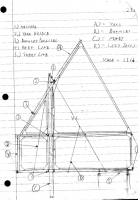
To do this, lets divide the sail into eight panels, which will require one Yard and Eight Boomlets, for a total of ten spars, including the mast.
These Boomlets will be splayed, so that the 45 deg. angle, between the lowest Boomlet and the Yard, will be divided by eight, giving 5 to 6 degrees for each of the seven middle Boomlets. Fortunately, this is a whole lot easier to do than it sounds.
Now, we will assume that each Boomlet will have its own Sheetlet.
This is where the math comes in.
Since each Boomlet effectively has its own sheet, the bending load on each can be divided by eight, so it would seem that each Boomlet can have one eighth the sectional area as the old Boom, on the BL sail.
But this is clearly not the case. This because the stiffness of a beam is governed by its elasticity multiplied by its inertia, and limited by its material breaking strength.
The formula for inertia, for a rectangular section is:
I = w(d^3)/12
“w” = width and “d” = depth, and “d” always faces the load.
What this boils down to is that, with one eight the distributed load, we need to find the cube root to 0.125, or one eighth.
This works out to be 0.50, so our Boomlets will be 0.50 inch x 1.0 inch and will therefore weigh in at about 0.60 lbs each. But we can do better by complying with my rules and insisting on a square section. Doing this, I come up with a Boomlet which is 0.595 inch square. This now comes to 0.425 lbs per Boomlet, which is far better than 0.60 lbs, with the rectangular section.
So, with eight of them we will end up with 3.4 lbs - 1.2 lbs (for the old Boom), or 2.0 lbs more weight for the Boomlets.
The Yard will have the same duties it had before, so will probably remain unchanged.
But now, because the roach created from the Boomlets adds some SA, we can shorten the hoist of the mast to make up for this. The roach will add about 13% more SA, so the 10 ft Hoist can be shortened to about 8.8 ft.
Hmm. At about 1.0 lb a foot, this subtracts 1.2 lbs from the rig, which leaves only 0.80 lbs of additional weight. So this turns a 19 lb rig into an 19.8 lb one, an increase of less than 5%.
This kind of makes me wonder what Tom Colvin was talking about when he said a CL rig weighed four times as much as a Gaff one.
Now that I look at this, I see most of the weight coming from the mast. With a Gaff rig, you can have a system of stays and shrouds to help support the mast, so maybe the mast could be lighter. But there is no reason you couldn’t do that with this rig.
Another error I may have made here is that this rig is quite tall, with a 15 ft mast only netting 51.5 sf of SA. With a shorter Mast, the Yard and Boomlets would have to be longer, to get the same SA, so would have to be bigger in section. Still, it doesn’t seem to add up to four times the weight. I wish I still had the book I read this from.
I do remember him saying that the Yard on a CL had to be relatively massive, in order to carry the weight of the Boomlets without drooping. Perhaps he was just talking about the weight of the sail itself and counting the Boomlets as part of it.