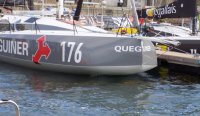
I am interested on scow
I would not put it like that. What you say is what pushes me: the two most sold sailing dinghies are Mirror end Optimist, both scow bowed (or pram bowed if you prefer).
The S.C.A.M.P. is scow bowed too. The OZ goose, the Brick. There are many scows that proved to be effective.
I wander if and how this shape could be used also in bigger vessels. Is it just a problem of look or what?
As I understand it, the Mirror was designed with a pram bow because it's easier to build in ply than a stem. The pram/scow also gives more stability than a normal bow for the length, but I think most of those boats were built to a design dictated by length, such as being able to be built with one sheet of ply. I started sailing on an 8'6" pram, the Manly Junior, which was a snub bow so that it could be stored on-end inside a clubhouse about 8'8" high.
I've just been trying to get Optis going in my club, which is another indication that I'm not against prams or scows as such. The kids don't like them, sadly, because of their bow so we may have to go to O'pens instead, which aren't my idea of a good hull shape.
While Optis, Mirrors etc are great boats, whether they show that a scow cruiser is an optimal design is an open question. The pram bows hit waves but because of their small size and low speed it's not like a big boat hitting waves. The prams also don't normally sail heeled like a Mini scow does.
I admit I don't like the looks of the Mini and Open 40 scows at all, despite the fact that I grew up on a pram/scow and my own first boat was a scow Moth. But the main thing is that most of the reasons given for the modern scow designs seem to be related to creating a faster boat within specific class restrictions and that may not mean a better boat per se.
I'm also interested in the way the design spiral works, and the way we define and measure boat sizes, and both those issues are related to the issue of scow v "normal" boat.