Advantages of the mast-aft rig
I've been interested in this design for a while. Here are some sites for anyone wishing to look into it further.
http://boatdesign.net/articles/mast-aft-sailing-rig/
http://www.runningtideyachts.com/monohull/
http://www.barefootsworld.net/windwalker/aftmastsailingcalc.html
I believe that sometime in the next few years someone is going to show up at a big-name race with a boat with a mast-aft rig, probably with an aluminum hull and carbon-fiber mast. At that point we’ll start seeing them everywhere, especially if they perform well. We've seen more radical developments than this in the last few decades.
Of course, the real advantages of the design aren’t so apparent against spare-no-expense racing yachts, with their rotating, aerodynamic, hydraulically-tuned masts and olympic athlete crews. For more modest boats, however, the benefits are more readily apparent.
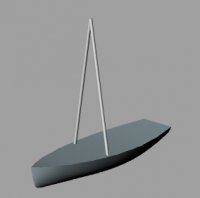
The mast-aft rig designs I’ve found online are monohulls or cats with the mast placed just in front of the cockpit, at about 2/3 of the LWL, canted forward 10 deg. and hinged to fold down for clearing bridges. They use anywhere from 2 to 5 sails. Typically a masthead genoa is used with a standard jib, sometimes with a fore staysail and/or mizzen.
Anyone taken aback by the idea of a canted mast should take a look at some pictures of clipper ships like the Flying Cloud - now there's some canted masts!
Advantages of the mast-aft rig
(cribbed from one of the sites above)
1) A rig that – is more aerodynamically efficient, enabling more speed with the same sail area and using a shorter mast.
2) – delivers an aerodynamically clean, parallel leading edge for all the sails.
3) – allows the whole sail plan to be roller-furled away.
4) – allows the furling of the sails without turning to weather.
5) – divides up the total sail area into smaller manageable sizes.
6) – maintains its balance center (CE) with different sail combinations.
7) – produces less heeling moments due to a lower center of effort.
8) – can be operated single-handed without leaving the cockpit. All the sails self-tack. The genoa and jib need to be tacked over past the forestays, which can be done quickly with roller furling from the cockpit.
9) – has the leech of all the sails operating clear of the mast, spreaders and shrouds, allowing sheeting for optimal performance of each sail, and eliminating spreader wear.
10) – simplifies rigging by eliminating mast track, slides, and mainsail boom with all its rigging and hardware, and the lubber's bane - an accidental gybe.