

Herman
Senior Member
- Joined
- Oct 20, 2004
- Posts
- 1,618
- Reaction score
- 94
- Location
- The Netherlands
JamesUk said:The floor grid of a Bavaria Match is bonded to the internal surface of the hull. The problem is the thickness amd area of the bonding, the pictures show cracks developing at the 90 degree turn from hull to the vertical face of the frames.
The J&J spec modification increases the area of the bonding by about 70% and the thickness of the bonding by 300%.
Bavaria should have increased it already during construction. Also, akeel laminate that thin will flex, and eventually wick itself loose from the frames. No matter how strong those frames are.
Two months ago the magazine Yachting World published a sequence of photos showing the steps of the reinforcement to a Bavaria Match. The pictures and text confirm the whole area of the bilge is cut back with an angle grinder including the inner hull surface and the side of the support frames.
Again, Bavaria should have sanded the inner hull before installing frames. You just cannot rely on chemical bonding to take place, especcially with DCPD resins.
In the 2004 ARC (transatlantic) there were about 18 Beneteaus, 13 Bavarias and 10 Hallberg Rasseys. Doesn’t sailing across the Atlantic count as real sailing in your book?
Of course that counts. But compared to the numbers of boats that are sold, Bavaria boats were in a sheer minority.
The modifications that are done right now to the 42 will definately improve the situation. I just hope that the problems will not be transferred to the next reinforcement. (transition from stiff area to a more flexible area).
About the picture of your boat: It is not a 42. Compare your situation to the pictures of the 42. See the difference? But do you also see your keel bolt, with just the washer? (of course i cannot see the rest, so can't judge too much.) but definately your structure seems to look a lot more solid than the 42.
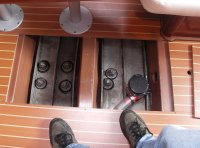


 . However the boat must have to pass the tests, for certification (in thre EU).


