6m low power (10 hp) cat

Manfred, if you drew a line down the centerline of each hull and removed anything on the inboard side, leaving them as a straight line, What would the wave flow in the picture above be changed to?

There would be a reduction of red colour between the hulls - of course. But you can inform yourself:

http://www.boatdesign.net/forums/multihulls/assymetric-cat-hulls-26826-4.html

http://www.hysucat.com/wp-content/u...Builder-Hysucat-and-Hydrofoils.compressed.pdf

http://www.icmrt07.unina.it/Proceedings/Papers/A/34.pdf

http://iptek.its.ac.id/index.php/jts/article/viewFile/90/84
 
May be this pic is better: http://www.panix.com/~brosen/catamarans.html

26938561zk.jpg
 
What is causing that heavy V shaped spray off the outboard leg? Prop too shallow?
 
What is causing that heavy V shaped spray off the outboard leg? Prop too shallow?

Jim, I do not know it exactly but I suppose two reasons for it. First there is the interference of the two bow waves which meet another under the bridge deck. This turbulent amount seems to hit the round shaft of the outboard motor and creates the double fountain. Please compare: https://www.youtube.com/watch?v=PMdIVN-HPT4
I would move the motor foreward of the bow wave crossing and make an obm fairing: http://homepages.paradise.net.nz/garyd/outboard.html or: http://speedfairing.com/index.html ; http://speedfairing.com/technical-data.html .
 
Might be bow wave interference, but the leg is streamlined.
 
Might be bow wave interference, but the leg is streamlined.
Yes, the shaft seems to be well shaped. But I could not see much of the motor from the vid. It is hiding more than it really shows.
 
Last edited:
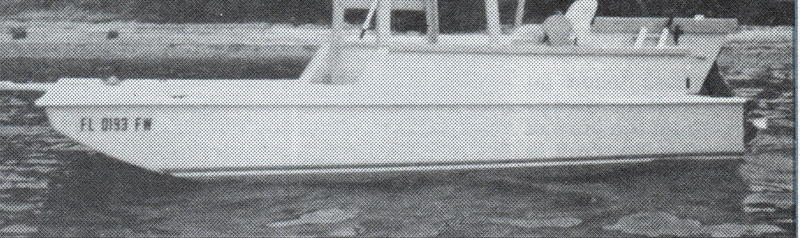
In MULTIHULLS, March/April 1990, I've found the "Kek-Kat" tunnel hull planing design which represents a totally different approach and a different opinion of the wave interference between the hulls. (16 ft, 850 lbs incl. engine)

27051764jp.jpg


The designer J.M.Koeck wrote:

"The "Keck-Kat is designed with ligth weight construction in mind, yet engineered to withstand high stressloads that are created by speed and moderate wave action. The traditional V-hull design pushes the water out from the center of the craft, whereas the Kek-Kats tunnel hull pushes the water to the center of the craft where the engine is mounted. Since this creates a swell, the propeller does not extend into the water as deep as with the V-hull designs. That is the secret to its shallow draft performance. She needs only 12" of water. As the speed increases, the lightweight construction and the aerodynamics of the tunnel hulls create very little drag. Depending of the engine size (40-100 hp), you can have a high top end for the performance enthusiast. Tunnel hull design is a proven concept, most offshore ocean racing records...."


27052230eo.jpg
 
Forum posts represent the experience, opinion, and view of individual users. Boat Design Net does not necessarily endorse nor share the view of each individual post.
When making any potentially dangerous or financial decision, always employ and consult appropriate professionals. Your circumstances or experience may be different.

  • Back
    Top