34th America's Cup: multihulls!

I think the sketch shows it so Gary will just have to para drop Sid to get the photos. I'm thinking they'd be fast around the island only if they made it through the tight spots.
 
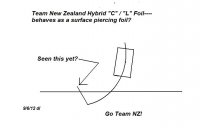
Doug and other foil nuts,

A curved dagger foil with L tip matching your sketch could have several different "lift distribution" profiles.

Choice A: Curved section and straight section (bottom of L) both have positive AOA and produce vertical lift. Due to canting angles, the straight portion provides WRONG direction side force and the curved section must produce enough correct direction side force for both the Wing/sail side force and the foil straight section side force.

Choice B: Curved section has positive AOA and produces vertical lift. Straight section has negative AOA and pulls down. Due to canting angles, both provide correct direction side force. Sounds like it would be hard to fly both hulls like this unless the straight section is actually pretty close to vertical.

Choice C: Straight portion is more of an end plate with neutral AOA.

Choice D: We are all dummies and this thing does somenthing really hard to out guess.

Flad, the two asymmetric foil sections can be built so that the lifting curved upper shapes will combine to do the correct job, lift up at near 45 degrees while the main greater asymmetric part has the flat side outwards, curve facing in - so that makes lift and anti-leeway correct. The L part has the curved area facing out from platform so that is providing lift upwards at something like 45 ... and also to leeward ... which may be counted by the main foil. The angle of attack can be altered by just slight movement fore and aft at foil bearing top.
I know nothing but I think the shallow V is making the monster very steady in flight.
Here is one of a number of foil setups I had on Groucho. The difference to NZilla's is that the main foil section faces out and the lower L part faces down and in. But it is similar but reversed - if that makes sense.
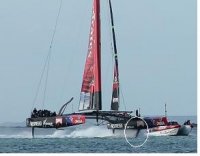
Also, peering at the marvelous photographs I think Doug's drawing has the main foil too angled, it may be more vertical and therefore the L part is flatter.
We need a spy stowaway on board, camera pointing at main foils; any volunteers.
 

Attachments

  • Copy of IMG_1277.JPG
    Copy of IMG_1277.JPG
    318.6 KB · Views: 507

Attachments

  • AC 72 TNZ surface piercing foil.jpg
    AC 72 TNZ surface piercing foil.jpg
    10.8 KB · Views: 2,258
  • AC 72 Team NZ  foil config based on 9-6-12 video.jpg
    AC 72 Team NZ foil config based on 9-6-12 video.jpg
    22.4 KB · Views: 3,181
  • AC 72 tnz  9-7-12.jpg
    AC 72 tnz 9-7-12.jpg
    41 KB · Views: 734
From Sail-World.com:

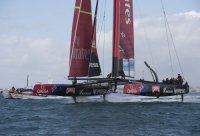
"In a media release issued nine days after images were first released on the interweb of their AC72 on foils, by photographer Graeme Swan, Emirates Team NZ have conceded their AC72 'can foil sailing downwind in a moderate breeze.' The photos were published in Sail-World last Monday, with a further set published on Thursday, and again on Friday morning.

They have questioned as to whether foiling can be sustained safely on the short America’s Cup courses.

Emirates Team New Zealand Grant Dalton said in the release issued late Friday afternoon NZT that all the teams will be testing foil design.

'The thrust of our testing is to determine if foils enhance performance overall. How will they affect upwind speed? Might that nullify any downwind gain?

'In addition, the effect on boat-handling in upper wind ranges needs to be assessed carefully.

'There is a tendency for the boat to dig in when it is bearing away and the placement of the dagger foils and their shape has a marked effect on this.

'Foiling is only part of the equation. Right now we see as many negatives as positives.' The release concluded. "
 
The next Kiwi boat may have the foils further forward (or maybe they'll make an operation, because no. 1 has already shown to be a "revelation-ary" success) - shift foils forward like the now ancient amateur designed foilers and the French 60,70, 100 and plus foot race designs. Look at what Coville has recently done shifting foils and beam on Sodebo, (which survived terrifying headstands with the foils in the further aft position last year).
Although a forward shift will slow, or halt, bow bury on NZilla, they'll end up with some weather helm ... which is not such a problem on a spread out multihull platform compared to the narrowness of a mono, doesn't apply the same, but it will be there. Rudders will have to be deeper to compensate. Just conjecture.
The speed of NZilla foiler, even at this early stage, (will they reach 50 knots?) is going to make a mockery of what now appears to be a too short a race course - either the course will have to be changed, enlarged (will still take them only minutes to complete) ... or they're going to have to detune NZilla. The latter might appeal to the other teams, especially Batship - which might be undertaking extreme and radical modifications ... or perhaps even a complete rebuild?
Nah, not defecation stirring, no.

 
The next Kiwi boat may have the foils further forward (or maybe they'll make an operation, because no. 1 has already shown to be a "revelation-ary" success) - shift foils forward like the now ancient amateur designed foilers and the French 60,70, 100 and plus foot race designs. Look at what Coville has recently done shifting foils and beam on Sodebo, (which survived terrifying headstands with the foils in the further aft position last year).
Although a forward shift will slow, or halt, bow bury on NZilla, they'll end up with some weather helm ... which is not such a problem on a spread out multihull platform compared to the narrowness of a mono, doesn't apply the same, but it will be there. Rudders will have to be deeper to compensate. Just conjecture.
The speed of NZilla foiler, even at this early stage, (will they reach 50 knots?) is going to make a mockery of what now appears too be a too short a race course - either the course will have to be changed, enlarged (will still take them only minutes to complete) ... or they're going to have to detune NZilla. The latter might appeal to the other teams, especially Batship - which might be undertaking extreme and radical modifications ... or perhaps even a complete rebuild?
Nah, not defecation stirring, no.
================
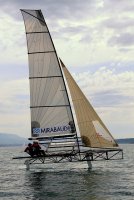
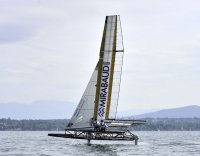
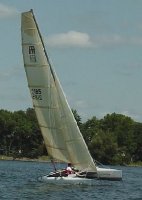
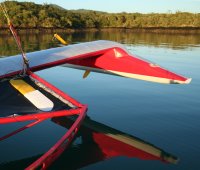
Gary, Bill Roberts showed with the Arc 21 cat that daggerboards can be moved forward w/o negatively affecting balance by paying attention to rudder and daggerboard area. Thomas Jundt proved the same thing on Mirabaud. I doubt weather helm would be any problem at all on a properly designed system which we all know TNZ will do!
Arc 21 shared lift: http://www.aquarius-sail.com/catamarans/arc21/index.htm

Pictures: 1 & 2 Mirabaud foiler with daggerboard forward of mast, 3) Arc 21 designed by Bill Roberts with daggerboard forward of the front beam using his concept of "shared lift".
 

Attachments

  • Mirabaud 2 from website.jpg
    Mirabaud 2 from website.jpg
    140.6 KB · Views: 719
  • mirabaud may 12.jpg
    mirabaud may 12.jpg
    63.2 KB · Views: 630
  • Arc 21 catamaran dgr fwd of beam-shared lift bill roberts.jpg
    Arc 21 catamaran dgr fwd of beam-shared lift bill roberts.jpg
    19.7 KB · Views: 589
I get the feeling that Grant Dalton is just playing some mind games with that press release. Oh yeah those foily things yep might as well throw them away! It is the AC afterall we need some good ole trashtalkin by the teams to get things going properly add in the odd visit to the courtroom and interpretations of an obscure rule and things will feel just like normal :D.
 
At the 20 - 30 knot speeds we are seeing, aren't we getting into wing territory, not the rig but a wing horizontally instead of a front beam. I have alway thought that a full foiler actually needs quite small foils, just enough to pop the hulls and get the speed up enough that the front cross wing can then take over, sort of a combination of water foils and fully air borne wing. We could then get into true ground effect shaping of the hulls to fully maximise stability. Phew so many AoA to think about.:cool:
 
I think they're under stating the performance also, they're doin almost 40 knots but by the look of the sea surface, they got much less than 20 knots of wind speed...
 
Without better spies, lets take a shot at using what we have.

Look at the left picture in post 484. Comparing the fully visible inactive (retracted) foil and then look at the active but not fully extended foil in the water.

The upper portion of the active foil is near vertical (lets say 5° cant inward) and my best guess for the inactive foil has this same upper portion canted in at close to 45°. The lower L portion on the inactive foil is tip down at about 5° off of horizontal. When I do the math, this has the L portion of the active foil at 35° off horizontal with the tip up.

Assuming the L portion has a positive AOA to generate lift, the angle above is such that it produces 0.7 lbs of wrong direction side force for every pound of lift. This makes the curved portion produce extra side force and overall creates wasteful induced drag.

The benefit of the above is that it does approximate a shallow V foil that tends to be more self stabilizing with respect to attitude control.


The comments about course dimensions are another interesting topic. Outright speed is important. However, if a foiling boat is constantly changing course, there is a big need to either either stay up through the turn or to turn fast & get back up to full speed quickly. Splashdowns and slow recoveries are probably worse than a slightly slower top speed on a short course.


As far as horizontal wings to get lift from air, it probably only make sense for an AC boat when you use a cross beam that needs to be there for structural reasons. When going upwind, your airspeed is higher than your water speed, and you can probably reduce hull drag more than you create with extra wing drag (compared to cross beam drag). On down wind legs, airspeed is much lower and extra lift is probably small. Any significant extra weight would just be a penalty. Since lift up front is most important on down wind runs, it really does not work out to try to get a big portion of lift from a wing.
 
Flad, remember too, these are asymmetric foils. If the L section has an angle of attack of say, 2-3 degrees, obtained by pivoting the complete board aft at case top (will only be a little movement figure) then the semi-vertical, lazy S part of the foil, imo, will not be producing a negative force, but positive lift to windward, it is just raked forward a little, (which slows ventilation by the way, bubbles don't like to fight down a forward leading edge) and set at, maybe, the same 2-3-4 degrees as the L section. There will be, guessing again, a semi-locked 2-3-4 degrees angle for the vertical foil part (I'm sure they can alter that too) - and the attentive crew will be reading which angle produces the best performance and least amount of drag.
This is all semi-blind conjecture on my part, shoot me down.
Also, guessing once more but based on my experiences, if/when the boat comes down tacking or gybing, it will not be a slow process to get up to flying again, if the winds are above 12 knots or so, won't be any slower (okay, maybe a few seconds slower) than a conventional non-lift foil boat coming out of a tack ... and once up and flying, the foiler will just accelerate, run away from other. But they're all going to be chasing foiling, don't believe Grant Dalton's smoke and mirrors screen.
 
Gary,

I am certain they will have well optimized asymmetric foil sections. I also understand that they can change both the canting angle and rake angle (fore – aft angle).

I was just discussing the fact that the picture shows an "L" lower portion that ends up more than a little bit in what would normally be considered the "wrong” angle off of horizontal. This is where the “correct” angle for a board curved in would be with the tip at the lowest point. The “correct” angle produces both a vertical “lift” force vector and a side force vector like a normal curved dagger board.

As far as the recent “foils may not be so good” tone in the press release, this reminds me of the battle of the wits by the Sicilian in the Princess Bride. He was trying to outguess whether his opponent would outguess how much he was outguessing the other guy before he selected the cup with poison. Of course the good guy (Wesley – the dread Pirate Roberts) had put poison in both cups, but was immune. So the question is: Is Grant assuming everyone will think he is fudging and giving us a straight story, or does he assume that we will think he is giving us truth as a misdirection and taking his deceit one step further.
 
Yes Flad, and maybe Grant Dalton is a turned again counter spy receiving undercover payments from all three AC72 contestants, so devious is he that I'm totally confused and have zero idea what's going on. Cheers.
 
Hi, When I was in Auckland over a year ago speaking to various people the discussion was about how much lift to give the boat they were talking 1T, 2T 3T?? I think the conversation after that changed to well lets go all the way and see what happens. As Dalton said there are just as many cons as pros but until you do it measure its velocity profiles with and without... Then you have data on which to make a decision. Plus its like having another tool in the toolbox for certain conditions. You have to have all the same tools and perhaps more then your opponent in an AC race. Cheers Peter S
 
Forum posts represent the experience, opinion, and view of individual users. Boat Design Net does not necessarily endorse nor share the view of each individual post.
When making any potentially dangerous or financial decision, always employ and consult appropriate professionals. Your circumstances or experience may be different.

  • Back
    Top