Semi-planing boats, an ecological opportunity in balance and harmony
The semi-planing boat is a specific type of boat that deserves more attention. Specialized methods are required to design a semi-planing hull, and therefore it is more complicated than merely forcing a displacement hull to go faster or a planing hull to go slower.
The stern design is the essential characteristic that distinguishes the semi-planing boat from other types. The area, width, and draft of the transom are critical factors in the semi-planing hull performance.
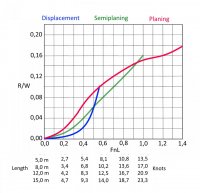
The semi-planing boat's optimal speed is around Froude's length number, FnL, 0.7. At this speed, the wave formation is most favorable. L is the wave shaping length, and it is not the same as the length of the waterline. The wave shaping length is intimately connected with the longitudinal metacenter radius. Thin end vessels provide a small metacenter radius. Plump end vessels create a large metacenter radius.
Several calculation models are available to optimize a semi-planing boat design, including Mercier-Savitsky, Groot, Delft DSDS, and more. They all have their limitations and are thus only a tool. It is necessary to check the basis of the calculations in the studies.
In addition to the static stability, the hull's dynamic stability should be calculated to verify that it remains stable over the entire speed register. This calculation is essential if the boat has a rounded transition between the bottom and the topside.
Consideration must be given to how hard the boat is going in the oncoming sea, the g-number, the vertical acceleration, which can be calculated using, for example, Koelbel. The bottom width, position of the total center of gravity, and the longitudinal trim angle affect the seaway movement more than the bottom deadrise.
To achieve optimal efficiency, one must include the minimum and maximum payloads in all of the calculations mentioned above.
Semi-planing boats deserves more attention.
JS
The semi-planing boat is a specific type of boat that deserves more attention. Specialized methods are required to design a semi-planing hull, and therefore it is more complicated than merely forcing a displacement hull to go faster or a planing hull to go slower.
The stern design is the essential characteristic that distinguishes the semi-planing boat from other types. The area, width, and draft of the transom are critical factors in the semi-planing hull performance.
The semi-planing boat's optimal speed is around Froude's length number, FnL, 0.7. At this speed, the wave formation is most favorable. L is the wave shaping length, and it is not the same as the length of the waterline. The wave shaping length is intimately connected with the longitudinal metacenter radius. Thin end vessels provide a small metacenter radius. Plump end vessels create a large metacenter radius.
Several calculation models are available to optimize a semi-planing boat design, including Mercier-Savitsky, Groot, Delft DSDS, and more. They all have their limitations and are thus only a tool. It is necessary to check the basis of the calculations in the studies.
In addition to the static stability, the hull's dynamic stability should be calculated to verify that it remains stable over the entire speed register. This calculation is essential if the boat has a rounded transition between the bottom and the topside.
Consideration must be given to how hard the boat is going in the oncoming sea, the g-number, the vertical acceleration, which can be calculated using, for example, Koelbel. The bottom width, position of the total center of gravity, and the longitudinal trim angle affect the seaway movement more than the bottom deadrise.
To achieve optimal efficiency, one must include the minimum and maximum payloads in all of the calculations mentioned above.
Semi-planing boats deserves more attention.
JS