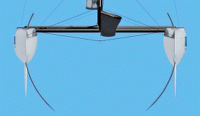
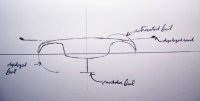
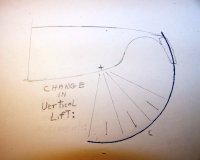
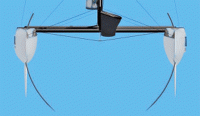
2) The idea of taking two equal boats like 29'ers or 49ers and replacing the normal foils on one with curved foils is a formula for failure of the curved foils since all their advantages are not being exploited. The T2 uses the foils in a manner that allows a fairly narrow ,low wetted surface, lightweight hull.
Doug, I am reluctant to reenter the discussion at this point, but you have just entered my area of expertise when it comes to the analyzing process of one part against another and by extension, how efficiently it might be built in a production scenario.
Does not two boat testing with identical hulls make sense to you in order to sort out the differences that may be provided by the design separation of which you speak? Go ahead and use your Tantra? to run a test, but there are several other properly configured dinghies out there that are obtainable for next to nothing that could be more than suitable and will rapidly allow a grouping of analytical data points to determine the potential.
Right now, it would seem that you are shifting analysis possibilities in order to support the argument. Serious analysis proponents would tell you that once you shift the discussion and the elements, you have made necessary a whole new set of data points. If you do not have a pair of T's from which a proper and credible analysis can be drawn, then you look for the next best set of data point producing subjects to get something that might indicate the possible success of the hypothetical suggestion you make. From that you may, or may not proceed, but without the correctly produced data, you are simply guessing as to the possibilities
The suggestion to use two identical boats evidences a failure to recognize the nature of these foils and how they can best be used in a dinghy design.
Are you saying that it is better to have two non-identical boats for this process? I am afraid that you have left the realm of science in the process and entered the realm of something else if you think that two nonidentical boats equipped with different setups will yield supportable data.
I think the Tantra II is probably a good choice for a proto because it is not the highest performance design possible using curved foils but , rather, is a "performance daysailer" that will perform very well while still being able to provide "amenities" for daysailing like a molded in cooler and dry stowage compartment big enough to carry a small tent. Further, it illustrates how a boat using "foil assist" can be more that just a performance machine-it can use innovative design to bring much more to the table: an easy to sail, beach sailable, shallow draft dinghy capable of excellent performance in a wide range of conditions while offering comfort not available in any current boat capable of the performance of the T2.
Are there any T1's on the planet that are capable of being modified and from which to draw conclusions, or is this a supposition based on something that existed years ago and is not available now? The answer, of course, is to build two T1's with the same configuration and equip one of them with the curved foils and then test them side by side in order to gather proper, equivalent data for comparison. Nothing like the present to build the paired craft and run the tests with full understanding that they may not yield the data you seek. I know this from years of building test modules of this sort and finding that the original assumptions were faulty and that the product had no future as a manufactured item.
It's an exciting concept that has a great deal of potential.
Right now, it has no potential and I am sorry to say that here on Boat Design. You have made assumptions. These assumptions have not been proven through standard means and at present, they are not able to be reproduced. What you have here is a collection of assumptions based on things that are not of the type that manufacturers seek before they tool-up in a prototype process, much less a full build.
You have said that this boat is not for home builders and that is what originally made it a non-issue for me and my interests. Now, it looks like the boat is also a non-manufacturable entity. It shall remain that way based on my experience in the field until a satisfactory prototype has been built and successfully tested against an identical design without the proposed changes.
At this point, I am out of the discussion based on both points of interest. No reasonably interested average person can build this boat outside of a factory and there is no proof that such a boat could work, even if it were built by a qualified factory.
Thank you for your time, Doug, but this is a dead end for me as I suspect it is for others who have been reading along with interest.