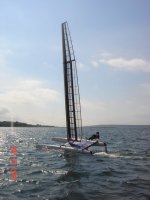
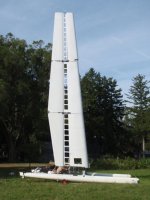
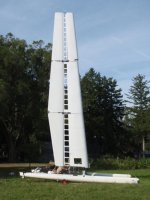
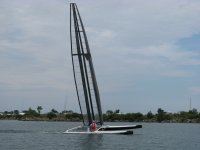
Comments on SA Thread regarding curved foils. Steve Clark is the only C Class using them in the upcoming LAC, but the A Class has been using them for awhile.
comment one:
We spent three days on Lake Pontchartrain training on A-Cats this weekend. We had three boats sailing; my ASG3 with Fiberfoam/Ashby mast/sail, a Marstrom Mk V with Fiberfoam/Glaser-Landy, and an updated Flyer MkI (update is higher aspect straight daggerboards) with Hall/Ashby. We had a high pressure system in place so we never had more than 10 knots of breeze doing most of our sailing in 6-8 knots (in and out on the wire upwind, more tiring than heavy air sailing!). From my perspective, we confirmed that curved daggerboards did not seem to have any significant overall performance advantage/disadvantage in the light air and this was consistent to what we saw at the 2010 A-Class WC. The only thing in regards to the foils was on several upwind runs, we had the Marstrom sailing with the windward board pulled up. It certainly did not seem to hurt its performance (not sure if it was helping). On the ASG3, I tried it twice and had two impressions, the helm lost some "feel" and it seemed like I was losing some height. Draw your own conclusions, the ASG3 has symmetric curved blades, the Marstrom curved blades have some asymmetry. At the beginning of the weekend session, one boat was consistently faster than the other two upwind and downwind. By the end of the weekend, the other two sailors had made some changes to rig/sail trim settings and all three boats were sailing pretty equal upwind and downwind.-----
comment two
I have quite a few years worth of VPP modelling on multihulls, their foils and rigs - much of it aimed at both C and A class. There are several key issues but, to keep it very simple, a cat hull of this type is working within the bounds of slender body theory. You aren't really worrying about wave drag from the hull but you are worrying about surface drag. If you partially lift the hull out so that its length reduces then the length to beam ratio can go down and you start worrying about other drags. Far more significant a drag component is the induced drag from the foils. Induced drag is directly related to the lift generated by the foil - the more lift it generates, the more induced drag it creates. If you try to lift the hull with a curved foil you have to increase the lift produced by the foil and thus increase the induced drag considerably. To make it worse, with curved foils the effective aspect ratio of the foil (which determines the ratio of lift to induced drag) decreases and so you end up making more drag relative to the lift. All this results, with a light weight cat, in the increase in drag from curved foils being significantly greater than the reduction in drag caused by lifting the boat. Tuning the foil section for the conditions is really key but difficult in practice. You tend to have to simply design for what you expect and run with that. The easiest variable that you have is to decrease the amount of foil you have in the water. Thus, as soon as you are fully powered up in an offwind course, don't just dump power in the rig, reduce the amount of foil in the water and increase the lift to drag ratio of the wing; you'll slip further sideways and heel less but you'll also possibly go faster (assuming you've got your polars right!). Never leave the windward foil down.
So, you ask, why do people who sail A's with curved foils think they are going faster? Well, it's not because the foils are reducing drag but because the lift generated makes the platform more stable and thus easier to power up and sail. this is especially true in big wind where control and maintaining power is more important than reducing drag. For minimum drag, the right asymmetric section with negative dihedral will be fastest (ie so that the leeward foil is vertical when the windward hull is just off the water). Of course there is a caveat - you could go faster if you could get the whole boat out of the water and on foils but so far only Moths have gone around a normal course faster when on foils. You also have to bear in mind that very few people can sail anywhere near 100% of the theoretical maximum speed.
So why do the big multihulls have curved foils? Because they are a lot heavier and different issues come into play.
Finally you might ask why I am stuck in an office in the middle of London when all this is happening, 21 years after I last appeared at a C class event. The answer is simple: I'm a mug.
--
And a response:
I certainly see the validity of everything you state about curved foils on light catamarans like the A and C. I believe the biggest surprise for us has been how competitive the boats with curved foils still are in light air.