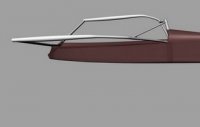
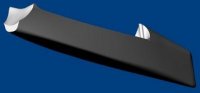
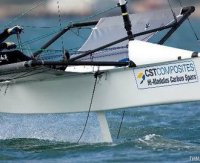
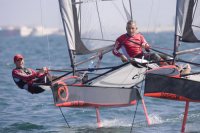
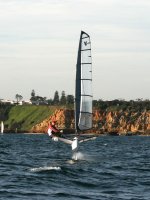
First, a Hobie trifoiler uses "feelers" not wands. They are small planing bodies connected almost directly to the pivoting main foil -and they stick way out in front of the boat.
And the blonde baby hair is split thinner and thinner until there is no substance left at all.
Get real Doug, what's the purpose of the "feeler" as you describe it? Does it not do the very same job as does the "wand"? If it is functionally doing the same thing, just using a different aproach, then it is the same thing as far as the foils and the boat are concerned.
The Rave Wands are directly connected to the top of the board and are retracted with the board-something the Hobie can't do.
It doesn't appear to need to do what the Rave does.
You still have to show how the two mechanisms do anything substantially different as far as foil pitch and response control are involved.
So, which of these two boats, the Rave and the Trifoiler, demonstrated the highest, verifiable speeds while foiling? This is, after all a thread in which a certain amount of crowing has been done about foiling speed, isn't it? So, let us know the answer to that question and then, simply acknowledge that the Trifoiler's "feeling wand" mechanism has apparently allowed the craft to achieve much better performance and it all comes off the bow of the ama hulls... imagine that?
One of the advantages of the midship wand on the Moth or any other boat is simplicity. It is likely the double wand installation on Ziegarts boat doesn't weigh much more than a single bow wand. It also allows a tighter mechanical installation.
You can prove this weight comparison, rather than speculate, can you... the double wand lightness thing? Tighter mechanical installation? Are you saying that this is a good thing, or does the mechansim in current use actually benefit from not being so digitally reactionary, giving the boat a bit of a forgiving feel to its high strung nature?
You can't beat it for use on foilers with retractable foils-something that is being seen more and more. And it may have other advantages as well.
The double wand keeps the wand wake away from the vertical fins-which is a good thing.
Wand wake as a disturbing function to the foil surfaces? Is this actually coming out of the mouth of a guy who has, for a couple of years now, loudly proclaimed that any foreign stuff in the water is not a problem for a foiler? And now, here you are suggesting that the simple presence of wand wake is a significant disruption to foil flow and lift? Can you see my grin from there as you search, frantically, for something, anything that might be postable in your defense?
This rest of this is pure speculation on your part, Doug, not fact. If what you say is true, you'd think that Prowler, Bladerider, the new MachII and all the rest of the Moth foiling community would have long ago adopted this approach on their own boats... yet, strangely, they have not. Strikes one as fairly significant, that.
The only production foiling boats out there and they do not choose to adopt the suggestions of Doug Lord. When will they ever learn?


 )
 )