I was just looking today for some original photos and text pertaining to some inspiration I originally had for my mast-aft rig design. It had appeared in a 1956 issue of AYRS (Amateur Yacht Research Society).
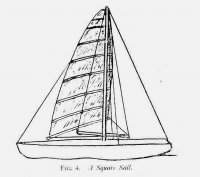
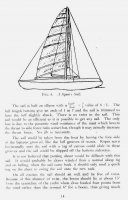
In that same issue I ran across this square rig idea. As I look at it from a number of different aspects, I think I see some original thinking,....some alternative possibilities :?:
Hopefully you will be able to read it as I tried excerpting a single page from a PDF document.
View attachment 108537
This rig, IMHO, is too complicated and too stressed to work well.
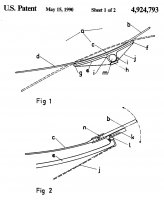
Apparently, the battens, or boomlets, if you will, are intended to ride up and down a wire, which itself attaches to another boom like structure, which crosses the mast, then has another wire running up from its aft end to the top of the mast, to counter act the one in front.
Presumably, the boom-like structure attaches to the mas, with a high load bearing pivot point.
What is likely to happen here is, when the sail fills, the boomlets will all pull on the luff wire, putting great tension on it. This load will be transferred to the pivot point of the boom-like structure, then to its aft wire. This will cause considerable bending moments on the boom-like structure, as well as considerable extra compression loads on the mast.
I see great difficulty in holding a reasonable shape to this sail in any kind of wind.
Add to that that it swaps luffs at every tack, means that it must have a shallow (in section) leading edge, which further reduces its likely efficiency.
Phil Bolger once proposed a rig quite similar to this, for a proa design of his. The sail was only held up by its halyard and the Boom wasn't intended to even touch the mast. It had a bunch of battens which gave it the half ellipse plan form. The interesting part was the boom was connected to the deck with two adjustable tethers, spaced maybe 15% of the Boom length from the sail's plan center line, on the Boom. Together they formed a "V" with the apex near the mast partners.
When the proa shunted, the forward tether was tightened and the aft one loosened, so the new front end of the boom tilted down toward the deck and the aft one tilted upward. This brought the Center of Area aft each time, while putting more tension on the new luff than on the new leach, presumably making the sail perform more like a fore and aft one.
I don't know if this rig was ever tried, but, in my mind's eye, I can see how it might work. It has far fewer parts and far fewer likely loads than the IYRS rig shown here.
Except on a proa, I just don't see how an athwart rig can be an improvement on a fore and aft one, though it certainly may have its place as a specialized down wind sail.
I once though of adding one to my Siren 17, which I was able to make self steer at any point of sail, from a reach to a beat. I was not able to get it to self steer down wind.
I came up with an idea for a remedy in the form of a "cross-jack" sail.
A "cross-jack" is a square sail with its lower corners missing, so all it needs is a halyard, a pair of braces, and an attachment point for the downward pointing apex. The idea was to make the yard equal to the Beam of the boat, and the sail tall enough, so s the yard could be hoisted, with its own halyard, just above the fore triangle. It would be set in addition to the jib, not instead of it.
I then though of not even bothering to give it braces, allowing the yard to pivot freely. The idea was that once the boat started rounding up, the yard would pivot in such a way as to give maximum corrective moment, to force the bow back down wind.
I never got a chance to try this idea, but it still seems enticing to this day.
Traditionally, the great advantage of the athwart rig is that one side of the sail surface was always upwind. This is probably the reason it was used on huge sailing vessels well into the 20th century.
Because of this property, it was possible to divide the rig into to separate sails, one on top of the other, on the same mast. This way crews could go aloft and safely (relatively speaking) furl these individual sails.
This could not be done on a fore-and-aft rig, as in the event of a jibe, the furling crew could end up on the down wind side of the sail, a very dangerous place to be.
For this reason, large fore-and-aft rigged ships had a single sail on each mast, as well as maybe a relatively small top sail. Most of the sail had to come down as a single unit, so it was enormously heavy.
To compensate for this, these fore-and-aft rigged vessels usually had more masts and were comparatively under rigged. One had as many as
seven masts, but most had four or five, for the larger vessels.
I think it is important to remember these historic facts when considering this rig type for a general purpose sail. The
Maltese Falcon is but a modern version of this rig, used much for the same reason it was used on larger ships in the past: to break up the sail area on each mast into smaller furl-able sails, on fixed spars. Except, this time these sails are furled by machines, rather than human crews.
Though it is true that the athwart (square) rig is best for dead down wind sailing, the fore-and-aft rig does fine with down wind tacks.