Polyester knit fabric

These forums are seemingly forever hosting people looking for a cheaper way to build a boat, commonsense tells you that if the cheapie methods did the job properly, they would have been adopted as standard practice, no-one likes spending more money than necessary to get the same utility. Now, how about some old hessian bags to bulk out that laminate.......

Hey, call it hemp fiber & wet out with peanut epoxy & you're green to go.....................:D
All I want to see is a beautiful frangipani print molded along/into the topsides of a hessian & peanut epoxy outrigger & paddling towards a golden sandy beach loaded with lobby & tropical fruit......
while I sip on a Caipirinha in the shade of .... well, a shady tree, reading the paper, kicked back in a comfy posi, listening to the waves swish up the beach,.... fabulous point break that I surfed from sunrise to worn out going off on the headland......


Jeff.
 
OOOOOOwww, harsh, agreed that the T material aint gunna be the strongest laminated structure but mixed using some other reinforcments & internal structure should be sweet..........

Jeff.

Now you you've got it, matey! I never had intentions of laying the whole of it up with targeted material, unless it somehow proves worthy. All along the idea was to have more internal reinforcement whether glass or epoxy, unknown. The only 'good' part of the idea is easily shaping a form.
 
Now you you've got it, matey! I never had intentions of laying the whole of it up with targeted material, unless it somehow proves worthy. All along the idea was to have more internal reinforcement whether glass or epoxy, unknown. The only 'good' part of the idea is easily shaping a form.

Obviosly......:idea: I pick stuff up quick....my mind is free..... the really cool part though is, icing on the cake.........;)

Jeff.
 
Its going to fall apart.
But don't let me stop you. :D

How about this rowboat.
No guessing about the structure.
One experiment at a time is always a good policy.


And as sweet as you're rower is, it's not what I'm after. I want a tub that is tough enough to land on Glacier Spit, Kachemak Bay in a bit of S'Werly, turn at the beach and land with bow into the weather. Rocks and gravel. I loved my Walker Bay (and even the ******* who took her) but 71 lbs was a bit much for me to get aboard alone at times. Also, she did not like to be towed at 25kts, so there you have it. I'm old and feeble, that's why my mind wanders around silly 'what if' projects like this. The overarching concept is pretty simple: build a little rower and do it in a way that engages what's left of my senses in an enjoyable way. I'm not really that interested in building something that someone else has. My wife tells me that I'm flawed. Hell, I wouldn't even be here if I could make what I wanted out of welded aluminum but I can't meet the weight requirement.

Of course nothing you have said so far will stop me. Now tell me why exactly why it's going to fall apart? I have no idea what you mean about 'one experiment at a time' and that being good policy.
 
Gentry. Trade theory for experience.

http://gentrycustomboats.com

My so-called 'theories' have lifelong led my to the most wonderful 'experiences' imaginable. I think we can assume that the creator of the site and work product you point to at one time started with an 'idea', ya think?

Not interested in anything there save this pic, which brings out my inner Aleut. I lived in the Aleutians and certain shapes grab me from that time.
 

Attachments

  • Mobjack 7.JPG
    Mobjack 7.JPG
    211.5 KB · Views: 447
Usually polyester fabrics are sized (machine finished) and the fibers are less willing to accept goo, compared to Xynole, which is what I'm assuming you're looking to duplicate. Some research into the particular fabric you're working with will tell, though fabrics used in dresses typical have a hard, smooth sizing performed on the fibers, which helps them repel stains and liquid spills. This feature also prevents epoxy penetration into the fiber bundles.

Par, my preliminary research into what you bring up about the finish of polyester brought up some interesting things. It appears that, in fact, the fibers usually are treated to make them more 'comfortable' and hydrophilic (sweat), see pic. At first I thought what you said made no sense because glass fiber could hardly be less refractory than PET. However, there is substantial information about how glass fiber is treated for very narrow usages like specific resins.

Thanks for the good input. I was unaware of Xynole and not trying to imitate it. I'm not trying to imitate anything because I'm clueless but learning fast!

So how is polyester treated that is specific to laminating? I can't find.
 

Attachments

  • Capture3.JPG
    Capture3.JPG
    43.4 KB · Views: 565
. . . So how is polyester treated that is specific to laminating? . . .

Well this is a loaded subject and pretty complex on several levels. Finding information will likely be proprietary and the textile industry, is worse than putting wings on fins, in early 80's America's Cup racing. These folks are nut jobs, that have workers sign NDA's before they can operate a new loom.
 
Yofish,

About my "harsh" comment.

The strength and stiffness and weight of a laminate is based on several things.

Strength comes from the strength of the fiber, its straightness in the cloth, and a reasonably long length. The polyester could be as strong as a SOF cloth, but it is not specifically selected for that. Polyester comes in lots of different "grades". The knitted cloth means there is no straightness at all. The fibers are quite long, but since they are kinked (Knitted) there is no fiber to directly take up the load.

Stiffeness comes from the fiber (not the resin) but if the fabric has no straight fibers, they just bend instead of stretch. Imagine the difference in pulling on a dress shirt instead of folding it. Bending the fiber is much easier.

Weight comes largely from the percentage of fiber to resin. Resin weights much more, typically. What you are really looking for is strength to weight. If you have knitted fabrics you will have low strength, and high weight (because the knit is "fluffy" with no way to squeeze out the extra resin). So you have the worst of both worlds. If you don't get the fiber fully wetted out, then you have no more strength and stiffeness than the dry fabric.

Another issue is that Dacron has to stretch to develop it's strength. The resin does not stretch very much. You will probably break the resin before you get much strength out of the Dacron.

You can make a boat as you describe - no doubt.
It will just be heavy and weak.

I thought you wanted a light boat ("70# is too much") that will take running up on the beach.

I'm going to leave you alone now.

Just one last suggestion. If you want a "tub" of a row boat (not 18') then try another Gentry SOF design (sorry Dave). There are others on the same site.
http://gentrycustomboats.com/PRP.html

Have fun :)

P%206.JPG
 
Yofish,

About my "harsh" comment.

The strength and stiffness and weight of a laminate is based on several things.

Strength comes from the strength of the fiber, its straightness in the cloth, and a reasonably long length. The polyester could be as strong as a SOF cloth, but it is not specifically selected for that. Polyester comes in lots of different "grades". The knitted cloth means there is no straightness at all. The fibers are quite long, but since they are kinked (Knitted) there is no fiber to directly take up the load.

Stiffeness comes from the fiber (not the resin) but if the fabric has no straight fibers, they just bend instead of stretch. Imagine the difference in pulling on a dress shirt instead of folding it. Bending the fiber is much easier.

Weight comes largely from the percentage of fiber to resin. Resin weights much more, typically. What you are really looking for is strength to weight. If you have knitted fabrics you will have low strength, and high weight (because the knit is "fluffy" with no way to squeeze out the extra resin). So you have the worst of both worlds. If you don't get the fiber fully wetted out, then you have no more strength and stiffeness than the dry fabric.

Another issue is that Dacron has to stretch to develop it's strength. The resin does not stretch very much. You will probably break the resin before you get much strength out of the Dacron.

You can make a boat as you describe - no doubt.
It will just be heavy and weak.

I thought you wanted a light boat ("70# is too much") that will take running up on the beach.

I'm going to leave you alone now.

Just one last suggestion. If you want a "tub" of a row boat (not 18') then try another Gentry SOF design (sorry Dave). There are others on the same site.

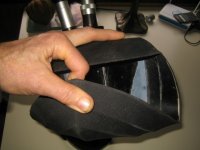
Mr. Upchurch, I didn't find your comment harsh at all, at least compared to some I've received on other venues. That's why I'm here and thank you for this post too; your explanation of how composites achieve strength and rigidity. In fact, the model is quite flexible (see pic). I don't know (yet) that that is bad, though. It feels rather 'tough' for lack of a better word, maybe resilient is better.

The beauty of experimentation is what can derive from the process. Set aside for the moment the idea of weight and strength and think of that as being irrelevant to a derivative offshoot of this model making test. Think about what that crazy Australian chap saw immediately: it being an easy method to get a boat shape for which to further reinforce thus obviating what you so well describe as a weakness. I do not think I'm wrong that this would certainly weigh less than a plywood over frame or plywood stitch and glue as the basic form, but possibly otherwise in the finished state. Not to mention the time difference to erect. On top of that, the potential to have a substantially superior work product. Wood was put on earth in order to eventually make mushrooms. In presence of water, this is an incontrovertible fact. As magnificent of a material that it is something is always making effort to eat it.


Now back to the pic: we see it quite mashed after which it rubber-ducky pops back up with alacrity. I did this flexing 200 times for kicks. I got the feeling that I could do it all day to no effect. I suppose I could build a machine to mash it repeatedly until failure but my intuition tells me that if I made it entirely of glass that it would fail rather sooner. Hmmm, what is strength?


As far as this other chap's boats go, they are quite beautiful but I haven't a moments desire to build one (except, perhaps, that luridly sexy Aleut sled!) because I design my own boats. I can accept that you don't like my design (and I could care less) but as a designer yourself, I think you can understand my sentiment. Along these lines and already having failed divers times in my life I have no illusions about what I'm doing here - it could easily come to naught - but I do know I'm already enjoying the doing!
 

Attachments

  • mash (Small).JPG
    mash (Small).JPG
    70.3 KB · Views: 438
Have fun. You clearly understand I'm talking from my bias.
I'm not really ready to criticise your self designed boats. I just wanted to provide some information which MIGHT make it successful.

And I am only a boat designer in my dreams. :)
 
High modulus elongation building methods have been employed previously, though specifically I'm talking about more than people power or small craft. Look into the "Lord" method and you'll find high modulus, yet quite flexible, very light weight hulls of significant size (70'+) suitable for patrol boat employment. The Lord method can be scaled down for recreational uses.
 
Forum posts represent the experience, opinion, and view of individual users. Boat Design Net does not necessarily endorse nor share the view of each individual post.
When making any potentially dangerous or financial decision, always employ and consult appropriate professionals. Your circumstances or experience may be different.

  • Back
    Top