
Parallel concepts - vehicle powered barges

rwatson

Senior Member
Joined
Aug 2, 2007
Messages
6,278
Reaction score
544
Location
Tasmania,Australia
Remember Myark - and the vehicle propelled barge.

"There are many vehicles in the world , a huge market left open if there can be an affordable practical custom designed light pontoon “less than 400kg” that can easily assembly in minutes and float the average car, then if wanted the car could propel pontoon with cars own HP."

http://www.boatdesign.net/forums/al...-custom-boat-builders-48314-9.html#post659534

and

http://www.boatdesign.net/forums/projects-proposals/amphibios-motor-home-45749-2.html#post604251


It surfaced again here

http://www.boatdesign.net/forums/boat-design/design-concept-50271.html


" I have thoughts on the manner in transferring the Vans automotive power to the propolsion and steering of the unit in a fairly simple manner.

The "Captain" would sit in the driver's seat of his van and drive the boat like he drives his van.

There will be no stored fuel or water on the barge, so that it may be transported to the "Hire site" on a truck....Maybe two or three to each truck, depending on demand.

In time I see these barges being in areas where houseboating is popular, and the limit to that is endless in Australia."


It seems that the R&D cost is a big thing, but the idea seems to have legs to my mind.


has anyone seen a commercial version surface yet ?
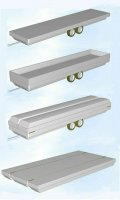
 

Attachments

  • Myark_6_m_folding_trailer_barge.jpg
    Myark_6_m_folding_trailer_barge.jpg
    38.7 KB · Views: 746
One of the design goals for my modular multihull concept (see my gallery) would be that it could be trailer behind a regular full sized pickup such as Ford F-250 or F-350, then after assembly and launch, could then carry the tow vehicle. Note use of trailer frame as mast. Cross beams could be ramps before final assembly.

Maybe even do it with a RV motorhome.
 
I'm not liking the amphib motorhome too much.

Rather than what seems to be 90% RV/10% boat, I'd like a 90% boat/10% land vehicle.

Retractable running gear just enough to get it out of water and cruise at low high speed of 60mph, and drive like any other fairly cumbersome vehicle. Something that could make a 'passage' but get itself safely high and dry to save cost and make maintaince etc much easier.

Lowering the wheels might help stabilize it at anchor or in rough water.

No idea what it would look like, but I guess it would be about 8' X 30'
 
Fraught with difficulties, imo, one that comes to mind in using the road vehicle to drive the boat is the cooling of the engine, working hard without the air flow. So scratch that.
 
Yes, cooling is a really valid point.

I was having trouble visualising the drive from the rear wheels turning the props.

If you had some sort of dynometer type rollers, how much wear would you get on the tyres, and how much loss of efficiency ?

Maybe you need a power takeoff like the old landrovers had, with a heat exchanger for the radiator ?

The concept is still persisting in my head. How great would it to be able to take shortcuts across rivers and estuaries !
 
The concept is still persisting in my head. How great would it to be able to take shortcuts across rivers and estuaries !

Just build an amphibious jeep. After all, an Aussie drove one across the Atlantic. How hard can it be?

PDW
 
For starters, a fast planing type of thing is just too hard all round. As a slow-coach, a portable outboard will suffice. It then gets down to designing for what kind of waters, obviously flat water is much easier to plan for. I'm sure it is all do-able, but I'm not sure there is much of a market in most places, if the places of interest are inaccessible, there will be minimal or no roads to drive on anyway, and dragging a long, wide trailer around on narrow windy tracks with a 4WD not entirely practical.
 
For starters, a fast planing type of thing is just too hard all round. As a slow-coach, a portable outboard will suffice. It then gets down to designing for what kind of waters, obviously flat water is much easier to plan for. I'm sure it is all do-able, but I'm not sure there is much of a market in most places, if the places of interest are inaccessible, there will be minimal or no roads to drive on anyway, and dragging a long, wide trailer around on narrow windy tracks with a 4WD not entirely practical.

I agree. It's a solution to a problem that doesn't really exist in practice.

As for powering and steering by the vehicle being carried, come on. Just how much of a Heath Robinson drive system do we want to build, sell, maintain and argue about in court?????

PDW
 
Yes indeed, all those concerns are very valid, and very pertinent. As we advise all new posters, it requires a firm SOR from the start, so that everyone doesnt chase their tails.

The most compelling area for this device that I saw, was the lake area in Canada. It seems that every small island has a house, accessed over flat water,so the towed barge would seem to be a potential solution.

Towing a barge has a bit of an edge over an amphibious vehicle, in that you are driving a much larger load bearing machine - say for transporting building materials.

Bringing the exercise back to my part of the world, we have an island off the coast, pretty well serviced by a ferry, but covered in miles and miles of wandering second grade roads.

For someone who wanted access to their property directly from the water, and avoiding the ferry trips and long roads, a towed barge might be viable.

Likewise, there are a large number of promontories, that have to be driven to via the winding coastline. For those familiar with the area - say, Cygnet to Geeveston, or even Cygnet to Southport. The direct trip across water is a lot shorter

The use of a vehicle motor to run props in water is trying to avoid doubling up on the most expensive part of boating - the motor. But - I guess the big question is whether the modifications to connect vehicle to propeller is cheaper than a couple of outboards as has been suggested. Mind you, outboards themselves are problematic when towing. - what with weight, deployment etc.

Finally, in my daydream - there is the 'challenge' of land access. With a properly formed boat ramp, you, run the theoretical vehicle off the barge via a ramp, and then lower the wheels on the barge, and pull the barge onto land. If the vehicle was a substantial 4wd, this could even be done on firm sand. If the barge was aluminium - (which seems to be the most viable option), you could even have re-inforced skidding surfaces on the bottom of the barge for some situations.

The state of the water is a big concern of course - not just for safety, but the corrosion on any vehicle carried. Some side and bow protection, without incurring too much windage might be desirable.

Oh well - we will have to wait for some intrepid soul to sort out all these issues, if the concept ever finds a compelling reason to come into existence.
 
Likewise, there are a large number of promontories, that have to be driven to via the winding coastline. For those familiar with the area - say, Cygnet to Geeveston, or even Cygnet to Southport. The direct trip across water is a lot shorter

Yeah - I was thinking that the other day when I drove from my place to Port Huon then back via Cygnet. Would have been a lot closer to drive across.

Not in time though, I strongly suspect. As has been said, a planing barge is really out of the question so one is limited to displacement speeds - 6 knots is likely to be maximum.

PDW
 
I am sure there are applications for this idea, and it has been done on a one-off basis, but as a commercial proposition, there would be too limited a market. Especially over open or even semi-protected waters. Maybe it would work in a situation where you can avoid a 100+ km roundabout excursion in an area lacking bridges, over a river or protected estuary, especially if the roads are bad. But the odds you will have good landing grounds at both ends is probably not good. This is very much a niche thing, imo, where there is a specific need in a specific circumstance, but not as a general recreational vehicle/boat combo, which is probably well catered to by car-top dinghies.
 
Maybe a hydraulic-driven prop would work. Could be powered from the axle (hub) or from a PTO (which is an easy option on some diesel trucks). This would help prevent water intrusion into the inner mechanical workings of something like rollers that the tires sit on, so a better option in saltwater/humid environments.

A raw water heat exchanger is not out of the question as a retrofit add-on to many vehicles. Still think it would take a lot to overheat a modern computer-controlled water-cooled engine as typically used in modern automobiles. They just don't overheat like they did in the old days.

Outboard is the easy option, but then you have maintenance issues, especially if the engine sits for a long time with no use. Reliable low-tech two-strokes are getting harder to come by, so then you need to worry about oil changes on the four-strokes (especially if you use dino oil, since it breaks down over time, you need to change it out at least once a year even with no use). Plus, outboards are pretty expensive for their given power output (which is understandable, given the job they're expected to do).
 
Start with a hybrid vehicle and use electric propulsion.

Dino
 
Cooling wise, I think you'd be OK with a old school belt driven 'always on' fan and a good "heavy duty" radiator, and an open hood(bonnet).

And make sure the cooling system is generally in tip top shape...flush, some 'Water Wetter" additive, new hoses, etc. All really cheap to do or even have done.

Even adding whole extra 'Frankenstein' extra radiators with their own electric cooling fans from junkyard cars wouldn't be a big deal. Most older American V-8 cars and trucks will have enough room between the radiator and grill to add a couple of small car rads w/fans.

Or it would be just two hose clamps tapped into the heater hose and a not too messy chore.
 
Forum posts represent the experience, opinion, and view of individual users. Boat Design Net does not necessarily endorse nor share the view of each individual post.
When making any potentially dangerous or financial decision, always employ and consult appropriate professionals. Your circumstances or experience may be different.

  • Back
    Top