Have any of the Moth Class rules been altered to reflect the use of foils and rudder gantries which didn't exist before the foil thing happened on the scene?
No. None.

To install this app on your iPhone:
Note: This feature may not be available in some browsers.
Have any of the Moth Class rules been altered to reflect the use of foils and rudder gantries which didn't exist before the foil thing happened on the scene?
====================================It would be helpful to have a flap on the aft foil that could be used to adjust the pitch trim. This would not have to be actively controlled. It would be used to fine tune for performance.

No. None.
====================================
QUESTION FOR ANYONE WHO HAS SAILED EITHER ONE OF THESE SETUPS :
With a single extension tiller ,it would seem that the direction to adjust the rudder flap would reverse with each tack or gybe; is it hard to keep track of which direction to rotate the twist grip for flap UP or DOWN ? Or is it easy to just remember clockwise or counter clockwise?

==========================The rudder twist grip is used as a gear change not as a real time height controller.
Response time between eyes, brain, wrist, and foil are too slow to react to pot holes in the water surface.
It's actually a requirement for stable pitch-heave coupling that the forward foil react faster to heave than the aft foil. The forward foil should control heave and the aft foil should control the pitch attitude.
The ideal would be to still be operating in the drag bucket. Looking at the data, it looks like flaps rather than incidence are the way to go.
The Fastacraft foils are a NACA 63412 section with a 120mm chord - Reynolds number of 66,000 per kt; say Re = 500,000 for takeoff. The profile drag is pretty constant from a lift coefficient of 0.1 to 0.7. This is where you want to operate. Say you designed the foil to take off at a lift coefficient of 1.2. The profile drag coefficient there is 0.01894, but at a lift coefficient of 0.6, the profile drag coefficient is 0.00816. So it would be better to double the area of the foil - that would cut the profile drag at takeoff by 14%.
With flap you can extend that to a coefficient of 1.0 or better. But with the bigger flaps and bigger flap deflections, there's such a strong suction peak at the hinge line that I wonder how good the predictions are. The hickup in the lift curve occurs when the transition (via laminar separation bubble) jumps from the flap to just behind the leading edge. The larger flaps extend the drag bucket a bit more. The best section lift/drag ratio looks to be with a 30% chord flap, operating near zero angle of attack.
I rather suspect XFOIL tends to overpredict the maximum lift. But the max lift doesn't seem to be very sensitive to the size of the flap. Flaps definitely increase the max lift, however.
To use the previous example, you could use a 30% chord flap to take off at a lift coefficient of 0.9. That would be a foil 1/3 larger than the unflapped foil that used incidence to take off at a lift coefficient of 1.2. But the drag coefficient would be 0.00872, saving 40% in profile drag once you took the different foil sizes into account. Using the flap to take off at a lift coefficient of 0.9 vice using incidence and no flap to take off at the same lift coefficient (same sized foils) would save 35% in profile drag.
Of course, the induced drag will be big contribution. But if you use full span flaps, the induced drag of the flapped and incidence cases will be pretty much the same.
Judging by the photos I've seen, the pitch attitude seems to be high. So I suspect the main foil is undersized. A bigger stern foil won't help because the load is being taken by the forward foil, and it has to trim at the same angle of attack to carry the load. Increasing the span would significantly reduce the induced drag at takeoff, too. So you might try a longer main foil and see if that is a worthwhile trade of takeoff performance versus extra drag at high speed or when hullborne.
-------------I don't think the flap deflection has anything to do with whether the boat is in a steady-state condition or not. The flap deflection is controlled by the wand, and is only determined by the flying height. In the photo, if the flap was deflected upwards, it was because the boat was trying to fly out of the water!
There's only an indirect correlation between flap angle and speed. Let's assume that the wand is set so the flap angle is zero when the boat is at its design flying height. With, say, a level pitch attitude, the lift on the foil will only be correct at one speed. At higher speed, that same angle of attack will produce more lift, which is more than the weight being carried by the foil. As the boat rises up, the wand will deflect the flap up to counter the rise. The boat will trim out at the height that corresponds to the flap deflection that brings the lift back down to equal the weight.
The problem with this is speed and height become coupled, and the flap is not powerful enough to counter substantial changes in angle of attack due to changes in pitch attitude. The wand does a good job of regulating the height once the boat is trimmed, but asking it to do the trim function, too, is using up a lot of its control power.
Adjusting the incidence of the main foil would be an option. For example, the incidence and flap deflection could be linked together like an antiservo tab. This would reduce the incidence at the same time it deflected the flap up. One problem with this is it increases the hinge moment compared to just using incidence control alone.
I think the answer is to start controlling pitch as well as heave. The aft foil could be given a flap of its own that the pilot could use to adjust the pitch trim, and thus the flying height and main foil flap deflection. Just what a Moth sailor needs - another thing to operate! Or maybe the aft foil could be run with a wand of its own.
I think a more promising solution is to add a forward/aft foil interconnect. The aft flap would be linked to the forward flap so that they moved in opposite directions. As the boat rose up, the wand would deflect the forward flap up to reduce the lift on the main foil. But it would also deflect the aft flap down which would reduce the pitch attitude and also reduce the lift on the main foil. The flap acts immediately, but the rudder foil takes effect a little later because it's not until the pitch attitude has changed that change in lift is seen. However, in the long term, the net effect is much more powerful.
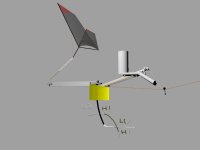
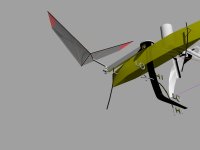
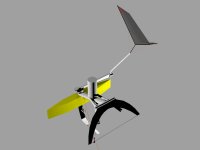
It would be possible to sum a manual trim input with the interconnect to the aft flap. The attached sketch shows a schematic of how it can be done. When the trim input is fixed, the two flaps move in opposite directions in response to the wand movement. If one considers the wand to be fixed in position, the trim input moves the rudder flap. Adjusting the ratio of aft flap to forward flap movement provides a means to tune the system for best performance. Naturally, Morse cables are probably a better way of mechanizing the system, rather than the pushrods shown. But the action would be the same.
Friction and having two surfaces instead of one may be tough for a wand to drive. After all, the energy to activate the controls comes from drag on the wand and you don't want any more of that than absolutely necessary. So it maybe desirable to put some kind of hydrodynamic balance on the flaps.
I wouldn't rule out external flap foils, either. It's a lot easier to arrange the pivot on the flap to make it balanced and it can form a slotted flap for high lift on takeoff if that's desired. At low flap angles, the main difference between an external flap and a single element section of the same total area is the drag of the brackets needed to support the flap. There may be enough other advantages to make the bracket drag worthwhile.
A tentative question:
This is not my area, but having been induced to look around this forum this thread is getting interesting. It occurs to me that conventional, ie, non-foiling monohulls with moth-like performance could be sailed entirely without the provision of rudder surface below the aft foil if a yawl-like rig is used, ie, the mizzen becomes the (aerodynamic) rudder and, as long as the boat is slippery enough to travel at a good fraction of the wind speed no water rudder is needed.
If this is applied to a foiler with a submerged foil on the daggerplate/centreboard and the rudder horizontal surface is made into a planing surface, ie, a ventilated foil running on the water surface so that it does not create sideforce then this principle may work here as well. This should give slightly lower trim drag, even if it doesn't it would at least be fun to play with; blasting around the harbour with only a couple of sheets in hand and no tiller. It's not a Moth, is it an interesting possibility?
Jon.