
lift without downwash?

Telltales at leading and trailing edges of a well trimed sail, show upwash-downwash phenomena.
(modified image stoled from archifamous Arvel Gentry's articles)
You are showing the velocities close to the airfoil, and your "downwash" immediately behind the airfoil is not what people normally call downwash. In the usual aero terminology, downwash of a 3D wing usually refers to the velocity well behind the wing, where the wing airfoil's local flowfield no longer has an influence.

The far-downstream downwash velocity is associated with the wing's trailing vorticity, and must be present if there is lift on a wing with finite span. The presence of trailing vorticity and downwash also implies that there is an induced drag on the wing.

In the infinite-span limit, the velocities in your sketch will still be present. But the far-downstream downwash and the induced drag will both disappear.
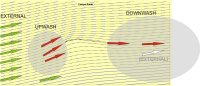
 
...downwash of a 3D wing usually refers to the velocity well behind the wing, where the wing airfoil's local flowfield no longer has an influence...

I thought on it as the airfoil modifying the flowfield from slightly forward to far behind, and local flow (appointed by telltails) as just part of the same (upwash-downwash) phenomena. Maybe I'm wrong?
 

Attachments

  • upwashdownwash3.jpg
    upwashdownwash3.jpg
    76.7 KB · Views: 5,877
Is lift possible without downwash?

Only if you have infinite span and produce a finite amount of lift.

Generating lift means you are changing the momentum of the air by changing the direction of its flow. That is "downwash". When you do that over a finite span, you will not only produce downwash, but you will also have trailing vortices in the wake at the edges of the deflected air.
 
Do you mean by downwash that there is downward flow of air at the foot of the sail?
 
Do you mean by downwash that there is downward flow of air at the foot of the sail?

That is too close to the sail for the usual definition of downwash because
it is influenced by "local" effects. As Mark said, downwash is a term usually
reserved for the flow further aft of the sail where local effects are negligible.

If you look up "horseshoe vortices" you will see a "bound" segment, which is
located on the sail, and two "trailing" vortices that start at the bound
portion and trail far behind the sail or wing.

The trailing vortices are responsible for "downwash" and induced drag.
(That portion of the trailing vortices on the sail, while creating a downward
flow, are not usually regarded as part of the "downwash".)

For an infinitely long wing (or one contained between wide long sidewalls)
there are no trailing vortices, hence no downwash, and hence no induced
drag.

That's about as simply as I can explain it.
 
So I googled downwash and had a good laugh. I thought you aero guys had all this stuff canonized.

I learned downwash depends on the problem at hand. It has different uses.

The meaning I had in mind was a sort of integral of momentum change in the direction opposite lift taken as the difference of momentum of the fluid entering and exiting a control volume surrounding the foil. However, it seems the vector can also be referenced to a vehicle's centerline- dealer's choice.

I learned it also refers to the difference in angle-of-attack between the real 3d world and the nominal 2d world in terms of a foil's performance. The loss of lift do to low aspect ratio can be explained by a downwash caused by a tip vortex that reduces the effective angle of attack of the airfoil, predominantly near the tip.

So there are the large scale, at-a-distance effects, and there are the localized effects. But the general idea is a change in momentum of the fluid opposite to lift.

Now we just need to figure out what it means regarding sailboats. We could choose it to be perpendicular to the sail's course and opposite lift, or we could put it in the plane of the surface. The difference is the heel angle. The surface boundary condition kinda throws a monkey wrench into the works.
 
Leo, we cross posted.

(or one contained between wide long sidewalls)

I don't quite get this part. Others have alluded to it as well. I would expect downwash based on force balance for any finite span, regardless of boundary conditions. I would also expect the value to be independent of control volume and equal to lift. Is downwash an angle, or momentum change?
 
Leo, we cross posted.


I don't quite get this part. Others have eluded to it as well. I would expect downwash based on force balance for any finite span, regardless of boundary conditions. I would also expect the value to be independent of control volume and equal to lift. Is downwash an angle, or momentum change?

There are no trailing vortices at the wingtips of a finite wing with infinitely large
"endplates" or walls, and hence there is no induced drag.
 
For an infinitely long wing (or one contained between wide long sidewalls)
there are no trailing vortices, hence no downwash, and hence no induced
drag.

Not so IMHO.. Thou downwash and trailing vortices are related downwash still excist with infinite span too, anyway in angles of attack when the foil produces lift.
BR Teddy
 
The answer to the OP question is - yes, it is possible, if the sail has an infinite height (or span). :)

"Downwash" is an aerodynamic term coming from the world of aeronautics, and is hence a matter of definition. The concept of downwash exists only for finite-span lifting bodies, and not in case of 2D airfoils like the ones shown in the pics by Quequen. For a finite horizontal wing, a downwash is defined as the net downwards-directed vertical component of the flow velocity, induced by the vorticity generated along the span of a wing when it produces a positive lift. Hence, the downwash doesn't exist for airfoils (which are 2D cross-sections of a wing), and it doesn't exist for wings which do not produce lift.
An important but often misunderstood thing is that the vorticity is created along the whole span of the wing, and not only at the wing tips - though the vortex intensity is generally highest in proximity of wing tips and other span-wise discontinuities (flaps, slats, ailerons, fuselage etc.).

These concepts remain valid for sails and keels too, but the reference frame has to be rotated by 90° on a plane laying perpendicular to the flow. So I'm leaving it to your ability of visualization.

Cheers
 
Aero experts,

My understanding of the definition of downwash says this picture is not correct, Please make it perfectly clear for me.

The green arrows coming into the sail is the airflow a ways in front of the sail. The green arrows leaving the sail should not be parallel to those coming into the sail, but should be pointed more across the page. This indicates that the air has been turned "down". Which on an aircraft wing would be "downwash" relative to the way the airplane normally flies.

Somebody who does this professionally please set me straight. Is downwash flow along the direction of the mast, or across the width of the sail?

Thanks.

Telltales at leading and trailing edges of a well trimed sail, show upwash-downwash phenomena.
(modified image stoled from archifamous Arvel Gentry's articles)

No matter how strange a foil can be, I can not imagine how, when Downwash is parallel to external flow (ie no Downwash), you can have Lift :confused:
 
My understanding of the term downwash on mainsails is that the wind spilled off the foot. That is why they made booms with shelves and laced the foot to it.
 
Not so IMHO.. Thou downwash and trailing vortices are related downwash still excist with infinite span too, anyway in angles of attack when the foil produces lift.

If you think that is a useful definition of "downwash" then by all means use it,
but it won't wash with some of us ;P

Perhaps you could show us how your definition translates into mathematics. :)
 
I agree with Leo. You guys should find an agreement about what the downwash means in the sailing world. The only definition I know is the aeronautical one, given in my previous post.
Once you have decided what is the meaning of the word "downwash" for you, we will be able to make a more meaningful technical discussion about it.
Cheers
 
Forum posts represent the experience, opinion, and view of individual users. Boat Design Net does not necessarily endorse nor share the view of each individual post.
When making any potentially dangerous or financial decision, always employ and consult appropriate professionals. Your circumstances or experience may be different.

  • Back
    Top