
Galvanized bolts underwater

goodwilltoall

Senior Member
Joined
Jul 31, 2010
Posts
844
Reaction score
26
Location
nation of Ohio
Greetings,

Does anyone here know how long galvanized bolts can hold up underwater?

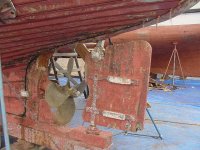
Bolts are 1/2" to be used to attach rudder. Have heard coating a ball of cement around them will be good for years.
 
If you are in fresh water, they will last several decades.
 
If by cement you mean concrete, you'll expedite their corrosion, compare to leaving them "uncoated", of course depending on how long the zinc (galvanize) takes to depassivate, inside the concrete wad. If exposed to stray electrical currents, dissimulator metals, etc., the process will accelerate too. A handful of 1/2" stainless bolts and nuts, seems a better choice for a few extra bucks. Is this where you think you need to make a savings?
 
The galvanized bolts will protect steel surfaces they are in contact with until the zinc layer has gone. I estimate 2-4 weeks in seawater, up to several months in fresh water. If they are not in contact with anything conducting, the bolts may live for several years.
 
We have floating docks in fresh water that are over 20 years old and have only minor corrosion. Mooring chains get changed every 10 years or so because of wear, not corrosion.
 
That was an old time practice believe i heard from G. Buelhler were they would make a cement ball around the nut ends (or the while assembly) then crack it before removing a rudder to find the bolts with no corrosion.

Also a pretty well known concept floated around to coat inside steel hulls with a cement slurry which also achieved same results, offcourse this is all hearsay I've heard over the years and reason for this thread.

S.S. Bolts would be easy but I thought being completely underwater water would cause oxygen starvation.
 
Here is a pic of what described above.

Found Kasten Marine (Metal Parts for Boats) writing about stainless and he is adamant about avoiding its use
 

Attachments

  • rudder2.jpg
    rudder2.jpg
    37.7 KB · Views: 1,122
There's oxygen in water you do realize. Now it's not "free oxygen", but any aeration nearby and it will be. Stainless has been used under water for shafts, struts, props, etc. for generations, so regardless of the naysayers, it does work. Buehler wouldn't be the wisest choice to get "old school" techniques from. Many of his "time and money" saving methods are time honored, though most aren't very good and have been supplanted, by better methods and materials, even by the old schooler's. An easy way to find out what really happens, is to cut open a hunk of reinforced concrete and see what you'll find. I can tell you the steel will be swollen with rust and busting up the surrounding concrete, if it has any water or ground contact. Concrete wicks up moisture like a sponge, so any steel, galvanized or not, will eventually rust.
 
Did get 316 ss bolts, put four on and left four galvanized, see how that works.
 
Greetings,

Does anyone here know how long galvanized bolts can hold up underwater?

Bolts are 1/2" to be used to attach rudder. Have heard coating a ball of cement around them will be good for years.


A bit late; but for seawater or fresh ? Bare galv will give many years in fresh water but not in seawater. Epoxy paint is always a better coating that galvanising for immersion.

Outside of leisure craft on seagoing vessels, rudder shafts couplings and their coupling bolts are commonly made of bright carbon steels. It's just painted over, and protected with an anode. Lasts indefinitely providing the epoxy paint coating isn't damaged and the anode depleted.
 
Forum posts represent the experience, opinion, and view of individual users. Boat Design Net does not necessarily endorse nor share the view of each individual post.
When making any potentially dangerous or financial decision, always employ and consult appropriate professionals. Your circumstances or experience may be different.

  • Back
    Top