Hi, I'm calculating the frictional and wave making resistance for 3 different hulls with same beam and different length. I already have the coefficient of these two resistance but is there a way to calculate the frictional resistance and wave making resistance(I also have the total resistance value) instead of coefficients?

The Boat Design & Boatbuilding Site
Install the app
How to install the app on iOS
To install this app on your iPhone:
- Tap the Share button at the bottom of Safari.
Tap ... if Share is not visible, then Share - Tap Add to Home Screen
Tap View More and scroll down if needed to see Add to Home Screen, then Add to Home Screen. - Tap Add on the top right to confirm.
Note: This feature may not be available in some browsers.
You are using an out of date browser. It may not display this or other websites correctly.
You should upgrade or use an alternative browser.
You should upgrade or use an alternative browser.
Frictional & Wave making Resistance
- Thread starter Bala5278
- Start date
-
- Tags
- resistance
Hi , I'm calculating the total resistance, frictional resistance and wave making resistance for a CAT. I used three different lengths 16.76m, 21.336m, 24.286m with same beam 1m. I used maxsurf to calculate the resistance but it gave only total resistance(Rt) and Coefficient of frictional and wave making resistance ( Cf, Cw). But I would like to now if there is a way to calculate the frictional resistance and wave making resistance with their coefficients since maxsurf didn't give those values.
Thank you
Thank you
I am sorry but I do not understand. In Maxsurf the method applicable to catamarans is the Slender body, by Mollan, and in it, in Maxsurf, no coefficient appears, only the form factor.
Probably to find out those coefficients that you need you would have to go to articles thate describe the method you are trying to use. I'm sorry I could not help.
Probably to find out those coefficients that you need you would have to go to articles thate describe the method you are trying to use. I'm sorry I could not help.
I used three different lengths 16.76m, 21.336m, 24.286m with same beam 1m. I used maxsurf to calculate the resistance but it gave only total resistance(Rt) and Coefficient of frictional and wave making resistance ( Cf, Cw). But I would like to now if there is a way to calculate the frictional resistance and wave making resistance with their coefficients since maxsurf didn't give those values.
Well, it is not as simple as Frictional + Residuary = Total resistance. There are many more sub elements of the total resistance.
However, to answer your simple question is a simple answer. The hulls that you use must have a displacement and thus must be floating on assumed draft. From the hydrostatics, you can obtain the wetted surface area. Once you have the displacement and thus WSA you can calculate the frictional resistance using the ITTC standard method.
Simple.

jehardiman
Senior Member
- Joined
- Aug 5, 2004
- Messages
- 4,173
- Reaction score
- 1,543
- Location
- Port Orchard, Washington, USA
As Ad Hoc and TANSL said, there is a lot more going on here, but to put a simple spin on it...
Total resistance (T) = Friction resistance (F) + Residual resistance (R)
These are non-dimensionalized into the coefficients Ct, Cf, and Cr by dividing by (1/2 rho V^2 L^2) where L^2 for Cf may be S, the wetted surface, so check your documentation. (IIRC ITTC now suggests only using powers of L and favors dropping S.)
The problem you are going to have is that Cr is a lot more things than just Cw. As TANSL points out Cw is normally calculated using non-viscous slender body theory and does not include all the things that make up Cr. Because this is a catamaran Cr will be more influenced by hull spacing because slender body theory may not apply in this case. The pressure effect from one demi-hull will effect the other so all Cw values will be wrong by some unknown amount. Additionally, Cf may be calculated by several methods, most based upon length only, and this will tend, for a constant speed, the make the longer demi-hulls have a lower Cf but for geosims a larger overall drag.
Total resistance (T) = Friction resistance (F) + Residual resistance (R)
These are non-dimensionalized into the coefficients Ct, Cf, and Cr by dividing by (1/2 rho V^2 L^2) where L^2 for Cf may be S, the wetted surface, so check your documentation. (IIRC ITTC now suggests only using powers of L and favors dropping S.)
The problem you are going to have is that Cr is a lot more things than just Cw. As TANSL points out Cw is normally calculated using non-viscous slender body theory and does not include all the things that make up Cr. Because this is a catamaran Cr will be more influenced by hull spacing because slender body theory may not apply in this case. The pressure effect from one demi-hull will effect the other so all Cw values will be wrong by some unknown amount. Additionally, Cf may be calculated by several methods, most based upon length only, and this will tend, for a constant speed, the make the longer demi-hulls have a lower Cf but for geosims a larger overall drag.
Hi everybody thanks for the reply. Yes i understand what you are trying to say.
Yes I have the displacement, wetted surface area, draft, coefficient of frictional , wave making, total resistance. I'm trying to find the resistance for different lengths of a CAT with same displacement and same beam. Can you tell me the ITTC formula for the frictional resistance and wave making resistance. I'm particularly asking this because that's exactly what I was asked to do that's why. Also I'm just looking for simple figures not very accurate results. This is just an research. Thank you for your support.
Yes I have the displacement, wetted surface area, draft, coefficient of frictional , wave making, total resistance. I'm trying to find the resistance for different lengths of a CAT with same displacement and same beam. Can you tell me the ITTC formula for the frictional resistance and wave making resistance. I'm particularly asking this because that's exactly what I was asked to do that's why. Also I'm just looking for simple figures not very accurate results. This is just an research. Thank you for your support.
John Perry
Senior Member
- Joined
- Nov 27, 2003
- Messages
- 308
- Reaction score
- 53
- Location
- South West UK
Have you come accross the Michlett software covered at this thread here:
Michlet 9.33 Released https://www.boatdesign.net/threads/michlet-9-33-released.52865/page-5#post-801313
I think Michlett software should enable you to do exactly what you have been asked to do. Also I think you will find the ITTC method for skin friction drag described in the Michlet documentation. I cant say for certain how well Michlet works, I have myself tried to verify its results against actual tow testing, so far totally without success which is probably down to rubbish experimental technique. I used Michlet to predict the resistance of the small row boat I built recently as described here in the thread 'design a fast rowboat'. I used Michlet to predict the resistance both with a solo rower and with a rower and a passenger on board. A few weeks ago myself and a couple of other members of Amateur Yacht Reseach Society tried to verify the Michlet results by towing the boat behind a small dinghy powered by an electric outboard in flat calm conditions on an inland canal with no detectable current. We tried a sensitive electronic balance and also a simple spring balance (a luggage scale which was not really sensitive enough) and we used a smartphone gps app for speed. We set up a camera on an automatic timer setting so that it would take a series of pictures of the force readings and gps readings while we very gently varied the speed of the tow boat. Completely useless results so far, drag readings were all over the place (four to one variation at steady speed!) This kind of testing just doesn't seem to be quite as easy as you might think! Possibly the towline was too short and the rowboat was not being steered accurately enough, so the towed boat was moving in and out of the propeller wash from the towing boat. We did not plot the results until we got back to base by which time it was too late in the day to try again. Haven't had the opportunity to try again since then. I dont actually have any motorboat to tow with, maybe I should ask if I could borrow some helpers and one of the rescue RIBs at the yacht club. I would be interested to hear comments from any one else who has tried this kind of experiment.
A couple of years ago I also used Michlett to try to find out which is 'best' - a catamaran or a trimaran (sailing boats) - a big question without a clear answer anywhere I have looked! Also a strange way to want to spend your free time during retirement! Michlet does allow for interference drag when hulls are close together and it also enables you to input hull sinkage and pitch - for multihull sailing boats these both vary with course and sailing conditions. It became basically a VPP with my custom software writtain in the Python language linking up with the results from Michlett. I never properly managed to get my software to tell Michlet what to do and to 'pipe' the Michlet output automatically into my programe - I realise Leo does not really want you to do that. Instead I used Michlet to make big lookup table for total drag for a 'typical' shape cat hull, a tri main hull and a trimran float all at various sinkages and pitch angles. I did get as far as producing a few polar performance plots including one for a trimaran with 'foil assist'. As they say, a work in progress, except that at the moment it is not in progress, too many other boat projects to distract.
Michlet 9.33 Released https://www.boatdesign.net/threads/michlet-9-33-released.52865/page-5#post-801313
I think Michlett software should enable you to do exactly what you have been asked to do. Also I think you will find the ITTC method for skin friction drag described in the Michlet documentation. I cant say for certain how well Michlet works, I have myself tried to verify its results against actual tow testing, so far totally without success which is probably down to rubbish experimental technique. I used Michlet to predict the resistance of the small row boat I built recently as described here in the thread 'design a fast rowboat'. I used Michlet to predict the resistance both with a solo rower and with a rower and a passenger on board. A few weeks ago myself and a couple of other members of Amateur Yacht Reseach Society tried to verify the Michlet results by towing the boat behind a small dinghy powered by an electric outboard in flat calm conditions on an inland canal with no detectable current. We tried a sensitive electronic balance and also a simple spring balance (a luggage scale which was not really sensitive enough) and we used a smartphone gps app for speed. We set up a camera on an automatic timer setting so that it would take a series of pictures of the force readings and gps readings while we very gently varied the speed of the tow boat. Completely useless results so far, drag readings were all over the place (four to one variation at steady speed!) This kind of testing just doesn't seem to be quite as easy as you might think! Possibly the towline was too short and the rowboat was not being steered accurately enough, so the towed boat was moving in and out of the propeller wash from the towing boat. We did not plot the results until we got back to base by which time it was too late in the day to try again. Haven't had the opportunity to try again since then. I dont actually have any motorboat to tow with, maybe I should ask if I could borrow some helpers and one of the rescue RIBs at the yacht club. I would be interested to hear comments from any one else who has tried this kind of experiment.
A couple of years ago I also used Michlett to try to find out which is 'best' - a catamaran or a trimaran (sailing boats) - a big question without a clear answer anywhere I have looked! Also a strange way to want to spend your free time during retirement! Michlet does allow for interference drag when hulls are close together and it also enables you to input hull sinkage and pitch - for multihull sailing boats these both vary with course and sailing conditions. It became basically a VPP with my custom software writtain in the Python language linking up with the results from Michlett. I never properly managed to get my software to tell Michlet what to do and to 'pipe' the Michlet output automatically into my programe - I realise Leo does not really want you to do that. Instead I used Michlet to make big lookup table for total drag for a 'typical' shape cat hull, a tri main hull and a trimran float all at various sinkages and pitch angles. I did get as far as producing a few polar performance plots including one for a trimaran with 'foil assist'. As they say, a work in progress, except that at the moment it is not in progress, too many other boat projects to distract.
Last edited:
.. Can you tell me the ITTC formula for the frictional resistance and wave making resistance. .
Friction:
Thus you then have wavemaking resistance= Total - Friction. That's it....very very simply!

Richard Woods
Woods Designs
- Joined
- Jun 29, 2006
- Messages
- 2,210
- Reaction score
- 182
- Location
- Back full time in the UK
John - try towing from the side with a long horizontal spar so the test boat is out of the wake turbulence. But variations in drag resistance between different designs are very small especially at low speeds so you have to be very precise in your measurements and keep repeating runs. Better to comparison test a known performer against the test boat rather than just the new design
a 10% performance increase between two similar boats is extremely unlikely. Even a 2% improvement is seen as a design break through
this article may help highlight some problems
Sailing Catamarans - Why Predicting Performance is an Imprecise Art http://sailingcatamarans.com/index.php/faqs/19-sailing-and-performance-questions/107-performance-predictions
Richard Woods
a 10% performance increase between two similar boats is extremely unlikely. Even a 2% improvement is seen as a design break through
this article may help highlight some problems
Sailing Catamarans - Why Predicting Performance is an Imprecise Art http://sailingcatamarans.com/index.php/faqs/19-sailing-and-performance-questions/107-performance-predictions
Richard Woods
Last edited:
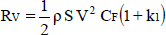
Some researchers of the viscous resistance, of international recognition, have considered it was necessary to affect this resistance by a factor "(1+ k1)", form factor for bare hull, which was obtained statistically. So, according to these researchers:
Last edited:
Forum posts represent the experience, opinion, and view of individual users. Boat Design Net does not necessarily endorse nor share the view of each individual post.
When making any potentially dangerous or financial decision, always employ and consult appropriate professionals. Your circumstances or experience may be different.
When making any potentially dangerous or financial decision, always employ and consult appropriate professionals. Your circumstances or experience may be different.
Advertisement:
Similar threads
- Replies
- 11
- Views
- 7,481


- Replies
- 32
- Views
- 21,937
