Epoxy water lock for wet exhaust

MichaelRoberts

Archimedes
Joined
Sep 6, 2015
Posts
82
Reaction score
26
Location
Australia
Just installing two 50 HP Yanmar diesels on a catamaran I am building
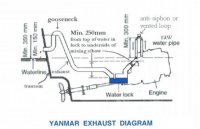
Yanmar "requires" that the level of water in the water lock muffler be 250 mm below the wet exhaust elbow.
Can't seem to fit any of the production water lift type mufflers - no space beside the engines
So I need to make a special shape to tuck in beside the engine bearers
Can I use West System epoxy to laminate a muffler - I've got lots and plenty of glass fabric too
The question is will it stand the heat - or do I need to use 316 stainless (which I can't weld)
Thanks for your advice
 

Attachments

  • Custom muffler.jpg
    Custom muffler.jpg
    344.5 KB · Views: 754
Data drives the decision.

Exhaust temp range must be known.

Normal epoxy doesn't even stand up to a heat gun. Stainless does.

Even stainless needs sufficient space to avoid a constant hot spot and burn through.

what boat?
 
Can you fit a production muffler in front of the motor & then fab a fibreglass cover over ?
 
Hello Peterbike - can't fit the muffler in front of the motor, it's pretty much up against the engine room bulkhead - just enough room to get at the impellerr
Fall guy is right, can't take the risk. I know epoxy softens as temp goes about about 80 C - and if the cooling water stops (seaweed over inlet) the plastic muffler would melt- I've got to go stainless - maybe I can fold the shape and pop rivet the ends - maybe I should eBay a cheap MIG welder
Fall Guy - here is picture of my boat - thanks for your interest
 

Attachments

  • Pic for Shellharbour Marina 3.jpg
    Pic for Shellharbour Marina 3.jpg
    197.4 KB · Views: 570
If you are close to the hull and it is epoxy and foam; not sure I'd be buying a welder and making my own parts. There are times to open the wallet. Find a custom muffler fab shop. One in California might spec the work and someone there in Australia could fab.

Boat looks gorgeous; take no shortcuts bud.
 
Have you considered underwater exhaust exits, without mufflers?
Correctly designed and executed, this can be a viable alternative.
Fire retardant resin should be used in construction of any exhaust system item.
 
Can I use West System epoxy to laminate a muffler

We did use epoxy to fabricate the tube. High temp and fire resistant just to be sure. Phenolic resin comes to mind. Commercial waterlock even comes in plastic. You need high temperature exhaust rubber tube though. Right after the exhaust, before the waterlock.
 
Too late - just bought a little MIG welder for $189 on eBay - anybody know how to MIG weld? I only know stick welding - and not good at that either
I hear you Fallguy - I will keep a good air gap and a heat shield between my DIY stainless muffler and the epoxy/glass hull
Like the idea of the underwater exit kapnD. Trouble is, Yanmar sort of insist on the above water exit (see attached) - probably there would be no warranty if I don't follow their rules
Good chatting, thanks
 

Attachments

  • Sketch Yanmar exhaust system.jpg
    Sketch Yanmar exhaust system.jpg
    45.1 KB · Views: 2,838
I profess zero expertise on mufflers, but I'm not sure to interpret you can't exhaust below wl. The requirement is the location of the waterlock.

Quite a few of these above hull exiting engines are disliked for noise. Before you build it; consider researching @kapnD s good advice and see if they offer a below waterline exhaust scheme at Yanmar.

If I were custom building such a boat; last thing I'd want is loud.

my boat will run twin 90 hp engines; not getting around loud; maybe got you beat on the low end; probably hard to hear the obs at idle
 
Last edited:
Can I use West System epoxy to laminate a muffler - I've got lots and plenty of glass fabric too
The question is will it stand the heat - or do I need to use 316 stainless (which I can't weld)
Thanks for your advice

Yes you can use epoxy. Normal wet exhaust hose is rated max. 100°C, Pro Set HT-182 is rated 149°C after postcure. Normal exhaust water temp is around 50°C, and high temperature alarms are usually set around 75°C. Glass transition onset for West 105 is 60°C, so even this would work. You don't have to believe a word I wrote, call your West system technical advisor and ask.

To laminate a tank, sculpt a plug out of styrofoam, laminate over it, dissolve foam with acetone or gasoline. To postcure (if needed) stick an incandescent lamp into it if you don't have a big enough oven.
 
Thank you very very much Rumars - clever idea laminating over a block of foam and dissolving out later - have not tried that one
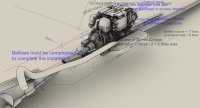
Here is my latest CAD drawing of the muffler tucked in beside the bearers
Muffler volume is more than double that of half full hose so residual water in hose when engine stops will safely drain back into low end
Fallguy I don't want any noise - just the occasional whoosh as the muffler blows water - so next problem is where to place baffles
What a great world we live in when so many knowledgeable people can so easily be reached
Thanks again
Muffler beside bearers with hose.jpg
 
A guy I worked with made wet exhausts for a sideline. I believe he used a phenolic resin.
 
Volvo Penta has an excellent technical article on the design of wet exhaust/waterlock. Outlet should be above waterline so you can inspect it. It should have a flaffer valve. The exhaust pressure pushes the water out of waterlock. The volume of the exhaust tube + the volume of the inlet tube should be less than the volume of the waterlock lest you risk flooding the engine with water when you shut off the engine. The stagnant water from the exhaust tube and the inlet will flow back to the waterlock. It should have enough capacity so that it does not overflow.

Yes we did fabricate the waterlock out of SS and tig welded. There is also a baffle on the waterlock. High temp rubber inlet, ss waterlock, epoxy fiberglass tube for outlet.
 
  • I can’t tell from your drawing where the vessels waterline falls in relation to the motors exhaust outlet , but I’d be more comfortable with a dry exhaust riser to insure no return water flow. The Yanmar drawing has potential to flood the motor through the exhaust through extended cranking or water intake seeping. Although in theory it will work, IMO holds way too much water.
  • Visit sbmar.com “tips” section for some great reading on the subject.
 
Morning gentlemen

kapnD -
  1. the attached side elevation shows waterline
  2. the Yanmar mixing elbow is 80 mm/3.2 inches above water line
  3. muffler volume according to everything I read should be safely more than the residual water in the hose - in this case max 6 litres in the hose vs muffler volume about 17 litres
  4. the exhaust end of the hose goes to the lowest point of the muffler
  5. thanks - sbmar.com tips - very helpful
  6. there needs to be a little drain at the low point of the muffler to get rid of stagnant water (so cold cranking doesn't cause trouble) - but where to drain to

fallguy -
  1. will do everything I can so that all we hear is a quiet whoosh once a second as water is expelled. I have thick bulkheads with lots of sound insulation
  2. My old boat has a Perkins 60 - noise drives us mad after 24 hours through a storm. So for some years I researched going electric using BLDC motors with planetary gear boxes and lithium iron phosphate batteries. Reluctantly I concluded that it was not possible to store enough energy in a reasonable weight of batteries to endure stormy days.

rx composite -
1. the flapper valve at the sea end is a really good suggestion
2. will investigate high temp phenolic resin

Finally a political comment - please excuse. Some one said " open your wallet, buy a custom muffler …" Unfortunately for Australia we have become a society of consumers of Chinese made everything - our skills are depleted, our machine shops sold for scrap. At Sydney University where I taught engineering we had a vast workshop of lathes, milling, cutting and welding equipment - all sold for scrap and the skilled staff put out to pasture. Those with skill are in high demand. For example I have tried to get some custom stainless diesel tanks made - sheet metal workers just too too busy. We live in interesting times.

Thanks again for the valuable comments
Muffler side elevation.jpg


Michael
 
Forum posts represent the experience, opinion, and view of individual users. Boat Design Net does not necessarily endorse nor share the view of each individual post.
When making any potentially dangerous or financial decision, always employ and consult appropriate professionals. Your circumstances or experience may be different.

  • Back
    Top