rwatson, that's... Very interesting comparison  but you made your point. It's good to know that there is a lot of different experience still ahead. Thank you.
Petros, I thought that there were upwind sailing even before! If you say that it's only a century since upwind sailing technique was developed, what about Age of Sail ships? Entire wars were fought in seas and oceans, with everything from schooners to full-rigged ships. I realize that with mostly-square sail rigging they were designed to run downwind, but they still had some upwind capability, right? If not, how could they go back and forth across the seas, harbors, etc? I assume that sometimes there just weren't favorable wind, and it was upwind sailing versus smashing into rocks choice. So, what was their upwind capability, if any, how many degrees from the wind?
troy2000, thank you for advice with leeboards, but it takes about 2 minutes to remove them (or to put them in place), so I'd rather not risk it, since boat covers a lot of distance while doing that, and I pretty much can't control it, unless I rig an autopilot (also I don't want to risk it in stronger winds).
Well, another sailing day. Wind was very strong and gusty today (15-20m/s gusts, according to forecast). I started upwind from the berth (I always do that, so if something goes wrong, I could return easily downwind with sail or oars, if worst would happen), and fought through these gusts. I have to say that it was very, very difficult to do - I expected that boat will be able to point higher with strong wind, but drift ruined things. I guess it has to do something with hull windage, or lack of my skill. I tried flattening sail, as I red in books, but still, it was difficult. So I climbed upwind about 500 meters through 200m wide sleeve for about an hour (I guess I had to tack 15-20 times in these 500 meters). That's estimated, not accurate. I guess boat makes about 50-60 degrees into the wind. Not very efficient, but it's better than nothing.
As I approached the end of the sleeve, where it opens up to the broad part of the lake, wind and gusts increased to a level that I didn't dare to continue. I turned downwind towards the berth.
And then the hell started...
Mast leant forward, stressing the stays, hull started to crack in their attachement points, one leeboard made a distinctive wood breaking sound, and the boat turned towards wind so strong and quick, that I couldn't counteract it with rudder. Sail started to flutter painfully, and the boat heeled so much that the side went underwater, and collected a few buckets of water. It would certainly collect more, but I released mainsheet, turned nose towards wind, sacrificing the sail rather than sinking the whole boat. Recovered from panic, I established upwind course again, since it seemed safest, and tried to slowly turn downwind again - same thing happened (I didn't turn exactly downwind, just some 30-40 degrees from downwind, with intention of zigzaging), I couldn't control the boat. I couldn't even remove leeboards, since I had to fight with the mainsheet and rudder. In seconds, I attached additional pulley to the mainsheet, and covered that 500m distance back to berth in less than 5 minutes - but as I approached it in about 5-6 knots I understood with horror that boat can't enter safety of that berth with leeboards still down, and if I remove them, it'll drift so much that we won't be able to come back. In lack of choice, I removed leeboards, folded the sail, and started oaring against wind. Sail freed itself from the folding line, and started flutter again. In about 10 minutes, this chaos finally ended.
Well, things could be worse. Sail shattered itself, unglued in few places. Leeboard broke a supportive wood block (because it was pierced with numerous wood screws without drilling holes first, my bad), but it's nothing too important. I'm just lucky that mast didn't fall, breaking off rails.
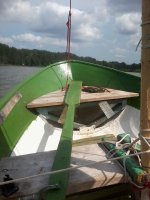
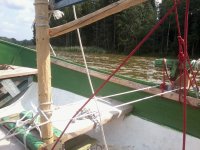
Repairs took me about 2 hours. I refitted the mast, attaching stays in 2 different places rather than 1 to distribute the load (also moving them backwards, to hold mast better on downwind), re-lashed leeboards differently so that stress is easiened on the wood and screws, and fixed unglued sail section with lots of almighty duct tape.
So, today I learned that nature is not something to joke with, and it's better to be safe than sorry.
Anyways, I don't remember exactly reading anything anywhere how to deal with wind gusts in upwind and downwind runs, so that they don't break or flip around the boat. In upwind, it seems intuitive to loosen the mainsheet and turn nose into the wind, but that might flutter the sail to death. On downwind, I don't know. Turn around to point nose into wind again? Might be dismasted by the time I do that. Try to increase speed, so that apparent wind would lower, and loads from the mast would easen?
If anyone can give any advice how to deal with gusts in boat where things barely hold, I would appreciate that. I don't plan to sail into similar conditions again, but they can happen without warning as they did today.
but you made your point. It's good to know that there is a lot of different experience still ahead. Thank you.Petros, I thought that there were upwind sailing even before! If you say that it's only a century since upwind sailing technique was developed, what about Age of Sail ships? Entire wars were fought in seas and oceans, with everything from schooners to full-rigged ships. I realize that with mostly-square sail rigging they were designed to run downwind, but they still had some upwind capability, right? If not, how could they go back and forth across the seas, harbors, etc? I assume that sometimes there just weren't favorable wind, and it was upwind sailing versus smashing into rocks choice. So, what was their upwind capability, if any, how many degrees from the wind?
troy2000, thank you for advice with leeboards, but it takes about 2 minutes to remove them (or to put them in place), so I'd rather not risk it, since boat covers a lot of distance while doing that, and I pretty much can't control it, unless I rig an autopilot (also I don't want to risk it in stronger winds).
Well, another sailing day. Wind was very strong and gusty today (15-20m/s gusts, according to forecast). I started upwind from the berth (I always do that, so if something goes wrong, I could return easily downwind with sail or oars, if worst would happen), and fought through these gusts. I have to say that it was very, very difficult to do - I expected that boat will be able to point higher with strong wind, but drift ruined things. I guess it has to do something with hull windage, or lack of my skill. I tried flattening sail, as I red in books, but still, it was difficult. So I climbed upwind about 500 meters through 200m wide sleeve for about an hour (I guess I had to tack 15-20 times in these 500 meters). That's estimated, not accurate. I guess boat makes about 50-60 degrees into the wind. Not very efficient, but it's better than nothing.
As I approached the end of the sleeve, where it opens up to the broad part of the lake, wind and gusts increased to a level that I didn't dare to continue. I turned downwind towards the berth.
And then the hell started...
Mast leant forward, stressing the stays, hull started to crack in their attachement points, one leeboard made a distinctive wood breaking sound, and the boat turned towards wind so strong and quick, that I couldn't counteract it with rudder. Sail started to flutter painfully, and the boat heeled so much that the side went underwater, and collected a few buckets of water. It would certainly collect more, but I released mainsheet, turned nose towards wind, sacrificing the sail rather than sinking the whole boat. Recovered from panic, I established upwind course again, since it seemed safest, and tried to slowly turn downwind again - same thing happened (I didn't turn exactly downwind, just some 30-40 degrees from downwind, with intention of zigzaging), I couldn't control the boat. I couldn't even remove leeboards, since I had to fight with the mainsheet and rudder. In seconds, I attached additional pulley to the mainsheet, and covered that 500m distance back to berth in less than 5 minutes - but as I approached it in about 5-6 knots I understood with horror that boat can't enter safety of that berth with leeboards still down, and if I remove them, it'll drift so much that we won't be able to come back. In lack of choice, I removed leeboards, folded the sail, and started oaring against wind. Sail freed itself from the folding line, and started flutter again. In about 10 minutes, this chaos finally ended.
Well, things could be worse. Sail shattered itself, unglued in few places. Leeboard broke a supportive wood block (because it was pierced with numerous wood screws without drilling holes first, my bad), but it's nothing too important. I'm just lucky that mast didn't fall, breaking off rails.
Repairs took me about 2 hours. I refitted the mast, attaching stays in 2 different places rather than 1 to distribute the load (also moving them backwards, to hold mast better on downwind), re-lashed leeboards differently so that stress is easiened on the wood and screws, and fixed unglued sail section with lots of almighty duct tape.
So, today I learned that nature is not something to joke with, and it's better to be safe than sorry.
Anyways, I don't remember exactly reading anything anywhere how to deal with wind gusts in upwind and downwind runs, so that they don't break or flip around the boat. In upwind, it seems intuitive to loosen the mainsheet and turn nose into the wind, but that might flutter the sail to death. On downwind, I don't know. Turn around to point nose into wind again? Might be dismasted by the time I do that. Try to increase speed, so that apparent wind would lower, and loads from the mast would easen?
If anyone can give any advice how to deal with gusts in boat where things barely hold, I would appreciate that. I don't plan to sail into similar conditions again, but they can happen without warning as they did today.