
The Boat Design & Boatbuilding Site
Install the app
How to install the app on iOS
To install this app on your iPhone:
- Tap the Share button at the bottom of Safari.
Tap ... if Share is not visible, then Share - Tap Add to Home Screen
Tap View More and scroll down if needed to see Add to Home Screen, then Add to Home Screen. - Tap Add on the top right to confirm.
Note: This feature may not be available in some browsers.
You are using an out of date browser. It may not display this or other websites correctly.
You should upgrade or use an alternative browser.
You should upgrade or use an alternative browser.
anchor "STORM" DIY
- Thread starter Bonaparte
- Start date



Angélique
aka Angel (only by name)
- Joined
- Feb 15, 2009
- Posts
- 3,003
- Reaction score
- 338
- Location
- Belgium ⇄ The Netherlands
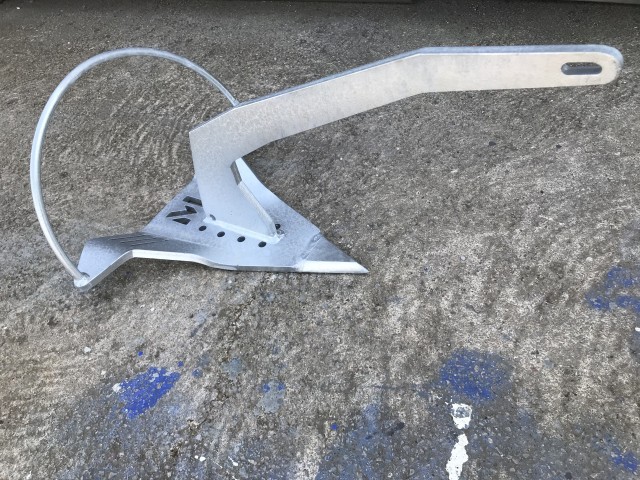
Being a two part issue is again only an advantage for Mantus there, and not for the customer.I heard of a sailor who bent the shank of his Mantus anchor (because it was made of faulty steel). Mantus promptly sent him a replacement. Easy to replace because it was bolted on.
According to Murphy with the storm anchor disassembled stored in the bilge there will be a day (or night) you're fighting your way off a lee shore, and then when you're unable to make it, you're also unable to drop the storm anchor, because it still lies disassembled stored in the bilge, and so while you there unsuccessful fighting your way off that lee shore, you have no time to get and assemble the storm anchor and bring it in position when you need it most.Some people have an extra large Luke fisherman's anchor as their storm anchor because they can break it down and store it in the bilges when not needed. You might be able to do that with a Mantus-type as well.
I'm not religious of any kind, but I'll think lessons can be learned from the Parable of the Ten Virgins, so be prepared and don't store any emergency stuff disassembled in the bilge.
→ line 13 of the parable → ‘‘ keep watch, because you do not know the day or the hour ’’ ←
Last edited:

gonzo
Senior Member
- Joined
- Aug 28, 2002
- Posts
- 18,626
- Reaction score
- 2,510
- Location
- Milwaukee, WI
That is bad seamanship.I will have only one anchor on the boat. But this will be good anchor.

ImaginaryNumber
Imaginary Member
- Joined
- May 8, 2009
- Posts
- 436
- Reaction score
- 60
- Location
- USA
FWIW, it's a three-part anchor; blade, stock, hoop (plus bolts, etc)Being a two part issue is again only an advantage for Mantus there, and not for the customer.

Part of the advantage to Mantus may also accrue to the customer. An anchor, which can be shipped flat, may be cheaper both to Mantus and to the customer. And a customer who damages part of an anchor may be able to purchase a replacement part cheaper than buying a whole new anchor.
I think of a storm anchor as being reserved for use during hurricanes/typhoons, which generally are known about well in advance. In the mean time, the anchor is adding ballast to the boat, thus fulfilling its obligation to have at least two uses for everything on board.According to Murphy with the storm anchor disassembled stored in the bilge there will be a day (or night) you're fighting your way off a lee shore, and then when you're unable to make it, you're also unable to drop the storm anchor, because it still lies disassembled stored in the bilge, and so while you there unsuccessful fighting your way off that lee shore, you have no time to get and assemble the storm anchor and bring it in position when you need it most.
I'm not religious of any kind, but I'll think lessons can be learned from the Parable of the Ten Virgins, so be prepared and don't store any emergency stuff disassembled in the bilge.
→ line 13 of the parable → ‘‘ keep watch, because you do not know the day or the hour ’’ ←

Also, as Gonzo suggested, it's not a bad thing to have an extra anchor or two on board in case your primary anchor becomes irretrievably fouled. All good reasons for a disassemblable or folding anchor.


Northill folding stainless steel anchor
Angélique
aka Angel (only by name)
- Joined
- Feb 15, 2009
- Posts
- 3,003
- Reaction score
- 338
- Location
- Belgium ⇄ The Netherlands
Now that's no reason to disassemble any anchor, in the contrary, you gave a reason to have the other anchors ready for use.Also, as Gonzo suggested, it's not a bad thing to have an extra anchor or two on board in case your primary anchor becomes irretrievably fouled.
All those reasons are passing by that a certain class of events may occur all the time, but are only noticed when they become a nuisance, such as forgetting to assemble the storm anchor when you may need it, or underestimating the upcoming weather in relation with the local currents, or rapidly deteriorating weather conditions, which sometimes can go faster than beforehand predicted.All good reasons for a disassemblable or folding anchor.
The benefits of a folding anchor are quite different to a disassembled one stored in the bilge, although the blade angles there look to me to be too much near parallel to the stock for a good dig in, would love to see some underwater footage of that process.-
Northill folding stainless steel anchor
BTW, are they forced to be always spread out when deployed . . ?
ImaginaryNumber
Imaginary Member
- Joined
- May 8, 2009
- Posts
- 436
- Reaction score
- 60
- Location
- USA
Now that's no reason to disassemble any anchor, in the contrary, you gave a reason to have the other anchors ready for use.
All those reasons are passing by that a certain class of events may occur all the time, but are only noticed when they become a nuisance, such as forgetting to assemble the storm anchor when you may need it, or underestimating the upcoming weather in relation with the local currents, or rapidly deteriorating weather conditions, which sometimes can go faster than beforehand predicted.
The benefits of a folding anchor are quite different to a disassembled one stored in the bilge...
In a perfect world all extra anchors would stay permanently shackled to their rodes, and all sails would stay permanently hanked onto the rigging. But since we don't live in a perfect world, many items have to be stowed in less than convenient locations. In the case of extra anchors that often means somewhere in the bilges.
The Northill anchor was adapted for use by the Catalina flying boats during WWII because of their compact shape and light weight.

Angélique
aka Angel (only by name)
- Joined
- Feb 15, 2009
- Posts
- 3,003
- Reaction score
- 338
- Location
- Belgium ⇄ The Netherlands
I'm OK with you disassemble them first before doing so, but it give me peace of mind I've warned about it.. . . . many items have to be stowed in less than convenient locations. In the case of extra anchors that often means somewhere in the bilges.
Angélique
aka Angel (only by name)
- Joined
- Feb 15, 2009
- Posts
- 3,003
- Reaction score
- 338
- Location
- Belgium ⇄ The Netherlands
Steve of the last video in post #54 has posted a lot of his anchor test videos, here's #1, and here's #70, the rest till now is in between.
There's a thread about it on the Trawler forums: Anchor setting Videos
The anchor test boat in the vids is an aluminum built ± 34' LOD Colvin Saugeen Witch* gaff sloop, with a pilot house instead of a cockpit, which usually sails in the PNW.
* Wayback Machine link to Tom's moderate displacement ocean sailing designs, since Tom's R.I.P. own website is offline since a while now.
There's a thread about it on the Trawler forums: Anchor setting Videos
The anchor test boat in the vids is an aluminum built ± 34' LOD Colvin Saugeen Witch* gaff sloop, with a pilot house instead of a cockpit, which usually sails in the PNW.
* Wayback Machine link to Tom's moderate displacement ocean sailing designs, since Tom's R.I.P. own website is offline since a while now.
Last edited:
Angélique
aka Angel (only by name)
- Joined
- Feb 15, 2009
- Posts
- 3,003
- Reaction score
- 338
- Location
- Belgium ⇄ The Netherlands
Marco, thanks for sharing your anchor test research, and the build info . . 
Like [U]Diesel guy[/U] said in post #50, to also have a kedge does make sense, I don't know how to say it in Slovak, as I don't trust automatic translators on any jargon yet, so I'll post the definition from the Oxford living dictionaries, as well as the there given example sentences, since some of them tell about the applications...
Definition of kedge in English:
Like [U]Diesel guy[/U] said in post #50, to also have a kedge does make sense, I don't know how to say it in Slovak, as I don't trust automatic translators on any jargon yet, so I'll post the definition from the Oxford living dictionaries, as well as the there given example sentences, since some of them tell about the applications...
Definition of kedge in English:
P.S. - Some more kedge info (in English): Wikipedia Anchor ---> Anchoring gear ---> KedgingVERB: (with reference to a boat) move or be moved by hauling in a hawser attached at a distance to a small anchor.
Example sentences:
[with object] ‘I kedged the dinghy to the port’
[no object] ‘most of the smaller boats had to kedge for a while’
More example sentences:
‘Nobody we saw kedged at this point, although we did consider both the act and the chaos it might cause if everyone tried it…’
‘In beautiful sunshine and beautiful surroundings we kedged ourselves off and managed to catch the last lock of the day into the swamp.’
‘As at Goshen, these craft, because of the narrowness of the creek, had to be launched sideways, and then were often kedged down the creek to the bay.’
‘The British were taken aback by the enemy ship's apparent burst of speed, but they soon discovered the trick and began kedging themselves.’
‘Disaster threatened until Captain Hull astutely towed, wetted sails, and kedged to draw the ship slowly ahead of her pursuers.’
‘Once we kedged our way off a mud bar on the Mystic River, the silty anchor tossed again and again till our boat glided free.’
‘In fact, the reverse may be the problem and we could be spending time kedged as the tide turns foul off Portland Bill (if we even get that far!’
‘The wheels extend below the deployed outboard hulls to assist in kedging by reducing friction, suction, and risk of hull damage.’
‘On October 16 the ships kedged their way up the harbor and formed a line out of range from shore.’
‘Preparations for kedging should be made well clear of the shore, outside any surf line which exists.’
‘A few boats came by and gave a ride to most onboard while we waited for the tide to turn and eventually kedged ourselves free.’
‘Still he dutifully logged the coordinates and, helped by the tide, kedged his ship off the reef leaving behind an island whose far and distant isolation would one day become its most valuable feature.’
‘Notice that you need to ‘pull on the line’ in order to actually perform the process of kedging.’
- - - - - - - - - - - - - - - - - - - - - - - - - - - - - - - - - - - - - - - - - - - - - - - - - - - - - - - - - - - - - - - - - - - - - - - - - - - - - - - - - - - - - - - - - - - - - - - - - -
NOUN: A small anchor used for kedging.
Example sentences:
‘The crew had run out the kedge anchor to move the vessel ahead when breaking seas interfered.’
‘The stern is marked by a small kedge anchor.’
‘So, equipped with kedge anchors and cable, and adorned in their skin-tight diving gear, they set off.’
‘Use a Dinghy or tender to row the kedge anchor in deeper water.’
‘At least double the scope required is paid out and the kedge anchor is dropped.’
- - - - - - - - - - - - - - - - - - - - - - - - - - - - - - - - - - - - - - - - - - - - - - - - - - - - - - - - - - - - - - - - - - - - - - - - - - - - - - - - - - - - - - - - - - - - - - - - - -
Origin: Late 15th century: perhaps a specific use of dialect cadge ‘bind, tie’.
Pronunciation: kedge / kɛdʒ /
Anchoring gear
. . . . A kedge anchor is a light anchor used for warping an anchor, also known as kedging, or more commonly on yachts for mooring quickly or in benign conditions. . . . .
Kedging
Kedging or warping is a technique for moving or turning a ship by using a relatively light anchor.
In yachts, a kedge anchor is an anchor carried in addition to the main, or bower anchors, and usually stowed aft. Every yacht should carry at least two anchors – the main or bower anchor and a second lighter kedge anchor. It is used occasionally when it is necessary to limit the turning circle as the yacht swings when it is anchored, such as in a very narrow river or a deep pool in an otherwise shallow area.
For ships, a kedge may be dropped while a ship is underway, or carried out in a suitable direction by a tender or ship's boat to enable the ship to be winched off if aground or swung into a particular heading, or even to be held steady against a tidal or other stream.
Historically, it was of particular relevance to sailing warships which used them to outmaneuver opponents when the wind had dropped but might be used by any vessel in confined, shoal water to place it in a more desirable position, provided she had enough manpower.
Last edited:
Hello, as I undestand it, A kedge anchor would be deployed to yer stern, more than possibly from a dinghy and would be used to pull you out of trouble if you hit a sandbank or ran aground in whatever shirt that happens
Forum posts represent the experience, opinion, and view of individual users. Boat Design Net does not necessarily endorse nor share the view of each individual post.
When making any potentially dangerous or financial decision, always employ and consult appropriate professionals. Your circumstances or experience may be different.
When making any potentially dangerous or financial decision, always employ and consult appropriate professionals. Your circumstances or experience may be different.
Advertisement:
Similar threads


- Replies
- 10
- Views
- 5,109