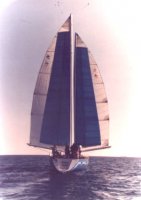
Below an interesting boat with 2 free standing masts and kind of wing sails :
http://www.voilesetvoiliers.com/gra...e-3-matin-bleu-la-goelette-ailee-en-question/
...
We should all learn how to speak French. That is the language of sailing!
At least when it comes to innovation.
Here, they have dealt with an ancient problem in a very interesting way.
The problem being the ugly bump the mast makes at the leading edge of a fore and aft sail.
This ugly bump disrupts airflow around the sail, often killing its drive.
There have been a number of methods, ancient and modern, to deal with this problem (though the ancients didn't understand aerodynamics in the modern sense, they were keen on what worked well and what didn't). I'll state them in the order they most likely appeared:
1.) move the leading edge (luff) of the sail forward of the mast. The mast is still providing drag, but is not disrupting airflow over the lee side of the sail, the side that counts.
Two examples of this are the northern European dipping lug and the more southern European latteen sail. (other cultures had developed these rigs as well, but they are well known in Europe)
The dipping lug sail was always set downwind (lee) of the mast, so the luff was always in clean air, and the lee side could form a nice fore and aft curve.
The lateen sail had a long yard along its entire leading edge, but since it was supported by the mast at one third to one half its length, The yard could be much thinner than a mast would be if it went up the entire leading edge itself, and so provided far less disruption.
2.) Increase the fore and aft length (foot) of the sail, so the mast thickness divided by the sail foot is smaller. This way, the air flow disrupted by the mast has a greater chance to reattach itself to the lee of the sail, restoring most of the drive.
A good example of this is a Cape Cod cat boat, with its short leading edge (luff) and its long chord. This may be a main reason early gaff rigs somewhat squat in their appearance.
3.) Set a smaller sail ahead of the larger 'drive' sail to smooth out disruption caused by the mast.
This sail was more often than not a jib. The jib directed clean airflow past the lee side of the mast, smoothing out disruption there. (later, when high tension luffs became possible, jibs were discover to produce excellent drive themselves)
4.) Streamline the mast by making it thinner, side to side.
This was done by turning the mast into the compression member of a truss system, with stays, shrouds and spreaders on either side. This worked best for upwind sailing, as when the boat was sailing across the wind, the wider fore and aft side of the mast ended up in front of the sail's luff. But since boats were judged primarily by their upwind ability, by that time, this seemed a small sacrifice.
5.) Streamline the mast and allow it to pivot with the sail. This way the fore and aft side of the mast almost never presents disruption on the lee side of the sail.
6.) Make the sail into a symmetrical airfoil, with cloth on both sides, and put the mast inside the airfoil.
This is what has been done here, except the symmetrical airfoil does not not extend the entire length of the foot.
I'm surprised the 'symmetrical airfoil' approach is not used more often. I suppose there is a worry about weight, or the symmetrical airfoil does not provide as much lift as a single cloth sail (forming an asymmetrical airfoil) does.
Maybe the second reason is why they took this approach. This sail, in its entirety, can still form an asymmetrical airfoil.



 ) all have very thin and long wings...