For race boats, how would you describe the potential key advantages ?
For the same reasons that they make good cruising rigs:
First, there are A LOT fewer rig parts to go wrong--drop, break, etc. The increase is rig safety is inversely proportional to the number of fittings that are not used--many hundreds of percent. As I have said before, if it is not there, it cannot break. If you break the rig, you are out of the race, most likely. If you want to be first, first you have to finish.
Second, free-standing rigs have proven themselves to be every bit as efficient as top notch stayed rigs, and in some cases, even more so. That means that they can sail to windward with the best of them. And in round-the-world racing, particularly in multi-stop races, you always have a mix of maritime weather and continental weather, which means that a lot of the time the wind is on the nose and you need to get to where the wind is coming from. Go back through the history of round-the-world racing and count how many times legs are won or lost in the last stages of the leg when boats are trying to beat each other upwind getting into port. It happens a lot.
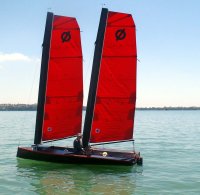
Third, a free-standing cat-ketch rig is naturally stable downwind (sails set wing and wing, booms forward of the beam) and this makes the boat practically immune to gybing. If you get caught in an uncontrolled gybe, the boat can suddenly broach and that puts you in danger, really great danger, of getting hit hard sideways by waves. Count how many times THAT happens in a round the world race! It's not so much the winds that break you, it's the waves! They cause real damage and they can roll you over. If you get rolled over, chances are you could be out of the race. With a free-standing cat-ketch rig, uncontrolled gybing and subsequent broaching simply do not happen.
Fourth, with the sails set for downwind as above, you are generating driving force by LIFT in the rig, not so much with DRAG as typically occurs with a stayed rig. This makes the boat that much faster, proven to be significantly faster than stayed rig boats of equal proportions. Also, you can sail a lot deeper downwind, you don't have to tack downwind as is typical with many open class boats. So your VMG downwind is much better, both because of speed and with pointing angle.
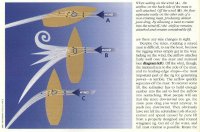
Fifth, with rotating wingmasts, sail handling is much easier. Setting and shaking reefs can occur while the boat is on course. On a stayed rig boat, if you are sailing off the wind and you want to set a reef, first you have to bring the boat into the wind--you are stopped dead in the water. You are not racing. You are not sailing toward the finish line. You spend 15-30 minutes setting the reef, then you get back to the business of sailing. During that reef time, if you are not careful, the boat can get beaten and broached by the waves. (See point 3 above.) Really, you are a sitting duck. The reverse happens when shaking out the reef--you are stopped dead in the water. On a free-standing wingmast cat-ketch, when you set the reef,
you stay on course, you do not stop. You luff the
mast, not the boat, by letting the boom swing out until the mast and sail weathervane. The boat is on course, sailing toward the finish line. You pull in the reef, and you reset that mast and sail to their proper angle of attack. You have not stopped all that time, you've gained miles on your competitors. The same happens in reverse when you shake out the reef--you are always on course sailing for the finish line, no stopping dead in the water, no threat of wave hits or broaches.
All that to me seems like A LOT of advantages, even more so now when race finish times between boats seem to be getting shorter and shorter. I would think that the prudent skipper would like to have all these factors in his quivver of tactical and design advantages.
Eric