
16/30 Sailing Canoe Rig Options + Skin Thickness

pyrrxa

Junior Member
Joined
Aug 10, 2026
Messages
5
Reaction score
0
Location
United States
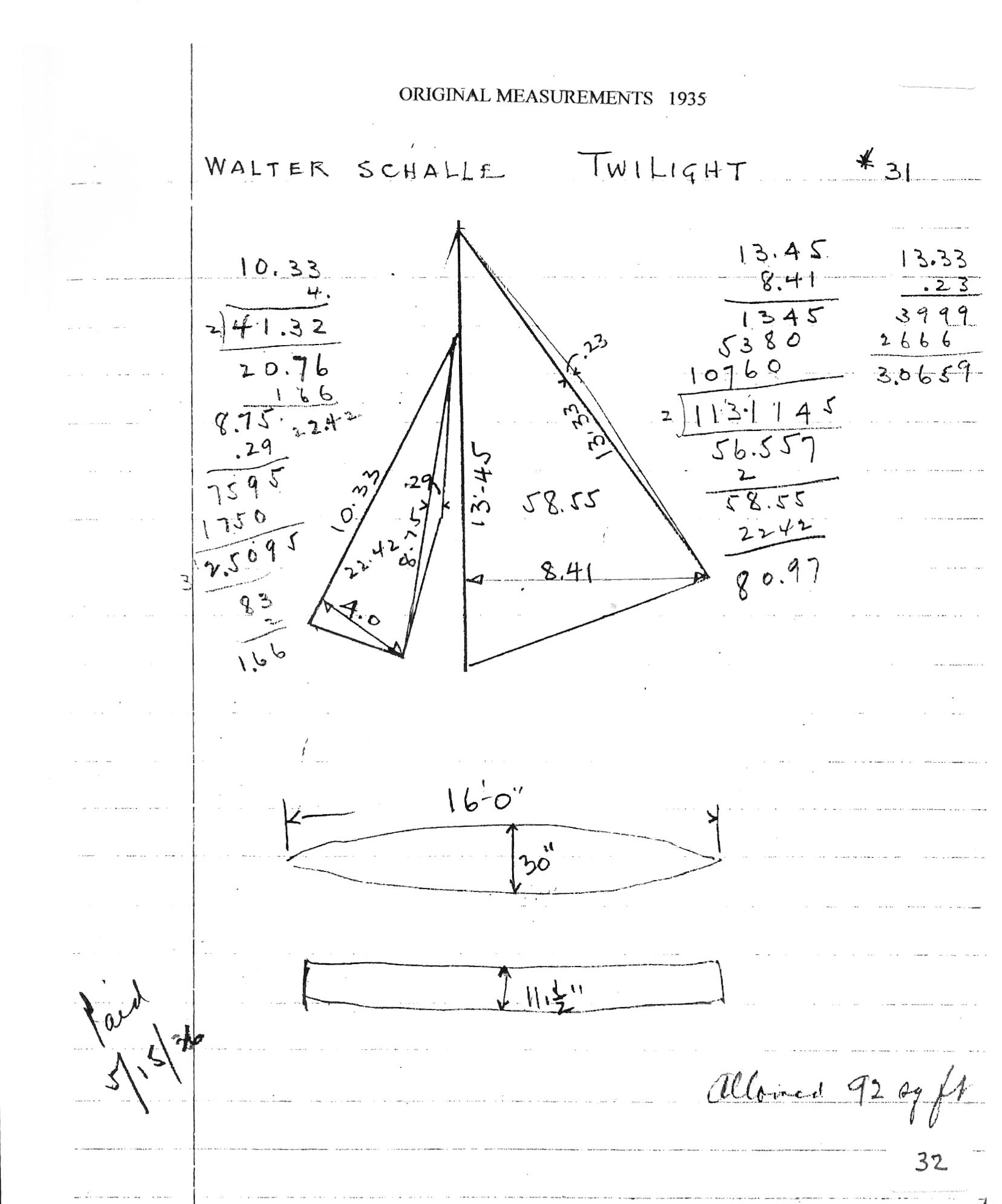
After a prolonged search for a boat that ticks my boxes of car-toppable, engaging sailing, and opportunities to waste time fiddling with over-complicated rigging, I've settled on building a 16/30 canoe. General construction documentation was created as a museum project back in 2009 in NY and published in Small Boats Magazine (Client Challenge https://www.scribd.com/document/710038848/Sailing-canoe-plans). For those unfamiliar, the 16/30 was an early attempt to standardize sailing canoes just before the first International Canoe rules were established. The 16/30 is traditionally ketch-rigged with about 90sqft of sail split 2/3, 1/3 between the main and mizzen. Supposedly a handful with just 30in of beam. However, in the spirit of not being able to leave well enough alone, I'd like to convert it to a fractional sloop rig of a similar size. The canusail.org website, run by the son of the American Canoe Association measurer during the period in question, has some of the original measurement documents for sloop-rigged canoes of this size.
zuk-053.jpg


The attached image shows the measurements for a later design by Walter Schalle, whose name shows up throughout sailing canoe history, so there is some pedigree there.

My intention is to mostly copy the design as shown, but my primary concern is sourcing spars and handling the additional load from a stayed rig. Windsurf masts make attractive options, but I've seen mixed results regarding converting them for sailing. Adding shrouds and a forestay should alleviate some of the issues with providing righting moment from the heel/partner rather than the boom, but I was curious if there was any experience with similar situations. I would design the sails with luff pockets ala moths/etc. Additionally, whether the shroud attachments/mast compression forces would need additional special attention beyond ensuring that they are well supported by blocking under the deck. My backup plan is to create wooden spars, at least for the mast. While more laborious, it may be that the effort to convert the windsurf spars and any subpar sailing characteristics would make it worth it.

Thank you in advance!
 
1786425086300.webp

A rough mockup of the rig, with CE marked. To my eyes it looks as though it will be too far aft, but I still need to calculate the CE of the original rig, and guesstimate the CLR.
 
It looks like an interesting project for use in warm water because you are likely to go swimming fairly frequently.If you have the luxury of bearable water temperature it will be great fun.I do have a couple of questions;why rake the rudder aft?It is the distance of the rudder from the CLR that determines the turning moment.The centreboard also looks a bit odd as it has a straight leading edge where most of us would put the radiused corner forward to deflect weed or stray lines.I also think you might avoid trouble by adding a generic human figure to the drawing to see if there is space beneath the sail when tacking.The hull shape looks really clean but there might be some cluttering when the mainsheet and all the steering gear are added.
 
The boat profile comes from the original plans, including the foil designs. I can’t speak to the designer’s intentions, but I’ll be replacing them with foils based on my 5o5 foils that I’ve got and been pleased with. I’m on the southern east coast, so warm water (and sandbars) are about the only things I have in abundance, sailing wise! Space under the boom is a definite question, since there is plenty of room with the ketch rig. I’ll do some calculations, but I think extending the cockpit aft a touch will help.
 
In addition to extending the cockpit,I'd suggest adding the tiller and extension(s).The 10 sq.m. canoes I have seen in the last few years are using long single extensions and the older cowhorn style has gone out of favour.Either way you are going to have to fit through the gap that remains and while facing aft is feasible when tacking,gybing also needs to be considered.A suitably scaled mannequin with pivoting joints might be a useful thing to add to your drawing.It will be more challenging if you opt for a self draining cockpit.Is this under consideration?
 
1786497107383.webp


With the current foils, the CLR is only about a foot behind the CE (~6.4% LWL). This should increase significantly with the higher-aspect rudder, but I may still have to move the mast step forward a touch. That would also alleviate some of the boom clearance issues.

All that being said, I feel like I'm speed-running the transition from American narrow beam canoes to modern ICs. I'd like to keep some of the classic feel of the 16/30, so I may need to do some priority analysis.
 
A few more thoughts:If a daggerboard is the intended foil,it may foul the mast when inserted or lifted,have you checked?The very high clew will make a mainsheet system quite a challenge.I did see some Moths a few weeks ago and wonder whether their cranked booms might be worth a bit of study both for human clearance and for mainsheet systems that work.I believe adding mainsheet,boom and tiller details to the drawing will be very useful.
 
1786571964133.webp


Added some of the rigging details and clearance dimensions. It looks doable with a transom sheeting arrangement, with the sheet taken off the boom like on a skiff. At the rear of the current cockpit, there's 3 ft of clearance to the sole, and 2.3 to the deck. My primary concern is that the high clew will make the sheet more of a leech tension control than an actual sheet. Probably fixable with the traveler, but I'll have to think about it. Switching to a traditional tiller + extensions potentially frees up some space, but I'm treating the deck as a no-step area so the effect is minimal.

1786572266107.webp


Looking at Falcon, a sloop rigged canoe from the '50s, the boom gooseneck is much higher. It also seems to have a flat deck overall, more like a modern IC.

1786572470739.webp


This view from the Antique Boat Museum shows the cockpit extending further forward than on the plans I have. Not much good without the higher boom position, but worth considering.
 
Forum posts represent the experience, opinion, and view of individual users. Boat Design Net does not necessarily endorse nor share the view of each individual post.
When making any potentially dangerous or financial decision, always employ and consult appropriate professionals. Your circumstances or experience may be different.

  • Back
    Top