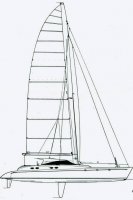
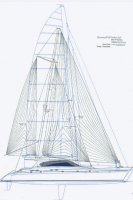
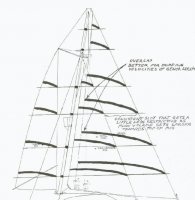
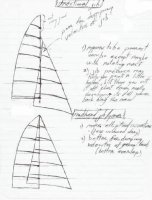
Aftmast rigs???

I think it is very useful to point out that absolute windward performance is a diminishing returns game. Once one gets to say 45 Degrees off the wind, at say a five knot speed, additional gains become exponetially more expensive. What really matters is speed made good to windward. So the faster your boat is, the more it can afford to point off the wind. This is good, because the faster a boat goes, the more forward the wind moves in relation to the boat (and sail rig choices much more limited).

A fast craft can't afford to point low in terms of apparent wind, because its apparent wind is so far forward that if it points low it will just reach back and forth. It's the other way around - the faster a craft is, the more attention must be paid to reducing drag and creating a high-pointing rig and foils.

This can be seen very dramatically on a high performance windsurfer or windfoiler, where you can easily switch entire rigs. If you use a rig or setup that "points off the wind" you will just reach back and forth, or maybe not even do that, because the apparent wind is so far forward. To get upwind you need a very high-pointing rig.
 
Hi Nick,
Welcome back to the forums, and this discussion in particular. I do welcome your contributions, particularly with illustrations.

Here is the problem I have with that diagram/analysis. That one vector component of your backstay force has a vertical ‘upward force’ to it. There is NO way in the real world that a sailboat’s backstay can pull ‘upwards’ on the masthead,….. horizontal at best.

I wanted to know what that horizontal force needed to be to offset the forestay’s forward force, regardless at first of what compression loads it was placing on the mast itself (that would come later).

So what forestay forward pulling force do I need to balance? The one presented by the 2 ton forestay load,...it’s horizontal component being 0.813 tons. Thusly, a backward horizontal force of 0.813 tons which translates into a backstay force of 2.25 tons ?
https://www.boatdesign.net/attachments/dscf9591-jpg.190750/


If I take your backstay load of something approx 5.5 -5.76 tons, and look at its horizontal component of 2 tons, ….that’s quite a bit in excess of the 0.813 pulling forward ?

Is my analysis in error?…..where??
 
Twin Backstays

I have always liked the idea of twin backstays,... to divide up the loading that each one carries, and the loads to the hull attachment points. I most cases its difficult to get this 'twin loading', as invariably one side goes slack due to slight migration of the masthead athwartships. I'm hoping to solve this by making the twin backstay(s) one continuous line that wraps around the mast at its upper connection ...or other solution?

Actually I am hoping to have BOTH of of my backstays (masthead and hounds) capable of performing similarly.

It might involve a method of wraping around the mast tube itself, or some sort of sheeve or 'loop' solution,....
https://www.boatdesign.net/threads/attaching-rigging-to-the-mast.68435/
https://www.boatdesign.net/threads/soft-rigging-solutions.47997/

Here is what those twin backstays look like on the model yacht,..
DSCF9605.JPG
DSCF9594.JPG


DSCF9595.JPG DSCF9598.JPG DSCF9598.JPG DSCF9600.JPG DSCF9602.JPG
 
Hi Brian,

I can assure you that the upwards force described in my diagram is most certainly correct. This is because it is created, not just by the tension of the backstay, but by the combination of the tension of the backstay AND the compression load on the mast.
The following diagram shows your forward leaning mast and back stay only (we'll ignore the forestay for now). If the mast is free to rotate about its base and supported so that it doesn't fall to port or stb, gravity will hold it in place as it leans forward. That is until we start pulling on the backstay. At this point it will start to rotate about its base and the masthead will follow the green arc - and in doing so move upwards! This is were the upwards force comes from. Each line in a vector triangle is always a COMBINATION of the other two sides. Each line must also always represent the direction of the force. The direction for the back stay and mast follow the angle of each component and the third vector which represents the rotational or torque force at the masthead which, if the forces are balanced and the mast head is static, is represented by a line tangential to the arc of rotation - yellow line in the diagram.
vectors.jpg

Now that we have established the correct angles for each vector we can give a value to one side of the triangle and find the balancing forces for the other sides. Working out the forestay is done in a similar way. The first to vector angles are the angle of the mast and the angle of the forestay and the third vector angle is again a line tangential to the green arc that also happens to be perpendicular to the mast. My original is correct and would indicate that a 2 ton static load on the forestay will result in some considerable forces of tension on the backstay and even bigger compression on the mast. All of this means more material in these components which means more cost and more weight aloft. This is always going to be the the disadvantage of a raked forward rig configuration. Not impossible though.
I am assuming you are familiar with the Dazcat Artemis?
Accessible Expedition Catamaran - The Multihull Centre https://www.multihullcentre.com/multimarine/current-projects/accessible-expedition-cat/
They use a similar aft-mast, headsail only set up, but the have kept the mast raked aft as this will reduce rig loads dramatically.

Hope this helps
 
I'm still thinking about the modifications I can make to my rig's staying.

In the mean time I just ran across this posting I made on another forum. It may help to explain why I became SO INTERESTED in this headsail plan,...

Arvel Gentry's passing & a Legacy of His Articles


Originally Posted by brian eiland
The gentleman who most deserves credit for finally getting the explainations of sail aerodynamics corrected, and upon which several excellent books by Tom Whidden and C.A. Marchaj are based has recently updated his website to include many of the technical papers and magazine articles he wrote on the subject originally. I had mentioned his name, Arvel Gentry, in these postings previously, but I could not make a direct reference to his many documents as they were not posted on his site at that time.

From his site,

Quote:

"I got involved in the technical aspect of sailing because I started racing. Reading the sailing books and magazines, I began to realize that most of what was written about the aerodynamics of sails was wrong, or certainly very misleading."

"The explanations for how lift is generated were based on popular myths. The description of the interactions between a jib and mainsail, the "slot effect", did not make much aerodynamic sense."

"I was soon launched on a quest to discover how our sails really worked. Over the years this resulted in a number of technical sailing papers and magazine articles. The technical sailing papers are archived in this section of my web site. My magazine articles can be reached from my Home page."

"If you are interested in sailing aerodynamics and how your sails work, you have come to the right place. All of my sailing technical papers and magazine articles are archived on the Technical Papers and Magazine Articles pages.

his original website (no longer any good)

Arvel Gentry has just recently passed away, but thank goodness someone has taken the job on to preserve his numerous papers. Check out the forum subject thread with a number of links to his papers:
Arvel Gentry's site

As is mentioned on the first posting of this subject thread that old website link is no longer valid. Rather have a look here for some fascinating articles of his on 'how sails work' :
Articles - Página web de arvelgentry

PS: His work contributed to my fascination with a primarily headsail rig. __________________
Brian Eiland

Excellent list of many of his papers in PDF form
 
Just posted a summary of some testing that verifies some of the aerodynamic claims I have been making about my aft mast rig.


http://www.cruisersforum.com/forums/...ml#post1903468
Wind tunnel and CFD investigation of unconventional aftmast rigs

.....CONCLUSIONS
In the present paper an unconventional rig has been investigated in comparison with a standard sloop rig by means of wind tunnel tests. The traditional sloop yacht rig used as a reference is a Comet 51’a Vallicelli Yacht Design & Co 51 feet IMS cruiser-racer. Several unconventional configurations have been tested, all characterised by an “A” shaped stern mast without mainsail in single-jib and double-jib configurations. Aerodynamic data available from experiments have been used to perform some performance prediction at full scale by means of a VPP code.

Both experimental tests and VPP calculation show that the double jib
configuration with overlap gives the best performance and also the same configuration without overlap gives better results in comparison with the standard sloop solution.

Numerical investigation have been carried out using RANS simulation in order to better understand the aerodynamic differences resulting from the experimental tests. Simulation results put in evidence a slat effect in the overlapping jibs configuration leading to more attached flow on the aft jib allowing for an higher pressure drop on the sailplan.

attachment.php
 
To place one sail behind other is a very typical thing to do ...

the ridiculous idea of a mast leaning forward with an absurd and delirious rig is quite another thing.
 
Carlos,...I suspect you have never read back thru much of this rather long subject thread,...perhaps that would be appropriate before adding your criticisms?

...for instance this posting of mine, Aftmast rigs??? https://www.boatdesign.net/threads/aftmast-rigs.623/page-7#post-198605

Aft-mast Origination & Justification

Over the past number of years I have attempted to make a positive case for my aft-mast {mast-aft} sailing rig configuration, both within, and aside of the technical discussions of sail aerodynamics. I now see some renewed technical discussions of the headsail/mainsail interaction, and lift/drag factors of cruising boat rigs under the Sail Aerodynamics subject thread; and some interesting new participants with respectable technical backgrounds.
http://boatdesign.net/forums/showthread.php?t=457&page=18

I’m going to refrain from re-entering these technical micro-flow discussions at this time, and watch where they go. Rather I will choose to do a review of why I pursued my alternative rig configuration for cruising vessels based upon the real-time, observable phenomena that we experience as sailors.

So here are a few other observations I based my thought processes on:


POINTING CAPABILITIES
If properly set up with reasonably good sail shapes and a tight forestay, the jib-headed sailing rig will outpoint the uni-rig vessel. Overwhelmingly I believe the majority of sailors would agree that the jib and/or genoa headed vessel will go to windward better than under mainsail alone….just good old practical observations from multiple sources. Hopefully we’ve come to the understanding that this phenomena is a result of the interaction of the leading sail and its following sail….the two sail combination producing a more favorable wind flow to the headsail that allows it to point slightly higher….again supported by multiple sources of which I will only sight two at this time.

I’ve referenced this experimental work by Hall Spars before, but I will again for a re-emphasis of their findings: Eric responds, “ first, of course, the boat would be improved upwind with a No.1 jib. Generally, we could not point as high as the others here (Block Island) and therefore had difficulty holding lanes.”
http://boatdesign.net/forums/showpost.php?p=5685&postcount=3
…again, good solid real-life experimental results from a respectable source

2) In racing situations we’ve often seen, or made use of, this ‘extra lift’ phenomena when we sought to make use of the ‘safe leeward position’ and force our windward opponent into a pinching situation. Even while we are just leeward of him in the race, the flow disturbance off his rig gives us a slightly better lift to weather.

3) Numerous other examples are available that I just didn’t have time to reference.

So, like any respectable sailor, I wanted at least the ‘capability’ of good weatherly performance to come to my rescue when I really might need it. I believe this aftmast design is capable of good windward performance, perhaps even exceptional in some cases.


SIZE OF THE HEADSAIL
Here is where a real argument will arise….mastheaded vs. fractional, big genoa vs. jib, how much overlap, etc.

From practical experiences I would be willing to bet that most all of us would prefer a fairly good size genoa sail in light-airs, for either pointing, reaching, or even running (particularly if we have no dedicated downwind sails). A Bermuda rigged cruising boat without a good size headsail or furling reacher is destined to be a motorboat in anything other than substantial breezes.

So I wanted my new design cruising rig to have a good size headsail, a genoa. And since I was not intending to utilize a rotating mast, why not make it a mastheaded sail where I could get the max sail area in the lowest CE form. On a multihull vessel I’ve got a good wide sheeting base to make better use of this genoa on a reach or a run.

Again, from practical experiences and theory both, I recognized the effectiveness of a good leading edge sail. I wanted one, even at the expense of a self-tacking headsail. This was to be a cruising design, not a racing vessel requiring multiple tacking capabilities. Fractional rigged designs are a requirement if you intend to have a rotating spar, or a self-tacking jib. I did not want to limit my effectively good headsail size in difference to the smaller self-tacking jib nor rotating mast. Besides, since I was looking to eliminate the mainsail, I saw no need for a rotating mast.

Please note I utilized the word “headsail” to speak of the most forward of the sails on my rig, even thought some would say I have a second ‘headsail’…a staysail.


STAYSAIL or MAINSTAYSAIL
Some sailors might term my second sail a ‘second headsail’, or an inner ‘staysail’ as one would find on a cutter rig. I’ve chosen to call it the ‘main-staysail’ because I have no traditional mainsail to perform the functions of the ‘following sail’ subject I addressed above (the interaction of the leading sail and its following sail....the two sail combination producing a more favorable wind flow to the headsail ). In recognition of this need for a good helper sail, I chose a cutter type configuration with a good parallel slot arrangement. Regardless of what you believe about the ‘slot theory’, etc, eventually you will have to come to the conclusion that with a multiple-sail vessel, the leading sail is helped more by the trailing sail than vice-versa.

So I wanted my second trailing sail to 1) help my leading edge genoa, 2) be self-tacking, and 3) be of a size and disposition that it be easy to handle. I had had experiences with a standard staysail on my personal ketch/cutter-rigged vessel, and I knew I needed to improve upon the staysail’s self-worth. I knew it needed to be separated some greater distance from the headsail to be more usable in a greater number of conditions, so it needed to be moved back. Could it be made a bit bigger and substitute for the combination of staysail and mainsail of the traditional cutter rig?? Why not, particularly since I desired to get rid of the traditional mainsail. And lets make it a bit bigger, locate it over the center of the vessel such that it could be utilized alone in higher wind conditions, make it self-tacking, and make it roller furl.

At this stage I realized I had a net overall lost of sail area compared to the traditional sloop or cutter. But wait a minute; I always had a deep appreciation for the ketch rig for a cruising vessel design…..lets add a mizzen.

KETCH RIG ATTRIBUTES
To those cruising sailors that have had the pleasure of utilizing a ketch rig, I do not think I need to sell them on the concept. In fact I think most of them would join me in the praise of this rig configuration. Besides the full sail configuration, they are happy to be sailed under genoa/mizzen, with the mainsail stowed or reefed, and under mainsail alone, or with a combo of genoa, mizzen staysail and mizzen sail. This is a balanced and very versatile cruising rig.

Of course they do require two masts and correspondingly some extra amount of rigging.

Could I add a mizzen sail onto my double-headsail configuration and come up with a ketch style rig?? Wow, I believe so!! I could even term it a ‘single-masted ketch’ !. The idea was born.:idea:

There is another big plus for a ketch rig on a multihull. The overall center of effort, CE, is lowered by a considerable amount compared to the sloop rig, and particularly the fractional sloop rig. Have a look at the illustrations below, and the illustration I will be providing for a big tri project I was consulting on. The rig heights can be a good 25% lower, and the overturning moments considerably reduced.

The overall sail area could even be increased on this lower aspect ratio rig. Besides, too much emphasis has been placed on hi-aspect ratio sailplans that are really only good for windward work. Marchaj, et al, have shown the virtues of low-aspect ratio sails for off-wind sailing….often two times more efficient!! Lets design cruising rigs for cruising sailors that….

…rarely want to go out bashing to windward. Here is an interesting first hand ‘cruiser’s analysis’. A Liveaboard Cruiser for the Real World
http://www.boatdesign.net/forums/showpost.php?p=35945&postcount=27
Having voyaged over 30,000 miles I have come to the conclusion that idyllic trade wind sailing with steady winds of 15 to 25 knots for 24 hours is a dream, or a myth made up by writers of cruising stories.
. And here a Capt’s experience with multiple head sails (cutter rig) http://www.boatdesign.net/forums/showpost.php?p=39964&postcount=80

Chris White has very high praises for a ketch rig onboard a multihull. Have a look at this separate posting below. I excerpted a few observations by Chris White during one of his voyages onboard his client’s 63’ foot ketch rigged catamaran, Concept 63. :cool:

My own experience; I have been the owner of a few sailboats, and one of them was a ketch-rigged vessel…more specifically a staysail-cutter ketch. For a cruising boat I really liked this ketch rig. It broke my total sail area down into more manageable size sails, it lowered my overall rig height, it allowed for helm balance by ‘tweaking’ the mizzen sail, it allowed for ‘mainless’ sailing under headsail/mizzen combo, and, had it been roller furling, it would have been even easier to sail single-hand. I went thru a particularly nasty offshore storm by initially running off downwind with just the small staysail, then upon full fatigue, lying slightly upwind under a backed staysail and reefed mizzen. Here’s a subject thread on going ‘mainless’ http://www.boatdesign.net/forums/showthread.php?t=21274

What did I dislike? I always thought the cutter staysail jib was too small, and it was marginalized by its too-close proximity to the headsail. And I was disappointed in the strip-area of the mainsail behind the spar that appeared to do nothing for forward drive. Now remember this was back in 1973, 35 years ago. I searched out as much info as I could find on cutter-rigged vessels, and I had heard of some aft-mast experiments in AYRS. My webpage “Sail Propulsion” describes a few other items/processes that influenced my selection of this aft-mast configuration.

So now I’d come up with a single-masted ketch that I thought even looked very presentable….not too radical. But it had a mast canting forward!! That would prove to be a VERY tough sell to the conservative sailor. Sailors are a very conservative bunch that cling to tradition.

Just by happenstance a sailing friend/professional captain came across a magazine clipping of a vessel named Diomedea Exulans. That clipping is in the archive section of my website, and I’ve posted it below. Here was a vessel with almost the same mast inclination as mine. This vessel’s rig design reinforced my thoughts about the possibilities of a forward raked mast

I had chosen a 10-degree forward cant to keep things in proportion, and allow for fairly good size twin headsails that would not overlap the spreaders. This cant could be reduced. In fact there was a problem with adapting this style rig to an existing in-build trimaran where I decided to reduce this cant to 6-degrees, and increase the size of the mizzen sail. The point is, the 10-degree cant is not set in stone, nor is the placement of the mizzen sail on the vertical backstay, nor do the spreaders need to be straight athwartships verses possibly raked back, etc, etc. There may be extra-light weight synthetic runners added to the tip of the aft jumper strut to counter the mizzen’s head from adding a torque force thru the aft strut to the mast at the hounds. And there could be other rigging additions as well.

What is needed is a ‘mapping of the rigging forces’ in this rig design, which might lead to subtle modifications that would optimize this rig. Personally I do not have the computer skills to set this program up. I had hoped that an adventurous client would come along with the funds to do this stress mapping and FEA as required to optimize this rig concept.

Is it worth the effort?? I would argue that it is a form of the ketch rig with lots of virtues for the cruising vessel, and particularly the multihull vessels. All three sails can be roller furled for great ease of handling. It should go the weather, and reach very well. It may well have more rigging members added to it than I have shown in the preliminary drawings, but it should still have less rigging than a conventional two-masted ketch.


BACKSTAY TENSIONS
The single biggest concern voiced about this mast-aft rig configuration is the large amount of backstay(s) tension it will experience as a result of the geometry and the need to maintain tight forestays, and then the extra compression loading this will impart to the mast.

This subject alone will consume more time and space than I care to give it with this individual posting here…so I will delay it for awhile till I post some other material I have collected on the aft mast subject.

But let me leave you with the analogy that came to my mind when I considered this aft-staying subject. When I looked at the profile view of the upper portion of my mast aft rig I saw what appeared to be an analogous situation to the athwartship staying of a mast by conventional spreaders and shrouds. My aft ‘jumper strut’ was acting as a spreader, and my masthead backstay was the upper shroud wire….and like a conventional rig, my lower backstay was a ‘diagonal’. The genoa’s headstay pull was analogous to the aft/sideways force of a twisted-off mainsail headboard, and the cutter sail headstay loading could be considered analogous to the headboard pull of a conventional reefed mainsail. These forces can be accounted for in a conventional rig, so why not with my aftmast arrangement??

In fact I can utilize a larger ‘cap shroud angle’ for my upper backstay than might be considered prudent with a conventional rig as I don’t experience the same degree of torsional instability that a conventional rig might experience. A larger ‘backstay angle’ could possible represent a smaller backstay load.

Oh well….more later. (sure would be nice to do a three dimensional space frame computer modeling of the rig where lots of the variables could be changed around to arrive at the most ideal form of this rig).

 
...or you might have a look at this posting,... Aftmast rigs??? https://www.boatdesign.net/threads/aftmast-rigs.623/page-7#post-198774

Sails in Combination

...I thought it might be interesting to revisit this portion of Paul Bogataj's paper

SAILS IN COMBINATION
Each sail by itself is much simpler than the combination of a foresail and mainsail as in the sloop rig. The sails are operating so close to each other that they both have significant interaction with the other. The most interesting feature of this is that the two sails together produce more force to pull the boat than the sum of their forces if they were each alone.

Earlier, upwash was identified as the increase in flow angle immediately upstream of a wing. There is also a corresponding change in angle, called downwash, just behind a wing, where the flow leaving the wing has been turned to an angle lower than the original flow. This is the cause of the well known “bad-air” that a boat just to windward and behind another boat experiences.

The mainsail of a sloop rig operates in the downwash of the forward sail, causing the flow angle approaching the mainsail to be significantly reduced from what it would be otherwise. This decreases the amount of force that the mainsail produces. The observed affect commonly referred to as “backwinding” is partially a result of downwash from the foresail, but is also due to the higher pressure on the windward side of the genoa being very close to the forward, leeward side of the mainsail, causing the flexible material of the mainsail to move away from that higher pressure.

The foresail of a sloop rig operates in the upwash of the mainsail. The wind as far upstream as the luff of a genoa is influenced by the upwash created by the mainsail. Hence, a jib or genoa in front of a mainsail has a higher flow angle than it otherwise would have by itself, causing an increase in the amount of force that the forward sail produces. So, while the mainsail is experiencing detrimental interference from the foresail, the foresail benefits from the interference of the mainsail. Notice that more air is directed around the curved leeward side of the foresail. This causes higher velocity (lower pressure) and more force. The net result is that the total force of the two-sail system is increased, with the foresail gaining more than the mainsail loses.

There is a converse affect to a windward boat receiving “bad air” (downwash) from a boat ahead and to leeward. A leeward boat gains additional upwash (“good-air”?) from a boat just to windward and slightly behind that acts like a lifting windshift until it moves ahead of the windward boat. This is the same phenomenon from which a foresail of a sloop rig benefits.

Another consequence of the difference in flow angles that the two sails experience in each others’ presence is that the mainsail must be trimmed to a much closer angle with the boat’s centerline than the foresail, which is able to be trimmed to a lead position well outboard. This angle represents the difference in upwash on the foresail and downwash on the mainsail due to each other.

MASTHEAD RIG.
On a masthead rig, where the forestay is attached to the top of the mast and both sails taper to basically zero chord length at their heads in a similar fashion, the interference effects of the sails on each other are similar along the entire height of the mast. The mainsail ends up being rather tightly trimmed all the way up becauseof the genoa’s downwash, and the genoa gains from favorable upwash all the way up.

FRACTIONAL RIG.
A fractional rig has the more complicated characteristic that the top of foresail is not as high as the top of the mainsail. This means that the top of the foresail is very close to the front of the mainsail at a height where there is still an ample amount of chord length in the mainsail. As the foresail luff approaches the mainsail luff, the upwash on the foresail due to the mainsail increases, because the low pressure behind the mainsail has more affect the closer the flow gets to it. This causes the top of the foresail to experience even more upwash and contributes to a fractional rig’s foresail being trimmed more twisted than a masthead rig’s foresail.

The top of the main on a fractional rig extends well above the foresail, leaving the upper portion of the mainsail free to experience the apparent wind without the downwash interference of the foresail. Apparent wind toward the top of the mast comes from a much higher angle, so the mainsail above the foresail experiences much higher wind angles than the lower portion of the mainsail where the genoa is causing substantial downwash. This change in flow angle with height on a mainsail is quite dramatic with a fractional rig and leads to trimming a fractional rig’s mainsail with more twist than a masthead rig’s mainsail

...and a couple of flow sketches (please excuse their older rough nature)

Attached Files:

 
Last edited:
Structure of the Vessel to Support Rigging Loads

have a look here,... Sail Loading on Rig, Rig Loading on Vessel https://www.boatdesign.net/threads/sail-loading-on-rig-rig-loading-on-vessel.2293/page-4#post-114487

Vessel Substructure to Support Rigging Loads

The Boat ‘Is’ the Structure

Who would have ever dreamed that a lake sailing, ultra light-weight, racing catamaran would encounter, and be capable of sustaining rigging loads comparable to those of an America’s Cup boat??

From a recent article in Seahorse magazine, “Alinghi, Birth of a Crazy Boat”, this paragraph emerges, “The boat ‘is’ the structure. These boats are now so complex, and the loads so high, that structural aspects take on a particular high importance: imagine that on a 1.2 ton boat you can reach 23.7 tons of mast compression…levels seen on an IACC design weighing over 24 tons! Also one cable in the substructure is sized at 56 tons…it is amazing that such light boats can produce such enormous loads.” (let alone absorb them, BE)
Alinghi Catamaran
http://www.boatdesign.net/forums/showpost.php?p=98787&postcount=39
….attached PDF

The point is ‘the boat is, or should be, designed as a structure’ to carry the rigging loads. In far too many cases with production vessels and custom vessels this is not the case. Most are concerned with a maximization of the interior layout, and bulkhead placements are supplemental to this interior layout configuration. Yes, care is taken with the placement of the mast and the need to support the compression loads of the mast, but seldom are the shrouds and stays tied to a 'designed substructure’ of the vessel…they are simply and traditionally attached to the outer hull skins and ends of the vessel’s shell.

This ‘flaw’ can be even more of a problem with a multihull vessel. The catamaran platform lacks the ‘backbone’ structure of the traditional keeled monohull, or central hull structure of the trimaran. Yet seldom is there any serious thought given to some sort of supplemental frame structure in these vessels. No wonder we see so much headstay sag. No wonder these boats can not carry a nice masthead genoa. Added to this equation, the shrouds are attached at a ‘shallow angle’ (half that of the forestay), so their aft-pulling capability is limited by both this shallow angle and the 3 point (tri-angled) configuration. Then at their point of attachment to hull sides (skins) there is likely no firm bulkhead backing, just skin. The shell of the hull is being asked to absorb the load, which it does in a ‘forgiving manner’ resulting in more forestay sag. It’s no wonder these vessels can’t carry a decent size headsail.

Now some would say this is not important, just utilize a fractional rig and smaller headsails. Rather interestingly this same Seahorse article discusses the preferred selection of multiple headsails and overlapping foresails for this optimized race boat. Naturally I found this observation rather interesting due to my preference for headsails, but I won’t rehash those arguments here, just reference a few subject threads I’ve contributed to these discussions. **see below

From another portion of the Seahorse article, “Alinhgi, Structural design:
The below-deck cable and beam truss structure is clearly visible in these two pictures, tying in the torsional loads that cause conventional cats to twist under sailing loads. The first boat sported a full carbon truss/tie rod structure on the centerline, looking somewhat like one side of a mast. This takes the place of a trimaran’s main hull, to carry the very high fore-and-aft loads generated by the forestay, mast and mainsheet.”


I have suggested such a fore-to-aft truss member be incorporated in the central wave splitting nacelle structure on my cruising designs:
A Longitudinal Beam & Headsails/Headstay Load http://boatdesign.net/forums/showpost.php?p=111971&postcount=71
…excerpt..“Imagine a flat, on edge, mounted down the centerline on the underside of the bridge-deck. This flat plate will act as a rib to strengthen the fore-to-aft rigidity of the vessel. If a tow-bundle of hi-tech fiber was laid along the bottom edge of this flat plate, the rigidity could be even greater, akin to a bottom truss structure”…(or one side of a mast).

Back to the Sea Horse article,"On Alinghi the concept was taken an important step further. The aft portion of the central longitudinal truss member was divided into two separate members that ‘Y’ out to the stern beam. This completely solves the Achilles’ heel of catamarans, which is torsional deformation of the platform. Alinghi’s windward hull trims down by less than one-degree compared to the leeward hull at maximum load.
Finite element analysis and a specially written truss-analysis program were used to calculate the loads on every structural member and optimize their stretch behavior under all conceivable loading conditions as some of these loads reach 40 tons."


This torsional deformation subject matter is certainly an important one, not only in race boats, but cruising ones as well. It can prevent us from carrying our sailing rig in a most efficient manner, and it can rack a boat to a slow death.

The big Polish RACE catamaran "Warta Polpharma" added a cross X bracing of hi-modulus cable between the inner corners of its fore-beam and aft-beam in an attempt to stiffen itself in torsion and racking. Team Adventure was also contemplating the same arrangement (in fact I believe they did such an installation right after the finish of the RACE in preparation for a trans-Atlantic speed run). Of course these are non-bridgedeck cats.

Solid bridgedeck designs that we find with cruising cats are advantaged over the trampoline cats with respect to this cross-brace stiffening. But particular attention must be paid to the ‘flat-plate nature’ of most bridgedecks, and their construction composition, and their positive attachment to the main crossbeams in order that they are utilized most effectively.

Many cats are seen to have basically a flat bridgedeck structure with some attached fore-to-aft stiffening beam/ribs on the bottom side. These attached beams/ribs do act to cut down the unsupported panel size and give a stiffer walking deck to the saloon, but they only act in a small manner to prevent the bridgedeck from bending fore-to-aft. And they don’t contribute to the athwartships or diagonal bending problems at all. If we give a little camber shape and/or add a corrugated channel shape to the flat panel deck we improve things a little bit further.

Athwartships bending is a most serious concern as our rig’s shrouds are always acting to bend our vessel up in half around the mastbase pushing down. In open-deck cats the stiff crossbeams along with their dolphin strikers and gull strikers resist these bending loads. In our cruising cats it’s the main bulkheads we rely on to do this job. But so often we see vessels with less than desirable bulkhead arrangements. I believe it is very important that their be a minimum of two major bulkheads, one fore, one aft, and that akin to the open-deck boats these two bulkheads must be continuous across the whole beam of the vessel. And these bulkheads need some ‘beef’ rather than just be made of some ‘flat sheet’ of ¾ or 1 inch plywood or the sort. What’s wrong with a good stiff 2 - 5 inch thick panel of hi-tech sandwich cored material. Now you have a ‘bulk’head! Make sure you have a good bond between this super bulkhead and your bridgedeck and you are on your way to a stiff boat. Throw in a couple of ‘diagonals’ of hi-tech yarn (possible buried within the other structures, skins, and panels of the boat) to triangulate things.

Now you’ve got a stiffer boat and some good substructure to mount your sailing rig to.

In the particular case of my rather unusual mast-aft design, I tie the shrouds directly onto the same ‘super’ bulkhead that my mast is mounted on. And one of my backstays (the mizzen forestay) is tied directly to the same super bulkhead right at the base of the mast. Its upward force is countered by the downward force of the mast. The other two backstays are tied to another bulkhead at the stern, while the forestays are tied to the ‘flat plate’ rib structure down the centerline of the boat.

**
Sail Aerodynamics
http://boatdesign.net/forums/showthread.php?t=457
Mastheaded Vs Fractional rig
http://boatdesign.net/forums/showthread.php?t=14089
Mast-Aft Sailing Rig
http://boatdesign.net/forums/showthread.php?t=623
Cutter Rig to Windward
http://boatdesign.net/forums/showthread.php?t=5596

Attached Files:

Seahorse_Aug2000.pdf
 
Aftmast Design from Finland

Just recently there has been a submission to the this 'wishbone sailing rig' subject thread,...a reference to another aftmast vessel design,....postings here:
WishBone Sailing Rig http://www.boatdesign.net/forums/boat-design/wishbone-sailing-rig-1999-22.html#post795388

Rather nice looking vessel design. There is an attempt to get the designer/owner to join the forum and submit his contributions about the design. Should prove interesting.

...more pics and dwgs over on the other subject thread.

I forgot all about this design ! If I recall I never was able to get in touch with the owner or anyone that could provide additional info
 
What are those 2 long poles stretching out to either side of the vessel from the base of the mast??

Those poles are the outriggers that provide the anchorage points for the shrouds,both upper and lower.The very generous angles that this arrangement permits are such that no spreaders are used.One interesting aspect of the designs is that you won't see any rigging wire,it is all done with modern polymers.It is interesting to study several aspects of the boats as they are driving progress in control systems and autopilots.
 

Attachments

  • MACSF.JPG
    MACSF.JPG
    458.3 KB · Views: 128
Yes that what I thought they were, but I wanted someone else's confirmation.

That's a nice photo you provide for an 'at dock view'. I don't think many marinas would have accommodations for vessels rigged like that.

My latest alterations to my aftmast rigged vessel would have some spreaderless shrouds (along those same rigging thoughts),...but they would be anchored to the wide beam of a possible bit extra wide multihull vessel itself, .....rather than outstretched poles.
 
Forum posts represent the experience, opinion, and view of individual users. Boat Design Net does not necessarily endorse nor share the view of each individual post.
When making any potentially dangerous or financial decision, always employ and consult appropriate professionals. Your circumstances or experience may be different.

  • Back
    Top