...posted over here,..
Multihull Structure Thoughts https://www.boatdesign.net/threads/multihull-structure-thoughts.62361/page-242#post-953100
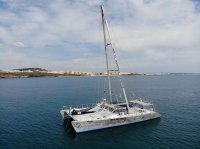
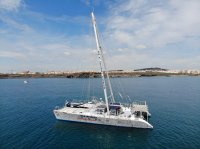
The following catamaran is used as a floating school, education tool about the marine environment.
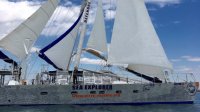
Sea Explorer plays a fundamental role in the Association Terre Marine Ecole de la Mer, which Franck and Bourguignon set up in 2014 to contribute to sustainability in the Mediterranean. They aim to engage the public toward greater understanding and enthusiasm for marine life and more responsible behaviour. In winter, the yacht is used for scientific research and educational film projects; in summer, it welcomes the public.
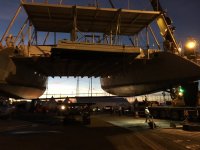
Michel Frank conceived this design with naval architect Nicolas Fauroux and structural designer Rivoyre Ingénierie. Micheal had the cat shell built by professionals in France in the Lerin Islands and then he and volunteers put in 38,000 hours to complete the cat from as many second hand and or recycled items that he could find. Many companies donated previous model equipment and left over building materials to help the build be completed. The cat was completed in 2017.
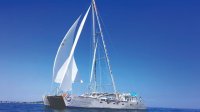
The cat is 79 x 37 foot with a “displacement” of 60,500 lbs. The 90 foot A frame aluminum masts carry up to 5 genoa’s of an unknow sail area. Michel has vast sailing experience and wanted an A Frame mast so that the mast connected directly to the crucial strong points of the boat, the hulls. This would allow the boat to remain light and strong. It also allowed a proper ladder and crows nest lookout points for spotting dolphins and whales.
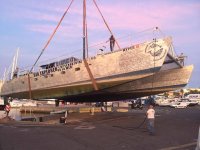
The draft is 4.3 foot over the hull rudder and propellers. The hulls have a flat bottom for beaching and have no keels or boards for lateral resistance. The hulls were designed to be long and thin to provide the “lateral resistance’ like a Hobie 14/16. The engine power has 2 John Deere PowerTech™ 4045TFM85 engines with direct drives for port maneuvering and emergencies. For additional motoring the cat carries lithium batteries (54 kWh used EV car battery), battery management systems, 4 x 10kW electric motors and solar charge controllers with 25kW of solar panels. The intention is to power the cat by wind and solar with minimal fossil fuels.
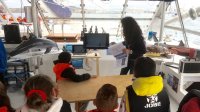
The accommodation is vast but the main cabin is used for education and a “lecture” hall. The catamaran is equipped with microscopes, underwater camera and aquariums covering 250 square meters (2700 square foot) spread over three decks. The hulls have the sleeping spaces, toilets and galley equipment.
The structure is basically aluminum. The multichine hull has a flat bottom and is a simple shape to build. The remaining wing deck and cabin structure is flat panels so its basically cut and weld. Simple fast shape. BUT like all big boats addition things like engines, winches, deck gear, plumbing, electrical lines etc take the same amount of time as any 79 foot cat. The reason the cat took 38,000 hours (18 years of 40 hour weeks) to build this cat. Also the comment about the A Frame mast reducing the loads and weight of the cat is only partial valid. At this size of cat to add some additional weight to strengthen the main mast carrying for a single mast is a minor addition.
The performance of the cat is moderate for 2 reasons. The owners have no reason to push the cat as it is an education tool and why sail hard with children on board who may get scared or seasick. Result the statement “typical sailing speeds of 5-7 knots”.
An interesting total concept and catamaran. The jpegs give the idea.
Attached Files:


 - Piic 1 - Piic 2 - Piic 3 - Piic 4 - Piic 5 - Piic 6 - Piic 7

 , the other option is of course to ask forum member