Hogfish Maximus - 44ish sailing sharpie?

Chris,

What is the maximum displacement and lightship displacement of Hogfish Maximus?

How do you expect HFM to behave in a knockdown or a capsize? What is its Angle of Vanishing Stability?

Do I understand correctly that the daggerboard will pop up if it strikes anything? How is the hold-down mechanism constructed?

In one of your blogs you wrote:
When the tide goes out from under your boat you want a nice soft spot for your boat to sit on for the next 10 hours or so. Sand is great, mud is nice but muddy. Round rocks ok , but move the conchs out of the way if you can. Not for the boat but for them as 16 tons is a lot to bear for the duration of the tide…
How is the plywood bottom of HFM built such that it can safely rest on round rocks? I'd prefer not to rest a steel-hulled boat on rocks, to say nothing of a plywood hull!

You also wrote:
When the tide goes out we would be on the bottom. No big deal if the wind stays this way. If not when the water comes back we would have about a half an hour of bumping before lift off. This we have done with both Hogfishes at least a thousand times. These boats were designed and built for this.
How does your bottom paint survive thousands of groundings? Even on sand it seems that if your boat bumps for 1/2 hour that could be pretty abrasive to paint, and even to epoxy/fiberglass.
 
Hogfish stability

Imaginary number,
The HFM as loaded with water, fuel,food staples for 6-8 months,all my tools , books , clothes , large dinghy,and on and on of what we want to have to be sailing off the grid and be mostly self sufficient is about 32,000 lbs. I have been carrying around for years 2,000 extra lbs of lead pigs that I have salvaged from a wreck that I plan on selling.
When we built our house here in the Bahamas we carried over from the states a distance of 395 miles on average 3-4 more tons of supplies on board.
The HFM carries about 2,000 lbs per inch of submersion. We loaded her down the last trip over 8" above her waterline.
In this mode she still sails along great reaching speeds of 7 knots + on the trip over. Once you get the mass moving it just moves along. This we did without an inboard diesel.
When building the original Hogfish my friend Wyatt Huggins that worked For Tom Fexas yacht designs as Chief engineer for 30 years traded my rebuilding a skiff of his for a complete set of stability calculations . This includes weighing each piece of timber in the design, all mast calculations and done with the water tanks empty, full, and the centerboard up. 42 pages of numbers. This was done in1988.
As stated before I have sailed lots of ocean sea miles in my two boats. Never have I ever felt compromised by their hull shapes.
I believe the only way to roll one over is by a sea action and that would have to be from a mistake of the skipper. Having sailed in many gales down wind in up to 18' seas I find them to be excellent sea boats. I like not having a keel down at times. And when I feel I need it I just pull it down.
I was run over in the Hogfish while single handing to the Virgins by a US. Warship ruining without lights in 35 knots of wind with just my staysail up. I could not see him in the dark. My bow sprite hit his side and I ran down the length of the ship with the wake nocking me on my beam ends with the mast in the water. This broke the bow sprite off at the stem. The Hogfish just popped right back up and continued on sailing with the Hasler vane not missing a beat.
The only damage was the bow spite and my nerves.
In my designs the boats will float on their sides with no water coming in.
I belive they will roll right around because of the bouancy of the extra sheer .
I have tried when launching them on sea trials to sail into huge squalls under full sail to try and nock them on their sides. They just go over till the wind spills out of the sails but still somewhat under control.never have I had the sheers in the water for a second except for that fN ship.
I live in a remote island with only this iPad to use. I will photograph and post all this data on my facebook site as it seems to transfer there the clearest. I am computer eliterate .
The bottom of the Hogfish designs are made from 3 layers of marine grade plywood glued with 2 part epoxy. Then glassed over with 4 layers of 1 1/2 oz. Matt with a 10 oz. cloth to finish. I use polyester resin. On HFM I used vynelester as that's what I was building my flats boats with.
This is an extremely strong skin.
The problem with Jim's Alert was the hull was strip planked cedar and had only a supper thin skin of Dynel covering it so you could poke a hole through the skin with a small conch. I have settled down on my 66 lb Bruce many times and just flatten it into the sand.
Round rocks on an even bottom are nothing.
Now I use an ablative paint and if you are sitting in one spot for a month or so and you have not anchored yourself well enough to not be moving back and forth when the tide changes then you will polish off the paint on the curve of the bottom. It takes about 15 minutes for the tide to float the boat so not much bouncing but if a sea is coming in then you run out a kedge and all it takes is a few little bumps and the seas will lift you off to get back in deeper water which will mean about 5 " more depth.
Have never worn any glass off the bottom with my design method. But it's extra work in the building stage.
From my observations most aluminum boat people and steel ones try to be very carefull when grounding out as they have to deal with corrosion when the paint wears off. Not so with a thick glass skin.
The daggerboard floats and I have to crank it down with a line to a winch. I have a crash box system that I adapted from a Gold Coast Catamaran design from when I worked there years ago. The board will stop the boat like a keel but as I wrote you just release the down line and up pops your keel so problem over.
Hope this helps.
 
Here is a nice big sharpie, I think it may be a Colvin design, about 80'​
- - - -
- - - click pics to enlarge

Thanks Frank,

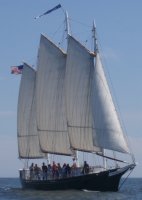
I've looked her up: Schooner SoundWaters
94302d1410444558-hogfish-maximus-44ish-sailing-sharpie-_80_steel_sharpie_schooner_soundwaters_.jpg

. . . A representation of a 19th century sharpie schooner . . . 80’ . . . steel-hulled . . . 32-ton . . .
She sure looks like Colvin style and fits his sharpie design range:
The steel sharpies are from 32’ to 78’ on deck.
Also interesting at Colvin's site: Shoal Draft, Centerboard Freight Schooners
Shoal draft, centerboard freight schooners:
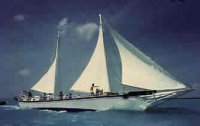
94301d1410444421-hogfish-maximus-44ish-sailing-sharpie-_colvin_57_aluminum_centerboard_ketch_lucaya_.jpg
57' aluminum centerboard ketch, LUCAYA, used as a cargo vessel. She is a fine seagoing vessel and extremely fast.

The smallest of this family is 50’ and the largest is 77’. At 60’, with the centerboard up, in light conditions, these vessels draw 3’3” of water. They are narrow, being around 13’ 6” of beam. Some are three-masted, but most are two-masted. These are very, very swift sailers and excellent sea boats. They are used mostly for package freight; however, one was designed for lumber carrying as the owner had a portable bandsaw mill aboard that he could set up on shore. In the 60’ and above size, headroom is easily obtained. With this shoal draft, they do inherit a very large centerboard, always made of wood, which dictates the interior arrangements that can be possible. These vessels are usually built of steel construction; however, the one shown in the photo (LUCAYA) is aluminum. The 58' and 60' designs are stock plans.
-- thumbnails as posted full in above quotes --
 

Attachments

  • _Colvin_57'_aluminum_centerboard_ketch_LUCAYA_.jpg
    _Colvin_57'_aluminum_centerboard_ketch_LUCAYA_.jpg
    4.4 KB · Views: 3,021
  • _80'_Steel_Sharpie_Schooner_SoundWaters_.jpg
    _80'_Steel_Sharpie_Schooner_SoundWaters_.jpg
    128.9 KB · Views: 2,609
Colvin boats

Nice pictures.
The green sharpie looks to be a good day charter vessel.
The aluminum Colvin ketch was built in a small boatyard in Key Largo . It was commissioned by an old friend David Cosby to haul freight but never did under his ownership. He once got as far as the Virgin Islands when I was there on the Hogfish. These boats were originally used in bays and short offshore jumps.
They have huge rudders which make them a challenge to steer even with a wrack and pinion system. Most owners revert to hydrolic steering.
The last boat Sara was built by another old friend Newell that took years to complete. Newell had tons of offshore experience. Once launched he used this boat for years doing Boy Scout trips in the Abacos. He sold the boat last year and then tragically died a few months later in a car crash on ice. Will miss him.
He over came the steering problem by putting a trim tab on the trailing edge of his rudder and used an auto pilot to steer the boat most times through this trim tab. Going up the masts on these boats are a ***** because of the rake. You cannot hang onto the spar. To much rake. They did that to make it easier to stay.
In today's world you could still have the old looks but go to a modern kick up rudder and put the masts more vertical. Aluminum spars will not need much to hold them in place.
These are great big boats that are suited to the waters they were designed for.
But you could sure take one anywhere you wanted if Handled properly.
 
Chris, thanks for your informative comments! I was surprised that you used polyester and vinylester over plywood. But I guess that worked well for you. Did you construct the hull upside-down, or right-side up?

I'm sure you're right that HFM can't be knocked over just by wind, by probably most boats can be capsized by a combination of strong wind and high, breaking waves. So I was curious if they would recover from a full capsize.

I've looked on your blog and Facebook site for the data you mentioned, but have not seen it. Am I not looking in the right place?

Again, thanks for your interesting description.
 
I'm sure you're right that HFM can't be knocked over just by wind, by probably most boats can be capsized by a combination of strong wind and high, breaking waves. So I was curious if they would recover from a full capsize.

.

I would also be interested. But considering that the boat is fairly narrow, with a lot of free board, and a 30%, or so ballast ratio. I think that it would recover in condition that would cause it to capsize in the first place.

The best boat to have in a hurricane, is a submarine.
 
Romp in St.Augustine Fla

I was just in St. Augustine to ready a boat for delivery to the Caribbean last week.
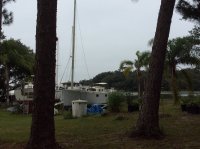
Here Romp sits for the past 20 years. Lots of no Trespassing signs and nobody in sight so this is as close as I got this time. I talked to the owner 3 years ago and went aboard . He wants $15,000.00 for her. The mizzen was up last time . She has some rot in the deck and a very basic Bolger interior. The hull is cored with Airex and glassed very well.

I hope the photo posts here if not it will be on my blog with more.
 

Attachments

  • image.jpg
    image.jpg
    356.9 KB · Views: 1,017
Chris,
How do you block up HFM when you haul her to apply anti-fouling paint? How high off the the ground? Must be a real challenge prepping and coating such a large surface while working on your back.

Did you build the lower portion of the hull right-side-up, or up-side-down?
 
Haul outs with Hogfish and flat bottom boats

Imaginary Number,
I have been very busy getting things together for our upcoming sail south. I will post the Hogfish stability numbers soon on my face book site under ISO pictures
About 30 pages so easier there than here for me.
On my blog I have pictures of Hogfish hauled out a couple of months ago.
I put two wood block stands under the aft main bulkhead and the forward bulkhead. I then put jack stands around the sides like you can see in the photos on my blog. It is very easy to paint then taking me 3 hours at most to put on a coat of paint. I lay on a piece of card board or whatever is about. It takes five gallons to put on two coats onHFM.
I have built all my one off boats with the hull being upside down. I install most of the interior when the boat is upside down as all the dust just falls down on the floor. I even put in as many deck beams as I can. This includes strip plank Catamarans up to 44'.
Building the hulls of both Hogfishes have taken 3 months from start to rolling over. It then took 3 months to finish the deck and interior. 1 month to paint .and a couple more months to fit the rig , electrics and hardware.
I keep a daily log of all my time for future bidding reference.
I will post a series of building these hulls on my blog soon. Nothing new really as it's just boatbuilding and is explained in many fine books.
I will be off sailing next month for the next several years so will be otta touch for long periods as internet and my time, interest will be in another world.
 
I have posted many photos of Bolgers Alert, Matt laydens Paradox, Hogfish , HFM sailing, sitting on the bottom and being built. I will be off cruising soon so I just wanted to say thanks for including my boats in your discussions on shoal draft boats.
You can find all this on my blog . I will be posting our travels on this blog with lots more sailing pictures . Hope to see you out there,
 
48770-where-ok.gif
I have posted many photos of Bolgers Alert, Matt laydens Paradox, Hogfish , HFM sailing, sitting on the bottom and being built. I will be off cruising soon so I just wanted to say thanks for including my boats in your discussions on shoal draft boats.
You can find all this on my blog . I will be posting our travels on this blog with lots more sailing pictures . Hope to see you out there,
:) Thanks Chris, for all the info posted on your blog and here
icon14.gif
 
Thanks for sharing.

If you sail close to the edge let us know what it is like. :)

7b3917a504bb60003bc4173c90bdf9b9.gif
 
Forum posts represent the experience, opinion, and view of individual users. Boat Design Net does not necessarily endorse nor share the view of each individual post.
When making any potentially dangerous or financial decision, always employ and consult appropriate professionals. Your circumstances or experience may be different.

  • Back
    Top