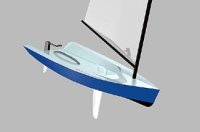
But if we say "a skiff is just a boat" then we lose a term that has, for decades, denoted a particular type of boat IN THE CONTEXT OF A FAST CENTREBOADER.
Surely the use of the term "skiff" in this context isn't trying to give it the pizzaz of the older boats or powerboats in the pics posted; surely it's trying to give a boat the connotation of being a baby along the lines of a 49er, 29er, I-14 or 18.
If Chris just wanted people to think "Cabrillo Skiff, wow that must be a powerboat or something like a Cotuit Skiff or a Westray Skiff, or a rowboat" then I was out of order and I apologise.
If, on the other hand, he wanted people to think "Cabrillo Skiff, hmm that sounds like one of those cool fast sailing boats that are called skiffs", then it's different.
The term "skiff" was not used (outside of 4 specific classes), as far as I found in hundreds of hours searching through most copies of Yachting, One Design and Offshore Yachtsman/SW, Sail, Sailing, Yachts and Yachting, YM, YW, etc from about 1950 to 1995, as a label for a high-performance sailboat.
I've spoken to most of the world's top dinghy and skiff designers, read enough original source material to know how the world's first international class was partly inspired by a blow-up raincoat; how the Moth's beam related to an Austin A40 sedan; how the term "skiff" for their boats turned some of the 1930s 18 Footer racers of Sydney apoplectic with indignation. I've corresponded with those studying dinghy history in Scandanavia, France, the USA, NZ, the UK; with professional historians and professional marketers.
Frankly, along with a couple of Kiwis I'm damn sure we've done a shitload more research on this sort of stuff than anyone.
There is no high-performance sailboat class called "skiff" in any of the many class and handicap listings I have found from the '40s to the '90s (apart from 4 specific classes). The evidence is strong that no one (apart from 4 specific classes) used the term for high performance centreboarders for decades until it became cool about '95.
Even boats with a very similar design heritage to those 4 specific classes (Ie Bermuda Dinghies) did not use the term. Sure, there were Westray Skiffs (1 club in the world), a few Cotuit Skiffs, before WW1 there was the Canadian Skiff Association (which seems to have dropped the Skiff term by 1918) and there was a pre-ww1 "Malta skiff club". There were St Lawrence Skiffs, but are you really claiming the O'pen has a link to this big canoe that died long ago?
There were four high-performance Aus classes where the term was adopted as part of the class name. It had a convoluted history even there.
You can plot the primary characteristics of these boats easily. These boats have higher righting moment for length than any dinghy of their era; they have higher SA for their length than any dinghy of their era. They are utterly unique, utterly characteristic.
Despite the Skiff-fanatics' BS (which I post against as vehemently as I am now) Skiffs were NOT always the fastest boats (far from it), they did NOT have the mosst open rules (far from it), they were NOT the most progressive. But they did have specific design characteristics that no other class had, and that can be shown on a diagram of ratios.
When these characteristics were then adopted by UK builders in de-tuned ODs that boasted of their skiff heritage, the "skiff" label, almost never used in performance dinghy sailing, became popular. Now 14 sailors call their boats "Skiffs" a lot of the time - in contrast, until recently the official 14 history (and apparently 14 sailors) referred to the 14 foot Aussie class as "Skiffs" and I-14s as dinghies.
If you are right, and the term "skiff" as used in modern performance centreboarders did not come from the Aussie classes, then please provide a few examples of the term in use in such context before 1995.
I'm not a Skiffy, and I fight against their idea that "skiff" is an utterly fixed term. But why destroy a term that has a specific meaning in this context by applying it to almost anything that floats? Why turn English into a mess of marketing BS?
And why downgrade sailing racing dinghies, a proud line of craft that has often created faster boats than the Skiffs, by applying the "skiff" label as an adjective?
If you want to label all new and exciting boats skiffs, people may start thinking dinghies are old and cruddy, and that will really hurt the sport.