FarmerColin
Junior Member
- Joined
- Feb 2, 2008
- Posts
- 16
- Reaction score
- 0
- Location
- England
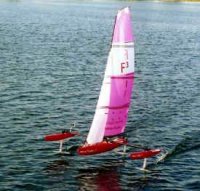
The Rave multifoiler uses a wand whose pivot is near the back end of the main foils and close to midship. I've had a few hours experience on that boat in varied conditions and some friends have had hundreds of hours sailing the boat.I've got several hundred hours of testing rc models utilizing midship Bradfield wands with not one crash/pitchpole in widely varying conditions. An interesting thing is that the most experienced Rave guys have told me that the boat almost never pitchpoles or flies out of a wave.
On the other hand Moths with bow wands seem to have trouble with certain specific conditions in waves.
If you draw a moth flying level in waves in a crest to crest half length equal to the distance between the bow and the daggerboard and compare a midship(board mounted) wand with a bow mounted wand it appears that for(at least) that specific condition the main foil on the boat with the bow mounted wand will enter the wave with the flap calling for maximum lift where the mainfoil on the boat with the midship wand will enter the wave with the wand calling for minimum lift. Thus the boat with the midship wand would be far less likely to burst thru the wave and wind up crashing.
Considering an upwind speed of 13 knots( 21.9 ft.per sec./6.68m/sec.) and a downwind speed of
22 knots( 37 ft.sec./ 11.3 m/sec) it seems to me with "normal" wand response that the boat with the bow wand would be far more likely to come out of the wave into air on the other side than would the boat with the midship wand.
Any comments?
Have any of the Mothies that have designed their own boats experimented with a midship wand?
Doug I'm not convinced that the midship wand is less prone to the problem you mention. One can draw similar diagrams - say with the wave crest at the midships point causing the foil to command maximum lift with the wave trough at the bow where the midship wand is being fooled into making what appears to be the wrong decision. However, one thing that can be said for the fore/aft location if the wand(s) is the effect this has on the sensitivity of the wand to the attitude of the boat. If the wands were located so far aft that they were alongside the rear foil then the wands would be sensitive to height but substantially insensitive to the attitude of the boat. Conversely were the wand to be cantilevered a long way ahead of the bow (practically difficult I'll admit!) it would become extremely sensitive to the attitude. So moving the wand further forward will contribute to pitch damping. Of course the foils have an inherent pitch damping as a rising foil is at a lower effective angle of attack (at 7 m/s boat speed a 0.5m/s rate of rise will reduce the angle of attack by about 4 degrees). Perhaps the ideal fore/aft location needs to be calculated taking account of the moment of inertia in pitch, area and aspect ratio of the foils, fore/aft separation of main and rear foils etc. However, I suspect the optimum would only be right for one speed as the 'loop gain' of the system would increase as the square of the boat speed.
One advantage of having the wands almost co-located with the foils is that the wand will unload the foil as a wave trough passes by.
I guess in an ideal world one would scan the surface ahead of the craft and analyse this to minimise the chances of a foil hitting the surface or the hull kissing the surface but I think the required sensors etc are rather out of place in anything but the most exotic machine.
Last edited: