DogCavalry
Senior Member
- Joined
- Sep 22, 2019
- Posts
- 3,697
- Reaction score
- 1,854
- Location
- Vancouver bc
Prandtl said nothing of the sort.
Oh, @jehardiman got there fustest with the mostest, as a great general once said.
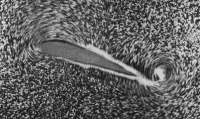
Ok, from a different direction, as Wagner demonstrated in his work with Indicial response at T=0 following a perturbation, lift is already equal to 50% of what it will be when circulation is fully established, when there is no circulation whatsoever. Lift asymptomatically approaches it's full value over distance traveled, as circulation is induced by the forces acting on the free stream fluid by that lift. It was empirically demonstrated that Cl is close to it's full value after 7-8 chords travel.
Since a SPP travels about 1⅓ chord after the trailing edge enters the water, before the leading edge exits, there simply isn't the time for circulation to develop.
And what about the other examples I provided? The bottom of a planing hull can hardly be considered to have generated circulation, yet a good hull under good conditions can have an excellent lift to drag ratio. To say nothing of any body travelling faster than the speed of sound in it's medium. The wing of an aircraft above mach 1 also generates all the lift one could possibly want, with circulation no where in sight.

 randtl wrote out the entire theory after Lanchester had stated the ideas 10 yrs. earlier. The work is precise, there is nothing heuristic about it. There is no reason to ponder Lerbs or anything in sname. Just a bunch of detailed repetitions with change in the basic idea: circulation causes lift.