Check out the thumbnail in post#26cmaas,
Great build!
Would a winged prop cowling be worth a try?
Circular cowling with half a foil on each side.
Like an airplane fuselage and wings.

The Boat Design & Boatbuilding Site
Install the app
How to install the app on iOS
To install this app on your iPhone:
- Tap the Share button at the bottom of Safari.
Tap ... if Share is not visible, then Share - Tap Add to Home Screen
Tap View More and scroll down if needed to see Add to Home Screen, then Add to Home Screen. - Tap Add on the top right to confirm.
Note: This feature may not be available in some browsers.
You are using an out of date browser. It may not display this or other websites correctly.
You should upgrade or use an alternative browser.
You should upgrade or use an alternative browser.
Electric hydrofoil prop
- Thread starter cmaas
- Start date

Mr Efficiency
Senior Member
- Joined
- Oct 17, 2010
- Posts
- 10,374
- Reaction score
- 1,051
- Location
- Australia
This is what happens when I cut the power to the prop. This is what makes me believe that most, if not all, of the stern lift is coming from the prop. The boat should glide somewhat.
I notice when you cut power, the outboard kicks up noticeably, giving your leg mounted foil a distinct negative angle of attack, which of course will drag the stern down. You need to stop it kicking up when the thrust is cut.

Will Gilmore
Senior Member
- Joined
- Aug 29, 2017
- Posts
- 1,119
- Reaction score
- 539
- Location
- Littleton, nh
This is just a guess, I have little experience with the engineering physics of foil lift, but...
The way you have the rear foils, just ahead of the prop, means the prop is pulling a lot of water very fast across the lift surface. You may be experiencing much more lift from the rear foils than the vessel speed through the water would suggest. Water speed across the rear foils is probably something like 5 times the vessel speed through the water.
Perhaps that is where all your extra lift is coming from.
-Will (Dragonfly)
Mr Efficiency
Senior Member
- Joined
- Oct 17, 2010
- Posts
- 10,374
- Reaction score
- 1,051
- Location
- Australia
Where are you getting this "5 times" figure from, Will ? I think the leg kicking up ( lots of drag from the extension) certainly explains the stern being pulled down.
Will Gilmore
Senior Member
- Joined
- Aug 29, 2017
- Posts
- 1,119
- Reaction score
- 539
- Location
- Littleton, nh
What do you think the water flow rate would be just ahead of an outboard motor prop? I was, I think, being conservative. But, admittedly, I don't know what prop output flow rates are, much less the input flow.Where are you getting this "5 times" figure from, Will ?
Just trying to illustrate a thought.This is just a guess,
-Will (Dragonfly)
Mr Efficiency
Senior Member
- Joined
- Oct 17, 2010
- Posts
- 10,374
- Reaction score
- 1,051
- Location
- Australia
I would say the difference between the outflow speed and the inflow, in this situation, would be less than 50% greater. He may need an occy strap across the leg to stop it kicking up when the power comes off. Some manual tilt outboards may be lockable when in forward gear, not sure about that.
Will Gilmore
Senior Member
- Joined
- Aug 29, 2017
- Posts
- 1,119
- Reaction score
- 539
- Location
- Littleton, nh
Rewatching the video, I see what you are talking about. Once the power is cut, the foil and propeller become drag and the motor tilts out as the boat moves ahead.
-Will (Dragonfly)
-Will (Dragonfly)
I'm no prop expert either but I don't think that's how it works. If the prop slip is say 10% how could the prop "pull" even that much water up to itself? I'm pretty sure the prop has no effect on the water that it hasn't yet gotten to. I could be wrong though. It has happened before.This is just a guess, I have little experience with the engineering physics of foil lift, but...
The way you have the rear foils, just ahead of the prop, means the prop is pulling a lot of water very fast across the lift surface. You may be experiencing much more lift from the rear foils than the vessel speed through the water would suggest. Water speed across the rear foils is probably something like 5 times the vessel speed through the water.
Perhaps that is where all your extra lift is coming from.
-Will (Dragonfly)
Wow, good eye. I'm fairly certain I have inadvertently given you a red herring though. I'm going out tomorrow and will have my crack camera crew concentrate some video time on the deceleration. I think I didn't have the bracket pivot secured in that video. I'll also put some clearly visible marks on the outboard leg to try to get a better idea of prop depth.I notice when you cut power, the outboard kicks up noticeably, giving your leg mounted foil a distinct negative angle of attack, which of course will drag the stern down. You need to stop it kicking up when the thrust is cut.
Mr Efficiency
Senior Member
- Joined
- Oct 17, 2010
- Posts
- 10,374
- Reaction score
- 1,051
- Location
- Australia
You can lock it down in forward gear ?
What do you think the water flow rate would be just ahead of an outboard motor prop? I was, I think, being conservative. But, admittedly, I don't know what prop output flow rates are, much less the input flow.
Naah Will, your guessing is not even close. If we take typical values for a ten-to-fifteen hp outboard, the propeller would be ~9" diameter, rotate some 2400 rpms, produce ~1100 N of thrust in free flow (less behind the ob leg) and consume 14 hp at 11 knots (=5,7 m/s). The fluid velocity through the propeller disc would then be ~7 m/s and the average outflow jet velocity just below 9 m/s. The inflow acceleration becomes noticeable at about one propeller diameter ahead of the disc.
Mr Efficiency
Senior Member
- Joined
- Oct 17, 2010
- Posts
- 10,374
- Reaction score
- 1,051
- Location
- Australia
None of the after-market "hydrofoils" attached to outboard motors, that I have seen, are attached forward of the gearcase, for various reasons I guess, but I guess it does add a little bit of extra work for the prop to do, working in "second-hand" water. But the outboard leg and gearcase already does that to the prop, so it might be "third hand" with the forward mounted hydrofoil employed.

Heimfried
Senior Member
- Joined
- Apr 22, 2015
- Posts
- 577
- Reaction score
- 153
- Location
- Berlin, Germany
Hi cmaas,[...] Building a composite prop is not out of my skill set but designing one certainly is.
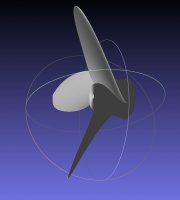
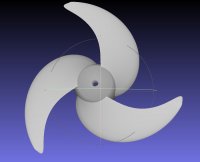
I'm (also) far from able to design a prop, but I wrote a software tool which can calculate a .STL file which is to my knowledge often used for 3D printing. The input is according to the definitions of the ITTC lexikon based on parameters including skew and rake, the profile of the blades ist starting at root with an airfoil profile and ending at the tips as ogival profile.
To get a good working prop in this way it would need test series with cheap and quick printed props. I don't know if you would consider this path a way to go for you. If so, I would provide the files for free.

Before considering new designs; what do you actually have, what rpms and what power at which speed. Then a check for available standard screws, after that: how far is it possible to modify an existing prop.
Forum posts represent the experience, opinion, and view of individual users. Boat Design Net does not necessarily endorse nor share the view of each individual post.
When making any potentially dangerous or financial decision, always employ and consult appropriate professionals. Your circumstances or experience may be different.
When making any potentially dangerous or financial decision, always employ and consult appropriate professionals. Your circumstances or experience may be different.
Advertisement:
Similar threads
- Replies
- 26
- Views
- 6,822


- Replies
- 5
- Views
- 5,043
