Converting a modern sloop to a lug rig

Thanks Igor, skaraborgcraft, Paul Scott for your replies.

Yes, I will keep an eye out for a used rig I could recycle, but I am also interested in coming up with an alternative that I could build more easily and handle more comfortably. If I were to build a Q17, I would keep the hull essentially unchanged, so I could see simplifying the standing rigging but not going unstayed or moving the mast, otherwise I may as well just choose a different boat.

So the upshot of all of this could be just a simpler and cheaper version of the Dobler rig as designed, a fractional sloop as his been suggested, or some sort of lug rig. A balanced lug with more of the sail ahead of the mast is an interesting possibility though I was originally thinking of a dipping or standing lug.

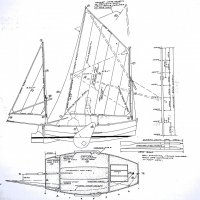
When I compare the mast position and centers of area of various lug-rigged boats to the Q17, then I find that the Q17 mast is too far aft to mount a sail comparable in area to what it carried as a masthead sloop. If anyone else wants to mess around to see what might work, the center of area is actually marked on the first Q17 side view I posted in this thread, but here is some additional info.

sailplan.gif

sails.gif
 
Satisfying sheet pressure? I can speak from experience taking a gaff rig downwind in strong conditions that sheet and tiller loads were excessive, as well as the occasional dipping of the boom. The same conditions under a lug where almost the divide was 45-55 either side of the mast was light sheet, light helm and reduced rolling. Gaff are pretty naff when reefed down too, as the area is too far aft, meaning more helm loads.

dipping or standing lug? Gaff rigs will take your head off.
 
If anyone else wants to mess around to see what might work, the center of area is actually marked on the first Q17 side view I posted in this thread,

I drew up a balanced 15m2 (161sq ft) rig for the Picara and it only required the mast tabernacle to be shifted to the other side of the bulkhead with and a backing block .
I will have a crack at it with the same mast placement, but not this evening.
 
Ok.... my printer did not scale out as planned, but its close enough for preliminary planning.
We will assume Dobler had his lead correct, so with the same centre of effort of sail plan and the same lead, we get this.

upload_2024-4-27_17-40-51.jpeg


This is a 176sq ft. The CoE is in the same spot as the existing sail plan. Now the fun part. The existing rig has an aft rake, but if we give it a slight forward rake, we get this.

upload_2024-4-27_17-42-50.jpeg


Which means the tabernacle support can also double up as sides to the keel box, its almost at the same angle. Before anyone thinks its daft, there is millenia of voyaging under sail with such rigs. It would certainly be a conversation starter.....
84c6b7c6236c8c5c47490084531e3c86.jpg


Anyhoo, its certainly possible to hang a lug rig on this boat, without disturbing the interior, if that is the goal.
 
Thanks very much for this, skaraborgcraft, but I am afraid this only confirms my own sketches and digital tracings that show that a balanced lug of those proportions is not the way to go without substantially redesigning the whole mast-step to case to keel structure to support an unstayed mast., which I really don't want to do. If I did eliminate the backstay then a lower aspect-ratio lugsail with a highly-peaked yard (to keep the forward end out of the forestay) might work. And while I admire the low-cost capability of a junk sail, the sheer number of strings and bits and bobs turns me off.
 
Which means the tabernacle support can also double up as sides to the keel box.....
That makes a lot of sense.
A balanced lug rig with lazy jacks is very practical and versatile on a small boat. The ability to fine tune the fore and aft CoE is a bonus.
 
Thanks very much for this, skaraborgcraft, but I am afraid this only confirms my own sketches and digital tracings that show that a balanced lug of those proportions is not the way to go without substantially redesigning the whole mast-step to case to keel structure to support an unstayed mast., which I really don't want to do.

Its not as much as you might think, you are basically running an 1 1/2 x 4in board from the sole, either side of the case and through the deck. If you have drawings for the case, i can detail exactly what i propose, unless you have completely changed tack. (pun intended)
 
If I did eliminate the backstay then a lower aspect-ratio lugsail with a highly-peaked yard (to keep the forward end out of the forestay) might work. And while I admire the low-cost capability of a junk sail, the sheer number of strings and bits and bobs turns me off.

A standing lug with jib is quite common and certainly workable with stays.

DSCN2216.JPG


Though this example not quite standing but with shrouds.

I posted the junk rig to demonstrate that perpendicular masts are not always needed. I agree there is a lot of string, but its only one sail to deal with, more of an issue on larger boats with heavy battens.
 
Its not as much as you might think, you are basically running an 1 1/2 x 4in board from the sole, either side of the case and through the deck. If you have drawings for the case, i can detail exactly what i propose, unless you have completely changed tack. (pun intended)

Yes, I am familiar with the SF Pelican but they just don't float my boat. (My turn with the puns.)

Yes, I have seen lugsails with jibs, but always with at least 3/4 of the mainsail area aft of the mast, which just doesn't seem like it would work in this case due to the location of the mast. A standing lug has even less area forward of the mast, though it would be less likely to foul the forestay and might be workable with a jib. Yes, I could go with all the sail area in balanced lug, but then that forestay becomes a problem. A dipping lug could certainly work but I just don't think that's practical in boat I want to be comfortable in sailing solo.

Thanks a lot for taking the time to explore this idea, I really do appreciate it, but I think I am going to put aside the lugsail conversion for now. In the case of the Dobler Q17, I think it makes more sense to stick with the rig more or less as designed. Dobler was an aeronautical engineer and designed quite a few boats, so I should probably build it as he intended or find a different design. This was never going to be my next project in any case, that's likely to be a much simpler and easier Bolger Storm Petrel. Baby steps.... ;-)
 
No worries. The mental work out harms no one.
I see you frequent that "other" forum. I would agree the Corsaire suggestion is a good one if you can find a sound one. If i ever move to Finistere, it will be my choice of trailer boat.
 
No worries. The mental work out harms no one.
I see you frequent that "other" forum. I would agree the Corsaire suggestion is a good one if you can find a sound one. If i ever move to Finistere, it will be my choice of trailer boat.

Yes, I do. I am have been working away from home for a few months, wrapping up in a few weeks, and I am looking forward to digging out all the plans I have already in order to come to a decision. In reality, some sort of a light beach boat probably makes more sense at this point than even Storm Petrel. I do have plans for Bolger's Japanese Beach Cruiser, which even my little car could tow. Decisions, decisions....

upload_2024-4-27_23-24-20.jpeg
 
I do have plans for Bolger's Japanese Beach Cruiser, which even my little car could tow. Decisions, decisions....

Yes, smaller can sometimes be better. Keeping to max of 500kg tow weight makes things very simple to avoid trailer registration and insurance. I have a braked 900kg trailer that can be pulled by a Yaris, but it will have to be "imported", tested, registered and insured. Seems far simpler to buy a French trailer in the end. Lots of interesting choices to get into that sub 500kg catagory. You must be aware of Jeromes work?

TT425_3D12.jpg


14ft and 375kg. Plans de voiliers, plans de deriveurs, plans de kayaks, plans de catamarans, plans de trimarans, plans de pocket cruiser pour construction amateur en contreplaque, Scow 420, Scow 450 et Naut 350, Naut 400, Naut 420, Naut 450, Yakyak 365 et Yakyak 425 (nautline.com)
 
Thanks, skaraborgcraft (what's your actual first name?), I had seen Jérôme Delaunay's designs at Duckworks and honestly had thought that they were too untraditional for my taste (and this from a guy who's first boat was a Bolger Brick). They also seemed oriented more toward cruising (big cabin, small cockpit for the size of boat) rather than day use with the occasional overnight or weekend adventure, which is more my scenario. I do see now that he as a few less extreme designs that could work for me. The Naut 350.2 is a cute little pocket cruiser though perhaps too small even for me and one of my sons (185-187 cm) and the Sharpie 470 is very much like the Bolger June Bug that I built years ago but developed into a day boat for 2-3 and overnight/weekend boat for 1-2. I'll have look for some Makerspaces or CNC cutting services near Lyon to see if I could have all the panels precut with interlocking finger joints.

N3502_3D9.jpg S4703D_17.jpg

Plans de voiliers, plans de deriveurs, plans de kayaks, plans de catamarans, plans de trimarans, plans de pocket cruiser pour construction amateur en contreplaque, Scow 420, Scow 450 et Naut 350, Naut 400, Naut 420, Naut 450, Yakyak 365 et Yakyak 425 https://nautline.com/plans_pocket_cruiser.php
 
Forum posts represent the experience, opinion, and view of individual users. Boat Design Net does not necessarily endorse nor share the view of each individual post.
When making any potentially dangerous or financial decision, always employ and consult appropriate professionals. Your circumstances or experience may be different.

  • Back
    Top