
Exciting New EPS Thruster (& Propulsion)

Didnt huisman build a big yacht a few years back with 2 rim drives for propulsion?
A few years of data there.
Edit - S/Y Ethereal
Perhaps we are talking about the same vessel that I mentioned back in posting number #51 on this subject thread.

Turns out I was incorrect suggesting that these were propulsion units. It appears as though they were just bow and stern 'thrusters'
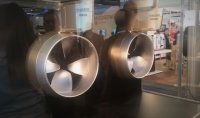
Initial orders have now been placed for another unconventional thruster, the EPS thruster from Van der Velden Marine Systems in Drachten in the Netherlands. Following the very first order for a super yacht being built in Taiwan, Royal Huisman Shipyard in the Netherlands, which is currently building a 58m ketch, Ethereal, designed by Pieter Beeldsnijder Design with naval architecture by Ron Holland Design, has ordered a pair of award-winning EPS Silent Thrusters for the vessel. Like the rim-driven thrusters developed by Rolls-Royce Marine and by Brunvoll and Norpropeller in Norway, the EPS thruster – versions of which are currently being offered for recreational craft and smaller types of commercial vessel and which was recently nominated for a Seatrade Award – does not have a conventional hub, and has no gap between the propeller blades and the tunnel, removing the main source of noise from the thruster. The EPS thruster does not have gears or a propeller shaft either, as highlighted in the November 2005 issue of Solutions.

Taking up just one-third of the space of a conventional thruster, it is also designed to be simple to install, with a flexible rubber mounting to further eliminate noise and vibration, and offers substantial savings in weight and offers equally powerful thrust to both port and starboard. Ethereal is due to be delivered in 2008 and will be equipped with two EPS 800 132kW retractable thruster units. The EPS bow and stern thrusters offer extremely low noise levels and an excellent power-performance ratio, and the retractable version of the EPS thruster is designed to suit the specific needs of yachts, where an uninterrupted hull shape helps keep drag to a minimum. Van de Velden Marine reports that measurements conducted on a prototype of the newly developed EPS silent thruster developed indicate that it is extremely quiet compared with some conventional thruster designs.
 
Hi Brian
Yes
On other media it did look like it had rim drive main propulsion?
I have since seen a little about local ferries in scandanavia with rim drives set up as azi main propulsion
 
I was very excited about the way things were moving along with new developments in those early days (~2008), but the world economy (and the mega yacht construction world simultaneously) appeared to really slowed down in those following years. The rim drive technology seems to have fallen off accordingly.
Now the interest seems to be getting back on track. Should be interesting.
 
Thanks for that reference publication. I had forgotten all about it.

I found this article on their pages:
http://www.mpropulsion.com/news/view,thruster-evolution-revolves-around-efficiency_39242.htm
Another recent arrival in the offshore sector is the Voith Linear Jet (VLJ) propulsion system. Successful tests on the VLJ were carried out off the Isle of Wight in the UK at the end of 2014. VLJs were selected as the main propulsion system on the 21m catamaran Trearddur Bay, which was designed for Holyhead Towing Company subsidiary Turbine Transfers by BMT Nigel Gee.

The VLJ is a new type of propulsor combining the best properties of conventional propellers with the best properties of conventional waterjets. At first sight, it looks to be a conventional propeller housed inside a nozzle, but it actually comprises a fully submerged custom-shaped deceleration/acceleration nozzle with a stator section aft of the rotor. The stator section cancels rotor-induced swirl and through that optimises the acceleration of the jet stream and the rudder inflow. The submerged position eliminates the requirement for a long inlet tunnel resulting in linear inflow and outflow and low marine growth sensitivity. The resulting benefits of this are increased efficiency and reduced noise and vibration levels.

The crew transfer vessel the system was tested on will take service technicians to offshore windfarms at sites all around Europe, initially at the Westernmost Rough site off the Humber for Dong Energy. The craft has achieved a trials speed of 30 knots – above expectations when compared to 26.5 knots for a near sister with jet propulsion. The efficiency of the VLJ would allow the craft to achieve the economical service speed of 25 knots required by Turbine Transfers even if the currently installed 10-cylinder 900kW engine was replaced with an 8-cylinder 720kW unit.

“The vessel is achieving more thrust at high speeds and when stopped in the water and pushing on a turbine than with conventional systems while achieving significantly lower noise and vibration levels,” said Alistair Knowles, a marine superintendent at Turbine Transfers. “It also adds to our green credentials through substantial fuel and emissions savings in our operations.”

VLJs are expected to be of interest in the workboat sector, the fast ferry and military and para-military markets. They are also expected to have potential applications on yachts and superyachts. In broad terms, the new propulsion system’s key benefits are lower fuel burn than vessels with waterjets or propellers. The high efficiency of the VLJ over a wide speed range means that, at 25 knots – where waterjets are not particularly efficient – the VLJ is significantly better. For vessels with fixed pitch propellers, power density becomes an issue above 30 knots, whereas the VLJ can be used for speeds of up to 40 knots without any such issues.

Other recent additions to the growing range and type of thrusters include the Verhaar Omega V-POD, an electric propulsion/manoeuvring system that can replace a conventional screw shaftline with rudder. The V-POD is a pod drive with electric motor in an underwater housing. It can be used in combination with a diesel-electric and LNG-electric generator set and is said to have a high level of propulsion efficiency. The company says it overcomes some of the disadvantages of existing pod drives, such as high costs and low efficiency. It is also designed to be easy to install and occupies a minimum of space. Depending on the application, it is available as a pushing or pulling design and can be supplied with or without a nozzle.

Wärtsilä recently passed the final step in securing type approval from Lloyd’s Register for its new WTT11 tunnel thruster. The WTT11 thrusters are electrically driven and can be delivered with a controllable pitch or fixed pitch propeller. Late last year, the company secured approval from classification society DNV GL for the design of its WST-14 thruster, which is part of the Wärtsilä steerable thruster (WST) compact series aimed primarily at tugs, anchor-handling vessels and coastal and inland waterway cargo vessels. The key benefits of the series include superior performance, easy installation, a high level of integration and ice class compatibility.

Article published in the Guide to OSV Propulsion, a supplement to Offshore Support Journal
 

Attachments

  • Yamaha harmo system.jpg
    Yamaha harmo system.jpg
    220.2 KB · Views: 1,384
Interesting thread - a little strange that the marine industry (including the leisure sector) are soooo slow to pick up on promising new technologies even when the advantages seem rather obvious! I am planning forward towards commissioning a 40 foot passage making trawler catamaran sometime in the next 5 years, and would love it to be powered largely (or even entirely) electrically. To this end there are obvious offers - such as the inboard and outboard motors currently available from Torqeedo, AquaWatt and OceanVolt (I am planning for approx. 2 x 55kW/80HP).

However there are now also options involving rim driven propulsion (RDP) units from 2 German manufacturers, Voith and Silentdynamics delivering similar thrust. Why not even combine RDP and outboards, or be ahead of the game entirely with contra rotating RDP units? These are genuinely exciting times, and a leisure craft of the type I have in mind could presumably even generate an income stream as a green technology demonstrator ...?
 
return to this subject,..
I had laid aside this subject/technology for a long time, then ran across this today,..
Striking hollow motor prompts new era of genre-warping vehicles https://newatlas.com/automotive/electric-donut-hub-motor/

It made me think back to this subject,...and wonder if Rim Driven Propellers/Propulsion/Propulsors were ever going to make it real time??
After all I was hoping to use this tech on my Dynarig catamaran, long ago,.... DynaRig MotorSailer https://www.runningtideyachts.com/dynarig/

Rim-Driven Propellers: Instead of propulsion blades being attached to a central hub and propeller shaft, they are rooted to the rotating inner rim of a circular nozzle type unit. The rim is electrically driven with a permanent magnet motor, where the motor windings are in the stator and where the rotor has a number of permanent magnets. The electric motor is an integral part of the 'propeller nozzle'. These units are cutting edge technology. First came the rim-driven thrusters, and very soon the rim-driven propulsers.

There are lots of pluses to recommend this new technology:


  • Smaller diameter than prop counterpart at equal power densities
  • Can be tucked close under the hull skin for less draft and more keel protection
  • No constraints as to location as with shafted props…can be located forward,…away from transom pitching
  • Rim-drive unit can be contained in its own 'waterbox', & accessible, & serviceable without hauling the vessel
  • Waterbox mounting would allow for partial retractability in shallow waters…full retraction under sail.
  • Less noisy
  • Less susceptible to fouling lines
  • Potentially safer for divers and marine life
  • No reduction and direction gearboxes required, instant fwd/reverse !!
  • Phenomenal maneuverability, joy-stick operable (gamefishing plus, plus)
 
Perhaps the limited ultimate power of these units has thwarted their development?

A review of progress and applications of ship shaft-less rim-driven thrusters - ScienceDirect https://www.sciencedirect.com/science/article/abs/pii/S0029801817305164
Future study
Although the shaft-less RDT propulsion device has seen a great deal of research in recent years and some of the products have already been applied on ships, but the output power of most products are below the megawatt (MW) level. Improving the output power of RDTs and applying them to larger ship propulsion systems are the most urgent issues facing researchers and developers at present, and integrated designs are also the focus of future development.
Conclusions
As a revolutionary innovation of ship propulsion device, the shaft-less RDT overcomes several disadvantages inherent to traditional propulsion systems such as difficult installation process, excessive size, and excess vibration noise, which gives it favorable potential for use in both military and civil fields. Dozens of companies have developed shaft-less RDT products, but few have disclosed the design and control of electric motor, bearings, and other key technical data due to commercial

...but this is an older article itself,...2017
 
Wonder what this company would have to contribute,.. Propulsors & Propulsion Systems https://www.kongsberg.com/maritime/products/propulsors-and-propulsion-systems/

We have the most comprehensive propulsion portfolio on the market, with everything from standalone solutions to fully integrated systems. Whether you want to maximise bollard pull, improve fuel efficiency, or reduce underwater noise, we have the optimum solution for you.

Our propellers, azimuth thrusters, and waterjets are continually improved and optimised in conjunction with our one-of-a-kind, in-house Hydrodynamic Research Centre. This guarantees exceptional performance and smooth operations for our customers.

Permanent magnet rim-driven thrusters https://www.kongsberg.com/kmagazine/2022/5/permanent-magnet-rim-driven-thrusters/
 
Yeah, Brian - thinking you would want to spend some more time researching rim drive propulsion.

In addition to low noise (especially underwater - preserving stress to wildlife), lower vibration, elimination of tip cavitation, and tangle-free operation; these drives in their latest electric incarnations, sport waterproof isolated components, water-based, bearingless lubrication, and power efficiencies beyond any other drive type. And as far as scaling, these propulsion units are really, really scalable - in either direction.
 
I took some time yesterday to look back thru some developments of this technology over the last few years. I still detect that most of the work on these rim-driven units has been aimed at the thruster market rather than the propulsion market.

I did find the high reliability and immediate reversing claims from this company very interesting,...
Subsea thrusters - Copenhagen Subsea https://copenhagensubsea.com/subsea-thrusters/
 
Forum posts represent the experience, opinion, and view of individual users. Boat Design Net does not necessarily endorse nor share the view of each individual post.
When making any potentially dangerous or financial decision, always employ and consult appropriate professionals. Your circumstances or experience may be different.

  • Back
    Top