You came up with a theory based on watching some videos. I've posted quite a bit of video evidence that contradicts your theory. You have no explanation for why your theory only works sporadically.
I have lots of actual sailing experience so I know what causes the classic Moth nose dive. So does anyone else who's sailed a Moth in chop and breeze.
Attached is a Bladerider main foil profile from AMAC, showing the flap should have a default ±9° of movement. The up movement can be increased to 11° by packing the cavity in the foil, but it also increases the AoA of the foil relative to the strut, so in reality this increases the maximum lift available while not really increasing the flap's ability to reduce it.
This modification was primarily to get the boat trimmed more level. If you look at early Bladeriders, they sailed a little bow up. Changing the angle between the foil and strut allows them to sail flat or a little bow down.
To get more flap up, the back of the strut is trimmed, but only a small amount as over stressing the Sika joint will cause it to fail.
Bruce's comment about if the flap comes up too far the foil will stall was only an extreme case, no one lets their flap do that, the strut stops it (and if it didn't, the system would be limited some other way). Did your +30° -20° cause your flap to stall?
You might also note that those comments are ancient history when people were messing with flexible wands, cable linkages, flaps on rudders and flapless articulated foils. Those days are long, long gone.
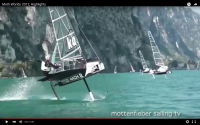
BTW, here's AMAC having a classic "ventilation drop" at Garda in 2012. You can see the boat doesn't start to crash until the mainfoil reaches the surface, the wand has been fully forward with max flap up for ages.
https://youtu.be/gK60RZDtnT8?t=5m19s