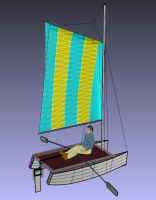
This last post pretty much nails it down. Novice designers often don't have the experience necessary, across a wide range of subjects. All too often we see lots of pretty pictures, with hours of computer modeling time invested, but to a seasoned and skilled eye, full of classic errors, misconceptions and impracticable elements and/or in engineering and hydrodynamics.
I'm at an age now where I mentor a few budding designers. I don't let them send me these elevated 3/4 color model images. The only thing these are good for, is a sales brochure presentation. These types of images, tell you very little about the hull, the appendages, the centers, the rig, etc. It's just a picture.
One fellow I work with, sent me a typical modern hull to have a look at. It was after I told him I would only look at technical drawings of the structure and the common elevation, plan and sectional, 3 view arrangement. My first question was why is max midship section was at 50% of the LWL and his reply was, the software he was working with defaulted to 50%, when he typed in the basic parameters for the hull form. He didn't know that though the midship section would normally be in the general vicinity of 50%, ideally, it wouldn't be dead bang at 50%, particularity if he wanted to optimize the water plane shapes, for the performance he was hoping for.
Simply put, he accepted what the software did, not understanding the realities of lines development, for the SOR he was working with. When questioned further, he didn't know if the displacement needed to be pushed forward or aft to optimize this area. He's now doing fairly well, though tends to change his mind too much. Before he started with me, he'd looked a some drawings, but had never really studied them. Why is the max midship section at 55% of the LWL, for example, instead of the default setting in the software. Why was a 19% lead employed in the rig, when the last set of drawings he was studying (also a sloop) used 15%. This guy is coming along fine and now has a data base of many dozens of designs, many of which he's taken apart, to see what choices where made and how they may have been optimized, for its particular set of design goals.
Yacht design is about study, with some solid engineering tossed in, so the end result doesn't fall apart on launch day. You have to literally eat dozens of designs, absorb and understand the choices made during their development, before you can also make these basic decisions for a new design. It also is tremendously helpful to have experience on the vessels with similar performance envelops. It's all but impossible to design a new full plane dinghy, without considerable seat of the paints time in one. Don't get me wrong, you could study and design, without even having been on the water, but you'll likely never develop anything of note, simply because you don't have the various experiences (hydro, engineering, seat of the paints time, etc.) necessary to permit you to push the envelop and develop something special, let alone capable of nailing down the SOR goals.
Metin, I don't know what your education or sailing experience might be, but there's no substitute for either. Study well known designs. Take them apart and find the centers, look at the way volume is distributed, the geometry, etc. and compare this with similar designs. Soon, you'll note some similarities keep cropping up, as well as some differences. Ask your self why these choices might have been made. Eventually, with a few dozen dissected designs under your belt, you will be able to do a similar design, incorporating what you've learned from the previous models, possibly making little tweaks, to improve it's abilities (this is what yacht design is really about). This coupled with actual butt in the boat time, will make you a yacht designer, possibly of some note. Anything less and you'll have lots of pretty pictures, but that's about it. This isn't meant as a series of insults to your abilities, but hopefully a guide for you to continue learning, both in front of the keyboard and with a sheet in your hand. I'm an old guy now, but I still manage to trim sheets a few times each week, often because I'm frustrated over something and need to calm down and think about something else for a while. I find a quick sail takes away most any of my major worries and I can get back to the project, whatever it might be, refreshed.